
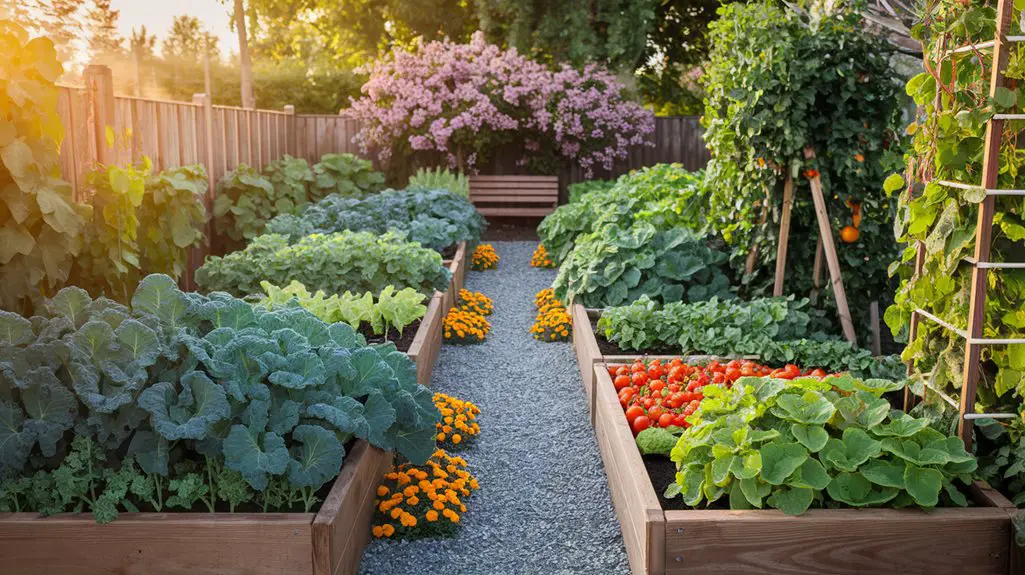
A 2014 National Gardening Association report found that about 35% of American households were growing some of their own food. You’ll find that a well-designed vegetable garden layout can raise your yield while cutting maintenance time.
Proper planning addresses critical factors like sunlight exposure, companion planting relationships, and efficient space utilization. The following tips will transform your backyard into a productive ecosystem that maximizes harvest potential throughout the growing season.
On this page
Assess Your Available Space and Sunlight Patterns
Before establishing a vegetable garden, how accurately have you evaluated your spatial parameters and solar exposure? Most vegetables require 6-8 hours of direct sunlight daily for ideal photosynthetic activity. Track sun patterns across your yard through different seasons using a sun calculator or manual hourly observations.
Measure your available square footage precisely, accounting for existing structures and setbacks. Document microclimates created by walls, fences, and mature trees that influence temperature gradients and airflow patterns.
Consider vertical dimensions for trellising and tiered systems to enhance growing volume. Create a scaled diagram indicating north-south orientation to improve row alignment.
Plot shadow trajectories during equinoxes and solstices to identify zones of varying light intensity. This quantitative assessment forms the empirical foundation for species selection and planting densities that will enhance yield potential. Additionally, incorporating raised garden beds can optimize drainage and soil quality, further improving plant health and productivity.
Choose a Garden Design That Maximizes Productivity
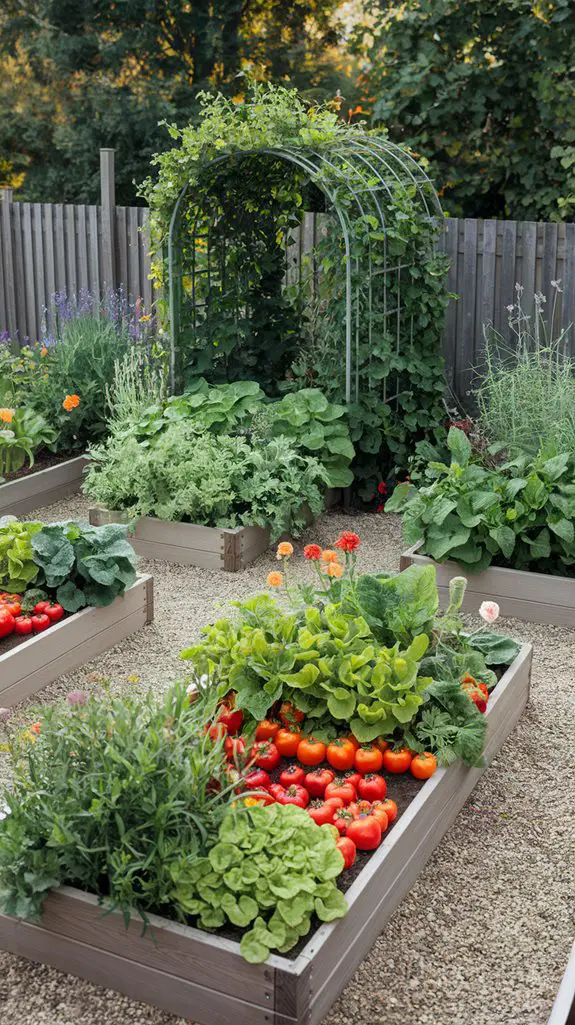
After completing your spatial analysis, selecting a superior garden design becomes your primary consideration for maximizing yield per square foot.
Consider raised beds (6-12″ deep) which offer enhanced soil control, improved drainage, and reduced compaction. Space beds 24-36″ apart to guarantee maintenance access while minimizing unutilized ground.
Implement succession planting techniques by interplanting quick-maturing crops (radishes, lettuce) between slower-growing vegetables (tomatoes, peppers).
Vertical growing structures optimize spatial efficiency; trellises for cucumbers and pole beans can triple production in the same footprint.
The keyhole garden design—circular with a central access point—minimizes pathways while maximizing growing area.
Square-foot gardening divides space into precise 1’×1′ sections, allowing for calculated spacing of different crop varieties according to mature size requirements. Additionally, utilizing container vegetable gardening can enhance your ability to grow a variety of crops in limited space.
Implement Companion Planting Strategies
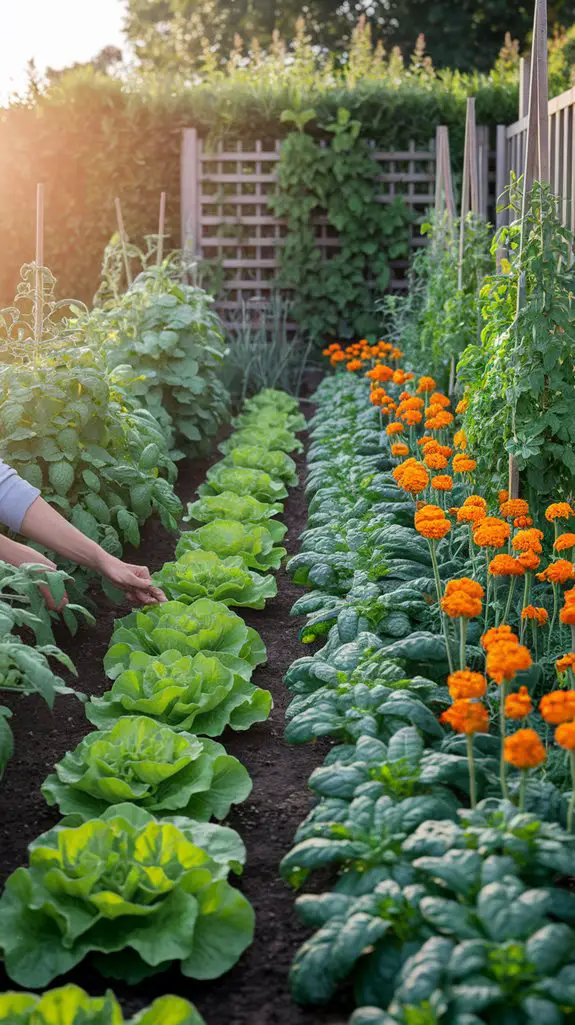
Companion planting strategies greatly enhance garden productivity while reducing pest pressure through strategic plant relationships.
By incorporating compatible plants together, you’ll create synergistic growing environments that maximize space utilization and nutrient cycling in your backyard layout.
- Cultivate aromatic herbs (basil, cilantro) alongside nightshades to repel aphids and attract beneficial pollinators.
- Intersperse nitrogen-fixing legumes (beans, peas) between heavy-feeding brassicas to improve soil fertility.
- Position tall trellised plants (corn, sunflowers) on northern borders to provide afternoon shade for heat-sensitive crops.
- Integrate alliums (onions, garlic) throughout beds to disrupt pest insect navigation and fungal pathogen transmission.
When designing your layout, consider both above-ground spatial relationships and below-ground root zone interactions for ideal companion planting implementation. Additionally, understanding plant compatibility can further optimize your planting choices to ensure a flourishing garden.
Create Efficient Pathways Between Planting Areas
Properly designed pathways between planting areas serve as the circulatory system of your vegetable garden, facilitating essential maintenance tasks while preventing soil compaction in growing zones.
Design primary paths at 36-48 inches wide to accommodate wheelbarrows and carts, while secondary paths can measure 18-24 inches for efficient movement between beds.
Incorporate permeable materials such as wood chips, gravel, or stepping stones that allow water infiltration and minimize runoff.
Position paths to optimize sun exposure and airflow throughout your garden while establishing a logical workflow pattern.
Consider installing irrigation lines beneath main pathways to simplify watering systems.
For sloped terrain, construct level pathways with slight cross-slopes (1-2%) to direct water away from beds.
This prevents erosion and waterlogging while maintaining accessibility during all gardening conditions. Additionally, a well-planned pathway design can enhance both the aesthetic appeal and functionality of your garden space.
Add Vertical Growing Structures for Space Optimization
Vertical growing structures maximize your garden’s productive capacity by utilizing the often overlooked third dimension of growing space. By incorporating trellises, cages, arbors, and wall-mounted systems, you’ll increase yield while maintaining accessibility.
Select structures based on crop requirements and spatial constraints, ensuring adequate sun exposure and structural integrity.
- Install A-frame trellises for cucumbers and beans, positioning north-to-south to minimize shadow casting.
- Mount modular wall systems for herbs and leafy greens, incorporating irrigation channels at 15cm intervals.
- Deploy tomato cages (minimum 152cm height) with 10cm grid spacing for ideal support.
- Implement cattle panel arches (213cm height) across pathways for squash varieties, creating functional tunnels.
For best results, secure all vertical elements at 45cm soil depth, and incorporate cross-bracing for structures exceeding 180cm height. Additionally, consider integrating space-saving vertical garden solutions to enhance your garden’s efficiency and aesthetic appeal.
Design Water-Efficient Irrigation Systems
Efficient water distribution forms the foundation of a sustainable backyard vegetable garden, particularly when precipitation patterns become unreliable.
Implement drip irrigation systems positioned at plant bases to minimize evaporation and use less water than overhead sprinklers.
Install a timer-controlled system with soil moisture sensors to deliver precise water quantities only when necessary. Group plants with similar hydration requirements in designated irrigation zones, allowing for customized watering schedules.
Consider installing rainwater harvesting equipment—a 55-gallon barrel can collect 0.6 gallons per square foot of roof area during rainfall. Utilizing rainwater harvesting not only conserves water but also provides plants with nutrient-rich water.
For container gardens, incorporate self-watering reservoirs with capillary action wicking systems.
Apply 2-3 inches of organic mulch around plants to retain soil moisture and suppress water-competing weeds.
Incorporate Season-Extending Features
Extending your growing season beyond conventional climate limitations requires strategic implementation of protective structures and environmental modification techniques. Deploy these systems to manipulate microclimate conditions, allowing earlier spring planting and extended fall harvests while protecting crops from frost, excessive heat, or precipitation.
- Cold frames with solar-activated automatic vents provide temperature regulation for seedlings with minimal intervention.
- Row covers (0.6-1.5 oz floating fabric) increase ambient temperature by 2-8°F while simultaneously acting as insect barriers.
- High tunnels with strategic ventilation systems enhance photosynthetically active radiation while moderating temperature extremes.
- Thermal mass installations (water-filled containers, stone pathways) absorb diurnal heat for nocturnal radiation, stabilizing root-zone temperatures.
Integrate these features into your garden layout during initial design phases to guarantee ideal placement relative to solar exposure and prevailing wind patterns.
Plan Crop Rotation for Soil Health
Implementing a systematic crop rotation strategy serves as the cornerstone of sustainable soil management within vegetable garden ecosystems.
You’ll need to classify your vegetables into botanical families—Solanaceae, Brassicaceae, Fabaceae, and Amaranthaceae—then rotate these groups across your plots annually.
This practice disrupts pest lifecycles, prevents pathogen accumulation, and optimizes nutrient utilization. Legumes fix nitrogen, while brassicas extract deep nutrients with their extensive root systems.
Follow heavy feeders (tomatoes) with nitrogen-fixers (beans), then light feeders (root crops).
Document your rotation schedule in a garden journal using a quadrant system: divide your garden into four sections, advancing each plant family one section forward annually.
This four-year cycle guarantees no family returns to the same soil until pathogens specific to that group have diminished below threshold levels. Additionally, using raised beds can enhance drainage and soil quality, further supporting the benefits of your crop rotation strategy.
Establish Dedicated Zones for Different Plant Families
When organizing your vegetable garden, designating specific zones for plant families creates a systematic framework that enhances garden management efficiency.
Group botanically related plants together based on taxonomic classification to optimize growing conditions and simplify pest management protocols.
- Solanaceae (nightshades) – tomatoes, peppers, eggplants, and potatoes require similar soil pH (6.0-6.8) and benefit from calcium amendments
- Brassicaceae (crucifers) – broccoli, cabbage, and kale prefer cooler temperatures and benefit from sulfur-rich soil
- Amaranthaceae – beets, spinach, and chard share nutritional requirements and susceptibility to leaf miners
- Fabaceae (legumes) – peas and beans fix nitrogen through symbiotic bacteria, improving soil for subsequent plantings
This zonation approach facilitates targeted soil amendments, streamlines irrigation scheduling, and enables precise implementation of integrated pest management strategies tailored to each plant family’s vulnerabilities. Additionally, understanding plant family interactions can further enhance biodiversity and resilience within your garden ecosystem.
Include Attractive Edging and Borders for Visual Appeal
Borders and edging materials serve both functional and aesthetic purposes within vegetable garden layouts, creating visual definition while establishing clear boundaries between cultivation zones.
Select materials compatible with your garden’s microclimate and design aesthetic—consider brick, stone, untreated wood, recycled plastic, or metal options. Each material exhibits distinct durability characteristics and environmental impacts.
Install edging to a minimum depth of 4-6 inches to effectively prevent rhizomatous weed encroachment and contain aggressive spreading plants. Curved borders can soften rectangular garden configurations, while straight-lined edging reinforces formal geometric designs.
You’ll find that strategically placed borders create effective microclimates by moderating soil temperature fluctuations and reducing moisture evaporation. For maximum visual impact, choose edging that complements existing hardscape elements while providing sufficient contrast against foliage colors. Additionally, consider using sustainable materials to enhance the eco-friendliness of your garden path.
Conclusion
Your garden’s layout transcends mere rows and beds; it’s a living laboratory of symbiotic relationships and microclimates. As you’ve implemented these design principles, you’ve created a biological mosaic where each plant contributes to the ecosystem’s resilience. The pathways, vertical elements, and companion groupings aren’t just practical features—they’re the circulatory system of your garden, efficiently distributing resources and maximizing photosynthetic potential within your defined parameters.
