
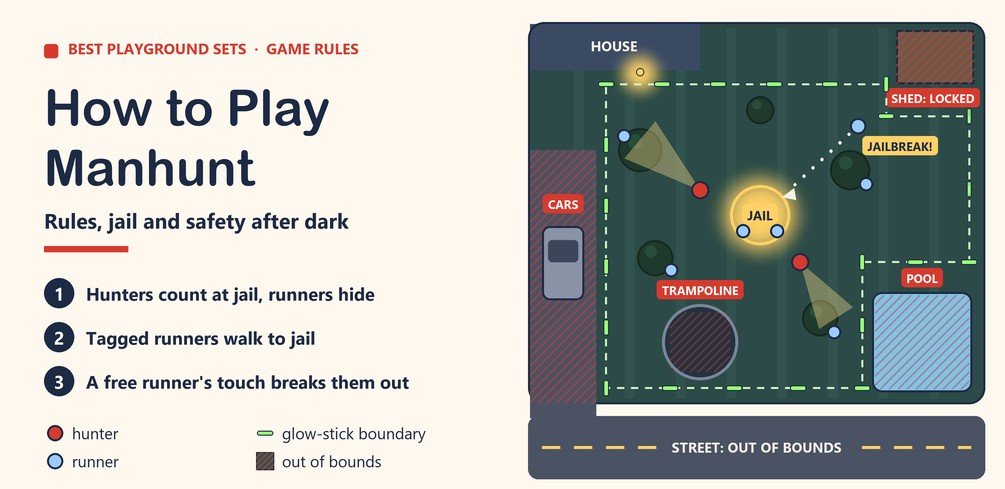
Manhunt is hide-and-seek mixed with tag, usually played at dusk or after dark. A few hunters count at jail while everyone else hides. Hunters tag runners and send them to jail, and any free runner who sneaks in and touches a prisoner breaks everyone out. The hunters win if every runner is in jail at once, and the runners win if anyone is still free when time runs out.
There’s no official rulebook, so these are the common house rules. You need about six or more players, a yard or two with clear edges, one lit spot for jail and a flashlight for every player. After dark, I’d keep it to kids about 8 and up, with an adult outside.
On this page
Manhunt Rules at a Glance
| Rule | Common setup |
|---|---|
| Hunters | About a quarter of the group (3 of 10 players) |
| Head start | Hunters count to 100 at jail |
| Round | 15 to 30 minutes |
| Tag | A light two-finger touch on the shoulder or back |
| Jail | One lit spot near the middle |
| Jailbreak | A free runner touches a prisoner’s hand |
| Hunters win | Every runner is in jail at the same time |
| Runners win | Anyone is still free when time’s up |
How to Set Up a Game
- Walk the yard in daylight. Agree on the boundaries and mark the corners with glow sticks, as in the diagram at the top. Look for the hazards the Consumer Product Safety Commission (CPSC) lists around a play area: low branches, tree stumps, roots, large rocks and bricks.
- Name what’s out of bounds. The street and driveway, parked cars, the shed and garage, the pool, the trampoline and the playset. The safety section below explains each one.
- Pick jail. One landmark near the middle of the field, like a tree or a lawn chair, lit by a lantern or the porch light.
- Split the teams. About a quarter of the group hunts. With kids of different ages, I’d pair each younger runner with an older one.
- Agree on three calls. “Jailbreak!” for a break-out, an all-in call to end the round (“olly olly oxen free” is the classic) and a stop word anyone can shout to freeze the game.
Start the first round while there’s still some light. On October 23, the sun sets at 6:04 p.m. in New York and 5:57 p.m. in Chicago, and civil twilight, the last of the usable daylight, ends about 28 minutes later, according to the US Naval Observatory.
How to Play Manhunt
- The hunters close their eyes at jail and count out loud to 100 while the runners scatter and hide.
- The hunters search. Runners can stay put or move, but staying in one spot too long makes you easy to find.
- A hunter catches a runner with a light two-finger touch on the shoulder or back. No tackling, grabbing, tripping or pulling clothes.
- Caught runners walk to jail and stand with one hand stretched out.
- A free runner who touches a prisoner’s hand without being tagged shouts “Jailbreak!”, and everyone in jail goes free. Some groups give freed runners a 20-second head start.
- A hunter can guard jail, but only standing in the open with a light on, so runners can plan a break.
- A runner who leaves the boundary is caught.
- The round ends when every runner is in jail at once or the timer runs out. Call everyone in, count heads and pick new hunters.
The Flashlight Rule
Decide before the first count what a flashlight can do. In the basic game, hunters use lights to search, and a runner is only caught by a touch.
In flashlight manhunt, a hunter’s beam counts as a tag, the way it does in flashlight tag. I’d start with touch tags, and for beam tags I’d make the hunter call the runner’s name, so there’s no arguing about who got lit up.
Either way, runners carry a light too, switched off while hiding and on when walking to jail or if something goes wrong. Keep beams on bodies, not faces.
4 Manhunt Variations
1. Jailbreak (Cops and Robbers)
The team version, which also goes by jail tag and sometimes manhunt itself: cops tag robbers and put them in jail, and robbers break them out by tagging a prisoner. In one version the robbers get five minutes to hide, and each robber is allowed only one jailbreak, which helps a game actually end.
2. Home Base Manhunt
One hunter, no jail. Runners hide, and any runner who races back and touches home base is safe.
The round ends when every runner who isn’t safe has been tagged. It’s the version I’d pick for four or five kids, when a jail would sit empty.
3. Infection Manhunt
Every runner who gets tagged joins the hunters, so the hunting team grows until nobody is left. The last runner caught wins. There’s no jail to guard, so there’s less standing around.
4. Ghost in the Graveyard
The gentler dusk game for younger kids. One player, the ghost, hides while everyone else counts at base from “one o’clock” up to “midnight.”
Then they search, and whoever spots the ghost shouts “Ghost in the graveyard!” Everyone races back to base while the ghost tags as many as it can, and tagged players hide with the ghost next round.
Close cousins: kick the can, where a free player empties the jail by kicking a can, and ringolevio, the old New York street game where each team has its own jail. If your group would rather chase than hide, freeze tag, blob tag and flashlight tag need no hiding at all.
Manhunt Safety After Dark
- Keep roads and water out of bounds. CPSC advises putting a home play area away from roads and driveways. The pool or hot tub is out too: the CPSC’s Pool Safely campaign says never to leave a child unattended in or near water, and during a game in the dark, nobody is watching it.
- No hiding in cars, sheds or appliances. Safe Kids Worldwide says to lock car doors and trunks, keep keys and fobs out of reach, and teach kids that trunks aren’t places to play or hide. CPSC has reports of children suffocating in freezers, clothes dryers, picnic coolers and old latch-style refrigerators, often during hide-and-seek, and most were 4 to 7. Lock the shed and garage too.
- Stay off the playset and the trampoline. CPSC says about 80% of home playground injuries happen in falls from equipment. We have a trampoline in our backyard, and it’s the first thing I’d rope off: the Pure Fun trampoline manual, for one, says kids shouldn’t walk or crawl underneath even when nobody’s jumping. My swing set clearance guide shows how much room around a playset to rope off.
- Hide on the ground. No roofs, and no climbing higher than your own head.
- An adult outside. Safe Kids tells parents to go along with kids under 12 on Halloween night. I’d use the same line here: if anyone under 12 is playing, an adult is outside, not watching from a window.
- Count heads at every all-in call. If anyone is missing, stop the game and look. Pool Safely says to check the pool first.
- Lights for the walk home. Runners will want dark clothes, which is fine inside the yard. Anyone walking home along a street should carry a flashlight or glow stick and have reflective tape on, as Safe Kids and the American Academy of Pediatrics advise for Halloween.
- Tick check afterward. The CDC says ticks live in grassy, brushy and wooded areas, which is where the best hiding spots are. Check under the arms, around the ears, behind the knees, in the hair and around the waist.
Frequently Asked Questions
What’s the difference between manhunt and hide-and-seek?
In hide-and-seek, the seeker only has to find you, and the first player found is usually it next time. In manhunt, a hunter has to tag you, caught runners go to jail, and free runners can break them out, so runners keep moving.
What age is manhunt for?
After dark, I’d say about 8 and up, with an adult outside for anyone under 12. Younger kids can play ghost in the graveyard at dusk, or manhunt in daylight inside one yard with an adult as the hunter.
How long does a game of manhunt last?
Plan on 15 to 30 minutes a round after the head start. Set a timer, because a round with a good hider can otherwise go on until someone gets called in for bed.
Final Thoughts
Set the boundaries in daylight, light the jail and count heads every round. After that, manhunt mostly runs itself.
Next, read my capture the flag variations, including a night version played with flashlights.
Please be careful and use at your own risk
None of the authors, contributors, administrators, or anyone else connected with BestPlaygroundSets, in any way whatsoever, can be responsible for your use of the information contained in or linked from these web pages.
