
Our picks at a glance
- #1
- #2
Yohood Kids Basketball Hoop Outdoor Height Adjustable 3-7 FT (details below)
- #3
Portable Basketball Hoop 4.1–8.5FT Adjustable (details below)
- #4
- #5
Kids Basketball Hoop Adjustable 5 to 7 FT Portable Basketball Hoop for Kids… (details below)
- #6
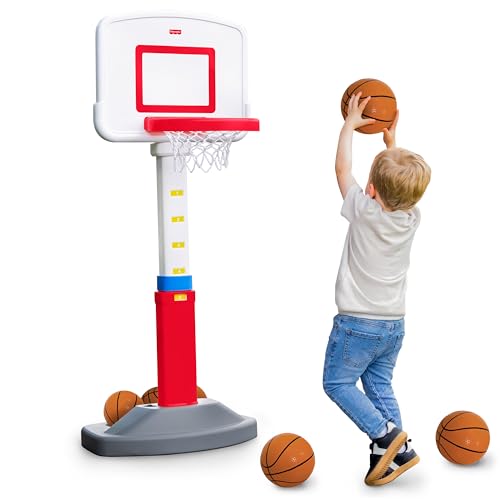
Fisher-Price™ Grow-to-Pro Basketball Hoop for Toddlers & Kids (details below)


For most families, the IGL Portable Basketball Hoop is the one to get, because it adjusts from 3 to 10 ft and can take a child from first shots to regulation height. If your kids won’t need a tall rim for years, the Yohood adjusts from 3 to 7 ft. For toddlers, the Fisher-Price Grow-to-Pro starts at 28 inches and comes with three small balls.
My dad built me a backyard basketball court when I was a kid, so I’m partial to a hoop as a gift. Every spec below comes from the maker’s Amazon listing, and where a listing doesn’t say, I’ve written “Not listed”.
In a hurry?
Here’s how the picks compare. The details for each are below.
| Pick | Rim height | Backboard | Base | Suits |
|---|---|---|---|---|
| IGL Portable HoopCheck at Amazon: IGL Portable Hoop | 3 to 10 ft | 40 x 24 in acrylic | Fillable, plus anchor base | Preschool to teens |
| Yohood Kids HoopCheck at Amazon: Yohood Kids Hoop | 3 to 7 ft | Size not listed | Fillable, wheels | Preschool and early grades |
| Mayfire Portable HoopCheck at Amazon: Mayfire Portable Hoop | 4.1 to 8.5 ft | 32 in polycarbonate | Fillable, plus weight bag | Grade-schoolers |
| Play22 Kids HoopCheck at Amazon: Play22 Kids Hoop | 5 to 7 ft | Size not listed | Fillable, wheels | Early grades |
| Hurtle Kids HoopCheck at Amazon: Hurtle Kids Hoop | 5.2 to 7 ft | Size not listed | Fillable, wheels | Small spaces |
| Fisher-Price Grow-to-ProCheck at Amazon: Fisher-Price Grow-to-Pro | 28 to 48 in | Size not listed | Water-fillable | 18 months to 5 years |
Planning more than a hoop? Here’s how to plan a backyard basketball court.
On this page
How to Choose a Basketball Hoop for Kids
Rim height and your child’s age
The youth guidelines from USA Basketball and the NBA call for an 8 ft rim at ages 7 and 8, a 9 ft rim at ages 9 to 11, and the full 10 ft from age 12. They give no rim height for kids younger than 7.
For those younger kids, I’d set the rim low enough that they can reach it with a normal shot instead of a heave. That’s why a 3 to 7 ft or 5 to 7 ft hoop works well for preschool and the early grades.
Think about how long you want the hoop to last. Under those guidelines, a 7 ft hoop is already low for a 7 year old, while an 8.5 ft or 10 ft hoop keeps going.
Backboard size and material
A bigger backboard is a bigger target, and it gives bank shots somewhere to land. The IGL lists a 40 x 24 inch acrylic backboard and the Mayfire a 32 inch polycarbonate one.
The other four listings don’t give a backboard size. If backboard size matters to you, check the dimensions in the listing’s photos before you order.
The base: sand or water
All six hoops stand on a fillable base, and the fill is what keeps the hoop upright. Water is easy to add and drain, while sand is heavier: the IGL’s main base holds 77 lb of water or 100 lb of sand.
Water expands when it freezes, and that can crack a plastic base. In a cold-winter climate, I’d fill with sand, or drain the base and store the hoop until spring, and I’d check the manual first.
Tip-over safety
A portable hoop is top-heavy by design. Fill the base all the way, the way the manual says, before anyone takes a shot.
Set it on flat, level ground, and don’t let kids hang on the rim or climb the pole. If strong wind is on the way, I’d lower the hoop to its shortest setting or lay it down.
Where it will sit
A driveway or patio is the natural home, because a ball needs a hard surface to bounce. Point the hoop so missed shots roll toward the house or the garage, not the street.
On a lawn, a ball won’t bounce and the base can settle unevenly. If grass is all you have, read our guide to basketball court tiles over grass first.
Four of these listings mention indoor play. Measure your ceiling before you plan on that, because the top of the backboard sits well above the rim height.
Giving one for Christmas
Order early and check the delivery date on Amazon before you count on it for Christmas. None of these listings gives a box size, so I can’t tell you whether it will fit under the tree.
Every hoop here needs assembly. IGL says most families finish within 45 minutes, and the others say only that instructions and tools are included.
Have the fill ready too. A couple of bags of play sand in the garage means the hoop can go up on Christmas morning even if the hose is put away for winter.
The 6 Best Basketball Hoops for Kids
1. IGL Portable Basketball Hoop
This is the hoop I’d buy for a family with kids of different ages, because no other pick covers as much height. It sets to 3 to 5 ft with two poles, 5.5 to 7.5 ft with three, and 8 to 10 ft with four.
That range matches the youth guidelines from preschool play all the way to the 10 ft rim. The 40 x 24 inch acrylic backboard is the largest here, and IGL calls it shatterproof.
The base is the most detailed of the six. The main base holds 77 lb of water or 100 lb of sand, and a separate anchor base adds 30 lb of water or 40 lb of sand.
Built-in wheels let one person tilt and roll it to the garage. The pole and rim are steel, and IGL says the labeled hardware is included and most families finish assembly within 45 minutes.
Before you buy, plan where a 10 ft hoop will live. At full height it’s a real driveway hoop, not something to tuck in a corner of the playroom.
Best for families who want one hoop from preschool to the teen years.
Pros
- Adjusts from 3 to 10 ft in three pole setups.
- 40 x 24 inch acrylic backboard, the largest here.
- Two fillable bases, with the weights listed.
Cons
- Changing height range means adding or removing a pole section.
- Too tall at its upper settings for most indoor rooms.
- Up to 140 lb of sand to buy and pour if you fill both bases.
2. Yohood Kids Basketball Hoop
The Yohood is the pick for younger kids who need a low rim now. It adjusts from 3 to 7 ft, so a preschooler can start at the bottom and a second-grader can still use it at the top.
What sets it apart is the frame. Yohood puts a triangular support between the base and the pole, which it says cuts down on shaking and tipping during play.
The frame is steel, the net is all-weather polypropylene, and the base is fillable. Two front wheels let you roll it between the driveway, the backyard and indoors.
Assembly is described as minimal, with labeled parts, instructions and the tools in the box. The listing doesn’t give a backboard size or how much the base holds, so check the listing’s photos before you order.
Under the youth guidelines, a 7 ft top setting is outgrown at around age 7. I’d choose this for a 3 to 6 year old and plan on a taller hoop later.
Best for preschoolers and early grade-schoolers who need a rim that starts at 3 ft.
Pros
- Starts at 3 ft, lower than most youth hoops.
- Triangular support between base and pole.
- Tools and labeled parts included.
Cons
- Tops out at 7 ft.
- Backboard size not listed.
- Base capacity not listed.
3. Mayfire Portable Basketball Hoop
The Mayfire sits between the kid hoops and the full-size one. Its 4.1 to 8.5 ft range covers the 8 ft rim the youth guidelines give for ages 7 and 8, which the 7 ft hoops can’t reach.
The backboard is 32 inches wide and made of polycarbonate, and the rim is described as shock-absorbing. That’s a step up in size from the small youth boards, though still well short of the IGL’s 40 inches.
For stability, Mayfire pairs a fillable base with an included weight bag. The base has built-in wheels, and the listing calls it lightweight, so the fill and the weight bag are doing the work.
The package comes with a manual and the tools you need. Mayfire doesn’t list an assembly time or the weight the base holds.
I’d look at this one for a 6 to 10 year old who’s starting to play on a team. It won’t reach the 9 ft rim used from age 9, but 8.5 ft is close.
Best for grade-schoolers who have outgrown a 7 ft hoop but don’t need 10 ft yet.
Pros
- Reaches 8.5 ft, enough for the 8 ft youth rim.
- 32 inch polycarbonate backboard.
- Weight bag included with the fillable base.
Cons
- Lowest setting is 4.1 ft, high for a preschooler.
- Stops short of 9 and 10 ft.
- Base capacity and assembly time not listed.
4. Play22 Kids Basketball Hoop
The Play22 is a plain, simple youth hoop with a 5 to 7 ft range. It suits a kindergartner or first-grader who is past the toddler hoop and wants something that looks like the real thing.
The main pole is steel and the net is all-weather nylon. The listing says the rest is made from a weather-resistant PE plastic, and wheels let you move it around.
Like the others, it stands on a fillable base. Play22 lists it for indoor and outdoor play and includes an illustrated manual and tools.
The listing leaves out more than most. There’s no backboard size, no base capacity and no assembly time, so look closely at the photos.
With a 5 ft minimum, it’s too tall for most 3 and 4 year olds. With a 7 ft maximum, it has about the same useful life as the Yohood at the top end.
Best for kids of about 5 to 7 who want a simple driveway or playroom hoop.
Pros
- Steel main pole and all-weather nylon net.
- Wheels and a fillable base.
- Illustrated manual and tools included.
Cons
- Only a 2 ft height range.
- Backboard size and base capacity not listed.
- PE plastic parts apart from the steel pole.
5. Hurtle Kids Basketball Hoop
Hurtle aims this hoop at small spaces. The listing names bedrooms, playrooms, garages and apartments, along with driveways and backyards.
The height range is close to the Play22’s. The title says 5 to 7 ft and the bullet points say 5.2 to 7 ft, so treat 5.2 ft as the lowest setting.
It has a shatterproof backboard, a steel support structure, built-in wheels and a fillable base. Hurtle doesn’t list the backboard size or the base capacity.
If it’s going indoors, measure first. The rim alone is 7 ft up at the top setting, and the backboard rises above that, so a standard ceiling may limit you to the lower settings.
Indoors, I’d still fill the base, and sand is the cleaner choice on a floor. A light hoop with an empty base can tip when a ball hits the rim.
Best for a garage, playroom or small driveway where a full-size hoop won’t fit.
Pros
- Listed for compact rooms as well as outdoors.
- Shatterproof backboard and steel support.
- Wheels for moving it between rooms.
Cons
- Title and bullets disagree slightly on the lowest height.
- Tops out at 7 ft.
- Backboard size and base capacity not listed.
6. Fisher-Price Grow-to-Pro Basketball Hoop
This is the toddler pick, and it’s a different kind of product from the other five. Fisher-Price lists it for 18 months to 5 years, with five rim heights: 28, 33, 38, 43 and 48 inches.
The set includes three small, lightweight balls sized for little hands, plus the hoop with net, backboard, pole, stand and base. The pieces snap together, so assembly is quick.
The base fills with water, and the materials are described as weather-resistant for indoor or outdoor play. At these heights it fits in any room with space to toss a ball.
Even a toddler hoop should have its base filled before play. A small child will lean on it and pull on the rim.
By 5 or 6, most kids will want one of the taller hoops above. That makes this a good first hoop for a little sibling, not a long-term driveway hoop.
Best for toddlers and preschoolers from 18 months to 5 years.
Pros
- Five heights from 28 to 48 inches.
- Three small balls included.
- Snap-together assembly.
Cons
- Outgrown by about age 5.
- Uses small balls, not a real basketball.
- Backboard size not listed.
What Else Goes With a Hoop?
A ball that fits. The same youth guidelines call for a size 5 ball at ages 7 and 8 and a size 6 at ages 9 to 11, both smaller than the size 7 that men use.
If your kids split their time between sports, a small goal uses the same patch of driveway or lawn. See our picks for the best soccer goals for a backyard.
Frequently Asked Questions
How high should a basketball hoop be for a 7 year old?
Eight feet, according to the youth guidelines from USA Basketball and the NBA, which cover ages 7 and 8. Of the hoops here, the IGL and the Mayfire reach that height.
Should I fill the base with sand or water?
Either works if the manual allows it. Sand is heavier and won’t freeze, and water is easier to add and to drain when you want to move or store the hoop.
Can a portable hoop stay outside in winter?
The listings here describe weather-resistant parts, so the hoop itself can. The risk is a water-filled base freezing and cracking, so drain it or use sand, and check your manual.
Can you put a kids’ basketball hoop on grass?
You can stand one on level grass for shooting practice, but the ball won’t bounce. A driveway, patio or court tiles make a better surface for dribbling.
Final Thoughts
Get the IGL if you want one hoop for the long haul, the Yohood for a child under 7, the Mayfire for a grade-schooler and the Fisher-Price for a toddler. Whichever you choose, fill the base fully and keep kids off the rim.
Next, read how to plan a backyard basketball court.
Please be careful and use at your own risk
None of the authors, contributors, administrators, or anyone else connected with BestPlaygroundSets, in any way whatsoever, can be responsible for your use of the information contained in or linked from these web pages.
