
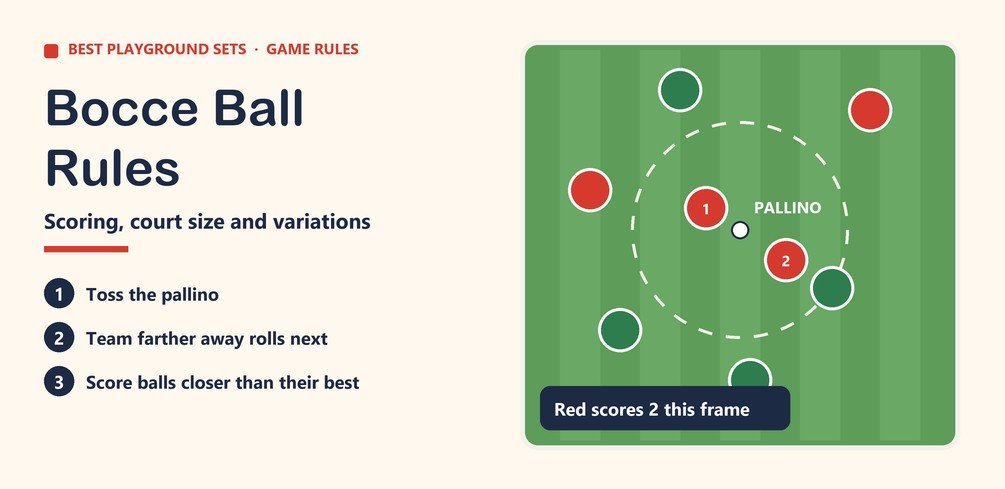
In bocce, one team tosses the small target ball (the pallino), then both teams roll their big balls to get as close to it as they can. When all eight balls are played, only the team with the closest ball scores: one point for every ball nearer the pallino than the other team’s best. Most games go to 12 points.
Bocce works for 2 to 8 players and is gentle enough for grandparents and older kids to play on the same team. You need a bocce set (8 balls and a pallino), a fairly flat stretch of lawn or gravel, and something to measure with.
The rules below follow the US Bocce Federation (USBF) open rules where official play has a rule, and say “house rules” where backyard games usually differ.
On this page
What You Need
- 8 bocce balls: 4 of one color and 4 of another. The USBF recommends 107 mm balls for tournaments; backyard sets are often a little smaller, which is fine.
- 1 pallino: the small target ball, also called the jack.
- A measuring tape or string: close calls are common, and eyeballing starts arguments.
- A court or open lawn: see the court sizes below.
How Big Is a Bocce Court?
The USBF’s official court is 86.92 ft long and 13.12 ft wide (26.5 x 4 m), with a flat surface and low walls around it. The same rules say unofficial courts can be smaller, and nearly every backyard court is.
| Court | Size | Notes |
|---|---|---|
| Official (USBF) | 86.92 x 13.12 ft | Tournament play |
| Backyard court | Whatever fits | Keep it long and narrow, and as level as you can |
| Open lawn | No lines | “Lawn bocce”: the pallino can go anywhere |
Grass slows the balls and adds bumps, which many families like because it evens out skill levels. If you want a permanent surface, here’s how to build a bocce court with artificial turf.
How to Play Bocce, Step by Step
1. Pick teams and split the balls
Bocce is played one against one, two against two or four against four. Each team takes four balls of one color: in singles each player rolls all four, in doubles two each, and with four a side one each.
2. Toss the pallino
Flip a coin. The winning team tosses the pallino from behind the foul line, and in official play it has to land past the court’s center line.
Under USBF-style rules, if a team misses a valid toss, the other team gets a try, and the teams alternate until one lands. In the backyard, just agree on a minimum distance before you start.
3. Roll the first ball
The team that tossed the pallino rolls the first bocce ball, trying to stop it as close to the pallino as possible. Underhand rolls and lobs are both allowed.
4. The team that’s “out” keeps rolling
This is the rule new players miss. After the first ball, the other team rolls, and it keeps rolling until one of its balls is closer than the leading ball or it runs out.
Whenever a team takes the lead, the other team rolls next. So turns don’t simply alternate: the team that’s farther away always throws.
5. Knock balls around if you want
Hitting the pallino or other balls is legal, and moving the pallino changes who’s closest. Once a team runs out of balls, the other team rolls its remaining balls to add to its score.
6. Score the frame and start the next one
When all eight balls are played, the frame is over and you score it (below). The team that scored tosses the pallino for the next frame, usually playing back toward the other end.
How Bocce Scoring Works
Only one team scores in a frame. Find the other team’s closest ball, then count how many of your balls are closer to the pallino than that one: each is a point.
So if your two best balls both beat their best, you score 2. If all four of yours beat their best, you score 4, the most possible in one frame.
Ties
If the two closest balls are from different teams and the same distance away, the team that rolled last rolls again until the tie breaks. If both teams are out of balls and it’s still tied, nobody scores that frame.
Points to win
Games are usually played to 12 points, and many leagues play matches as best two out of three games. You’ll also see 15 or 21. Some house rules require winning by 2; just settle it before the first frame.
Measure from the nearest edge of each ball to the nearest edge of the pallino. A string held at the pallino and pulled to each ball works fine.
Bocce Variations for the Backyard
1. Lawn Bocce (Open Play)
No court and no lines. The pallino thrower can send it anywhere in the yard, around trees and down slopes, which makes every frame different.
2. Roaming Bocce
Each frame starts where the last one ended. The scoring team stands at the pallino and throws it somewhere new, so the game wanders across the yard like a round of golf.
3. Short Game for Kids
Shorten the court, let younger kids throw from a step or two closer, and play to 7 instead of 12. A lighter kids’ or plastic set is easier for small hands.
4. Kisser Bonus
A common house rule: a ball touching the pallino at the end of the frame (a “kisser”) scores 2 points instead of 1. It rewards the soft, accurate roll.
5. Target Bocce
Chalk or rope a circle about 3 ft across around the pallino. Only balls inside the circle can score, which slows down big hitters.
6. One-Ball Rounds
For a big group, give each player one ball and play individual rounds; the closest player scores 1 and tosses the next pallino. It moves fast at a party.
Safety Tips
- Stay behind the thrower. The USBF says opposing players should be off the court or well behind the player in action. A bocce ball is heavy, and nobody should be standing near the pallino during a throw.
- Roll, don’t throw hard. Lobbing is legal, but fast overhand throws aren’t part of the game and are how people get hit.
- Watch toddlers. Small kids wander onto the court to chase the pallino. Pause play while they’re out there, and check your set’s age label.
- Mind the surface. Balls roll fast on hard or frozen ground and can reach a street or a window well, so set up away from both.
Frequently Asked Questions
Who throws first in bocce?
The team that wins the coin toss throws the pallino and then rolls the first bocce ball. After that, the team that’s farther from the pallino always rolls next.
How many points do you need to win bocce?
Usually 12. Some leagues and families play to 15 or 21, and some require winning by 2, so agree on the target first.
Can you hit the pallino in bocce?
Yes. Moving the pallino or knocking an opponent’s ball away is part of the strategy. The frame is scored wherever the pallino ends up.
Can you play bocce on grass?
Yes, and most backyard games are played on grass. Mow it short for a truer roll, or keep it longer for a slower, bumpier game.
Final Thoughts
Toss the pallino, let the team that’s farther away keep rolling, and score only the balls that beat the other team’s best. That’s all of bocce, and the rest is house rules.
For more games to set up next to it, see our yard games for family gatherings. Next, read how to play kubb (Viking chess).
Please be careful and use at your own risk
None of the authors, contributors, administrators, or anyone else connected with BestPlaygroundSets, in any way whatsoever, can be responsible for your use of the information contained in or linked from these web pages.
