
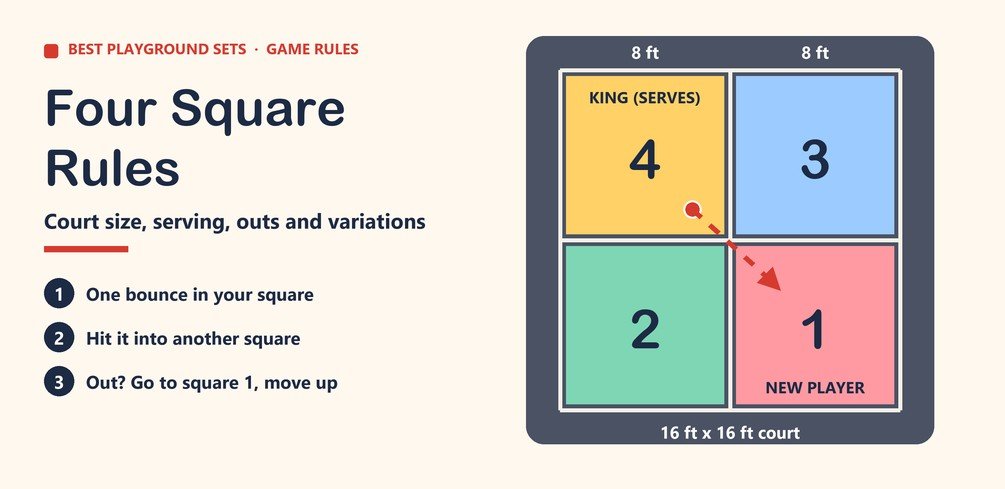
Four square is played on a square court split into four smaller squares, one player in each. The ball has to bounce once in your square before you hit it into someone else’s, and you’re out if it bounces twice, lands outside the court or you miss it. The player who’s out goes to the lowest square and everyone else moves up, with the goal of reaching the king square and staying there.
You need four players (more can wait in line), a flat paved spot, chalk or tape, and one playground ball. It works for kids from about 5 up, and the diagram at the top shows the court.
On this page
What You Need
A driveway, patio or playground blacktop, plus sidewalk chalk or painter’s tape for the lines. The ball is a rubber playground ball, and 8.5 inches is the usual size.

The Champion Sports Rhino is the kind of plain 8.5-inch ball most schools use, with a two-ply cover over a nylon-wound build. It ships flat, so have a ball pump ready.
How Big Is a Four Square Court?
There’s no single official size for backyard and school play. Square Four, the adult league that publishes formal rules, uses a court 16 feet on each side, split into four 8-foot squares.
Square Four itself says that size can be too big for young children. For kids under about 8, I’d draw a 10- to 12-foot court, with squares of 5 to 6 feet, so they can reach the ball.
| Who’s playing | Whole court | Each square |
|---|---|---|
| Kids about 5 to 7 | 10 to 12 ft | 5 to 6 ft |
| Kids 8 and up | 12 to 16 ft | 6 to 8 ft |
| Teens and adults (Square Four) | 16 ft (4.9 m) | 8 ft (2.4 m) |
Number the squares 1 to 4 so that 1 and 4 are diagonally opposite, as Square Four does. Some schools use names instead, with the top square called king or queen.
How to Play Four Square
1. The serve
The player in square 4, the king, serves. They drop the ball, let it bounce once in their own square, then hit it into another square.
Many schools say the serve has to go to square 1, diagonally across, and that it has to be underhand. Agree on that before you start.
2. One bounce, then hit
When the ball comes to you, let it bounce once in your square, then hit it with one or both hands into any other square. Play goes on until someone misses.
3. What gets you out
- The ball bounces twice in your square.
- You hit it and it lands outside the court, or doesn’t bounce in any square.
- You hit it before it bounces in your square.
- You catch or hold it, unless your house rules allow catching.
4. Line balls
A ball that lands on a line is where house rules differ most. Some groups call it out, some call it in, and many replay the point, so pick one rule before the first serve.
5. Moving up
The player who’s out goes to square 1, or to the back of the line if others are waiting. Everyone below the open square moves up one, and a new player steps into square 1.
There’s no score. You “win” by getting to square 4 and serving for as long as you can stay there.
Four Square Variations
The king often gets to call a rule for the round, and that’s where most variations come from. These are common ones, but house rules vary.
1. Catch and release
Newer players may catch the ball, then drop it and hit it. Playworks suggests this so younger kids can keep up.
2. Teams of two
Two players share each square and take turns hitting. It’s a good way to fit eight kids on one court.
3. Around the world
The ball has to travel to the next square in order, around the court, until someone misses. It slows the game down for beginners.
4. Categories
The king names a category, like animals or colors, and each player says one as they hit. Repeat an answer or freeze and you’re out.
5. No slams
Hard downward hits are banned and the ball has to bounce below waist height. It keeps a game fair when big and little kids play together.
Safety Tips
Play on flat pavement away from the street, and keep a few feet clear around the court for players chasing the ball. Driveways that slope toward a road need an adult watching or a different spot.
Sneakers, not sandals, and a soft ball for little kids. If someone’s crying, the round is over.
Frequently Asked Questions
How big are the squares in four square?
Square Four’s league court uses 8-foot squares in a 16-foot court. For young kids, 5- to 6-foot squares work better.
Can you play four square with more than four people?
Yes. Extra players wait in line and step into square 1 when someone is out, or play in teams of two per square.
Is a ball on the line in or out?
It depends on your house rules, and groups split on it. Decide before you play, and replay the point if you can’t agree.
What ball do you use for four square?
A rubber playground ball, usually 8.5 inches. A softer, slightly smaller ball is easier for young kids.
Chalk a court, agree on the line rule, and let the king serve. Four square pairs well with other driveway games like piko and tetherball. Next, read capture the flag variations for bigger groups.
Please be careful and use at your own risk
None of the authors, contributors, administrators, or anyone else connected with BestPlaygroundSets, in any way whatsoever, can be responsible for your use of the information contained in or linked from these web pages.
