
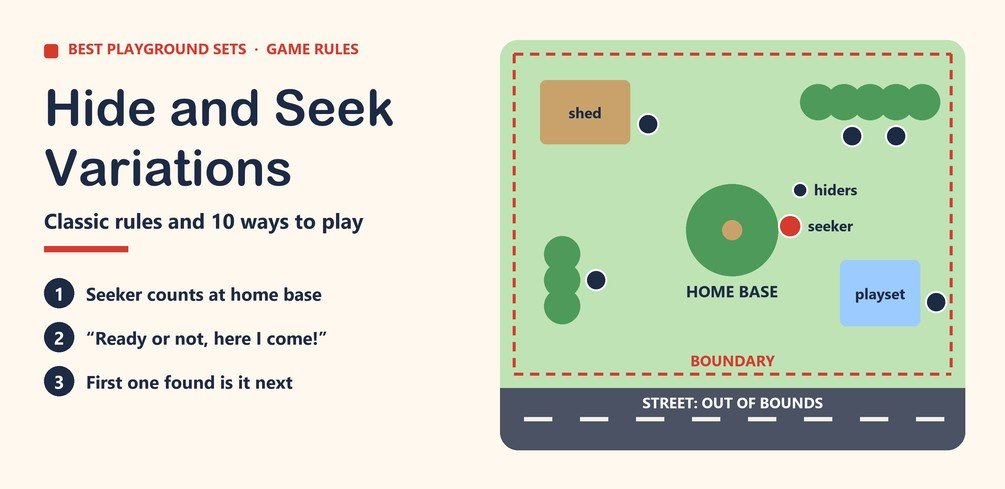
In hide and seek, one player (the seeker, or “it”) closes their eyes at home base and counts while everyone else hides. The seeker calls “Ready or not, here I come!” and searches, and the first player found is usually it for the next round. The 10 variations below change one rule each: who hides, how you’re caught, or what you’re looking for.
You need three or more players, a yard or house with clear boundaries, and a tree, porch step or wall to use as home base. It works for ages 3 and up, and little ones do best hiding with a partner.
There’s no governing body for hide and seek, so house rules vary. Agree on the rules below before the first count.
On this page
How to Play Classic Hide and Seek
1. Set the boundaries and home base
Walk the edges of the play area together and name what’s off limits. Pick one spot as home base, where the seeker counts.
2. Pick the seeker and count
Choose the first seeker with a counting-out rhyme or rock paper scissors. The seeker covers their eyes at home base and counts out loud, with no peeking.
I’d count to 20 in a small yard and up to 50 in a big one. Younger seekers can count to 10 twice.
3. Hide
Everyone else hides inside the boundaries while the seeker counts. Most groups say you have to stay in your spot once the count ends, though some let hiders move.
4. Seek
The seeker calls “Ready or not, here I come!” and starts looking. When they spot someone, they call that player’s name and where they are.
5. End the round
The round ends when everyone is found. The first player found is the next seeker, and the last one found is the winner.
If the seeker gives up, the traditional call is “Olly olly oxen free!” It means everyone can come out without being caught.
10 Hide and Seek Variations
1. Sardines
Sardines is hide and seek in reverse. One player hides and everyone else counts, then splits up to search.
When you find the hider, you quietly squeeze into the hiding spot with them. The last player to find the packed-in group is the hider next round.
It suits ages 5 and up and four or more players. Pick spots with room for the group, like behind a hedge, not inside anything.
2. Home Free
In this version, being seen isn’t enough. Hiders try to sneak back and touch home base, calling “Home free!”, before the seeker tags them or beats them there.
The seeker has to choose between searching far and guarding base. It adds running, so it suits ages 6 and up and a yard with open space around the base.
3. Flashlight Hide and Seek
Played at dusk or after dark, with one flashlight for the seeker. A hider is caught when the seeker shines the beam on them and calls their name.
Keep the beam on bodies, not faces. Walk the yard in daylight first so everyone knows where the holes, hoses and toys are, and keep an adult outside.
4. Ghost in the Graveyard
One player, the ghost, hides while the rest count together at base. Many groups chant the hours from “one o’clock” to “midnight” as the count.
Everyone then searches, and whoever spots the ghost shouts “Ghost in the graveyard!” All the players run for base while the ghost tries to tag one, and a tagged player is the next ghost.
5. Kick the Can
Set a can or plastic bottle in the open as base. The seeker finds a hider, calls their name, and both race to the can, and if the seeker gets there first, the hider goes to “jail” beside it.
Any free hider can run in and kick the can to free everyone in jail. The round ends when all the hiders are caught, so it needs five or more players to stay lively.
6. Camouflage
The seeker stands in one spot and can’t leave it. Hiders have to hide close by, where they can still see the seeker.
The seeker turns in place and calls out anyone they can spot, by name and location. It’s a good one for a wooded edge of the yard and for kids who like to stay still and blend in.
7. Buddy Hide and Seek
Players hide in pairs, and the seekers search in pairs too. Put each younger child with an older one.
This is the version I’d use with 3 and 4 year olds. Nobody is alone, and a little one who gets nervous in a hiding spot has company.
8. Hot and Cold
Here an object hides and the people don’t. One player hides a small toy while the others close their eyes.
The searchers look for it while the hider calls “warmer” as they get close and “colder” as they move away. It works with two players, and it’s an easy indoor game for a rainy day.
9. Marco Polo Hide and Seek
The seeker can call “Marco!” at any time, and every hider has to answer “Polo!” The seeker follows the voices.
Some groups limit the seeker to three calls a round. It helps a young seeker who gets frustrated, and it keeps long rounds from dragging.
10. Photo Hide and Seek
One player hides a stuffed animal, and a parent takes a close-up photo of the spot on their phone. The seekers study the photo for clues, like a bit of fence or a flowerpot, and go find it.
The closer the photo, the harder the hunt. Take turns hiding and seeking so everyone gets a go at both.
If your group likes the chase more than the hiding, try manhunt, which mixes hide and seek with tag and jail. For more running games, see our tag game variations.
Indoor Hide and Seek Rules
Indoors, the boundaries are rooms. Name the rooms in play and close the doors of the ones that aren’t.
I’d add three house rules: no locking doors, no climbing on shelves or furniture, and nothing closed on top of you. Shorten the count to 10 or 20, because hiding places are close.
Hot and Cold, Sardines and Buddy Hide and Seek work best inside. Save Home Free and Kick the Can for the yard, where there’s room to run.
Safety Tips
Never hide inside anything that closes. CPSC has reports of children suffocating in freezers, clothes dryers, picnic coolers and old latch-style refrigerators, often during hide-and-seek, and most were 4 to 7 years old.
CPSC and Lane also recalled millions of older cedar chests with lids that latch shut on their own, after children climbed inside and couldn’t get out. Tell kids plainly that chests, coolers, appliances and trunks are never hiding places.
Lock the car. Safe Kids Worldwide says to lock car doors and trunks, keep keys and fobs out of reach, and teach kids that trunks aren’t places to play or hide.
Keep water and roads out of bounds. A pool, pond or street should be well outside the play area, not at its edge. Lock the pool gate, the shed and the garage before the game starts.
Have a call-in signal. Agree on one loud call, like “Olly olly oxen free” or a whistle, that means everyone comes to home base right away. Count heads when they do.
Check for ticks. The CDC says ticks live in grassy, brushy and wooded areas, which are also the best hiding spots. Look kids over after a game along the yard’s wild edges.
Frequently Asked Questions
How long should the seeker count?
There’s no set number. Twenty works in a small yard or indoors, and 50 suits a big yard with lots of cover.
Count loud enough for the hiders to hear. That way they know how much time is left.
How many players do you need for hide and seek?
Three is the practical minimum: one seeker and two hiders. Sardines and Kick the Can are better with five or more, and Hot and Cold works with two.
What does “Olly olly oxen free” mean?
It’s the traditional call that ends a round. It tells everyone still hiding that they can come out without being caught.
What age can kids start playing hide and seek?
Many 3 year olds can play a simple version with a partner and a short count. By 5 or 6, most kids can hide alone and follow variations like Sardines.
Final Thoughts
Start with the classic rules, then add Sardines for a group, Buddy Hide and Seek for little kids and Flashlight Hide and Seek when it gets dark early. Set the boundaries first, and make “nothing that closes” the one rule nobody bends.
Next, read my capture the flag variations for a team game with hiding in it.
Please be careful and use at your own risk
None of the authors, contributors, administrators, or anyone else connected with BestPlaygroundSets, in any way whatsoever, can be responsible for your use of the information contained in or linked from these web pages.
