
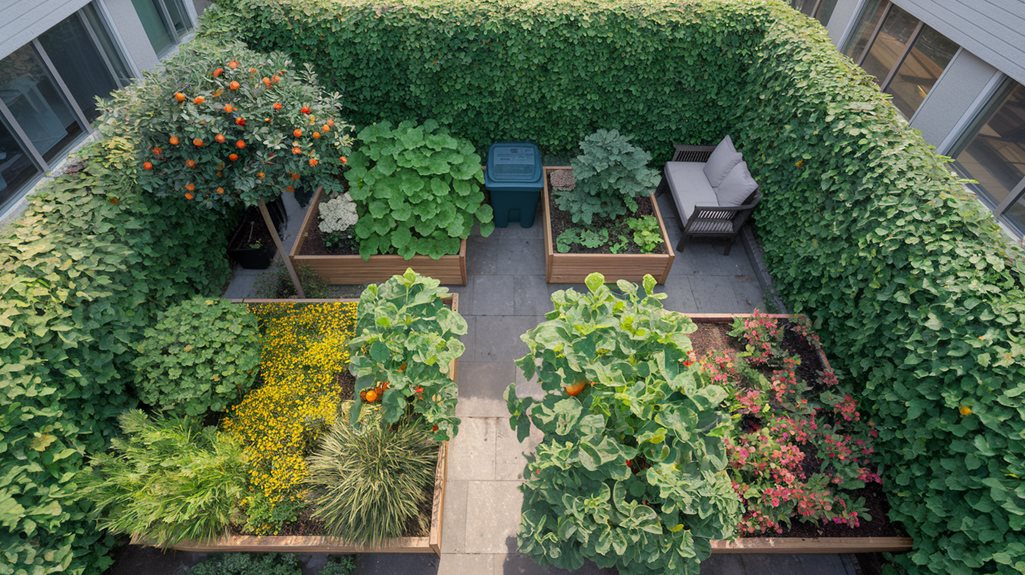
Can urban gardening transform the concrete landscape of city living into a sustainable ecosystem that benefits both you and your community? You’re likely surrounded by untapped potential right in your backyard or balcony.
Even minimal space can yield impressive harvests while reducing your carbon footprint and grocery bills. The shift from consumer to producer doesn’t require acres—just strategic planning and consistent attention. Discover how your urban plot can become part of the solution to multiple urban challenges.
On this page
Fresh Organic Produce at Your Doorstep
One of the most immediate benefits of urban backyard gardening is access to truly fresh organic produce.
You’ll harvest vegetables at peak ripeness, maximizing nutritional content that diminishes with storage and transportation. Home-grown produce eliminates pesticide exposure and reduces your carbon footprint by cutting food miles to mere steps.
In limited urban spaces, vertical growing systems and succession planting can yield surprising quantities of food. A mere 4×8 raised bed can produce up to 20 pounds of tomatoes or 80 carrots per season.
You’ll also gain food security through diversification—growing different varieties that aren’t commercially available due to their poor shipping qualities but superior flavor profiles.
The soil-to-table interval of minutes rather than days guarantees prime phytonutrient preservation, particularly water-soluble vitamins like C and B complex. Additionally, using raised garden beds can enhance soil quality and drainage, promoting healthy plant growth.
Mental Health Benefits of Urban Gardening
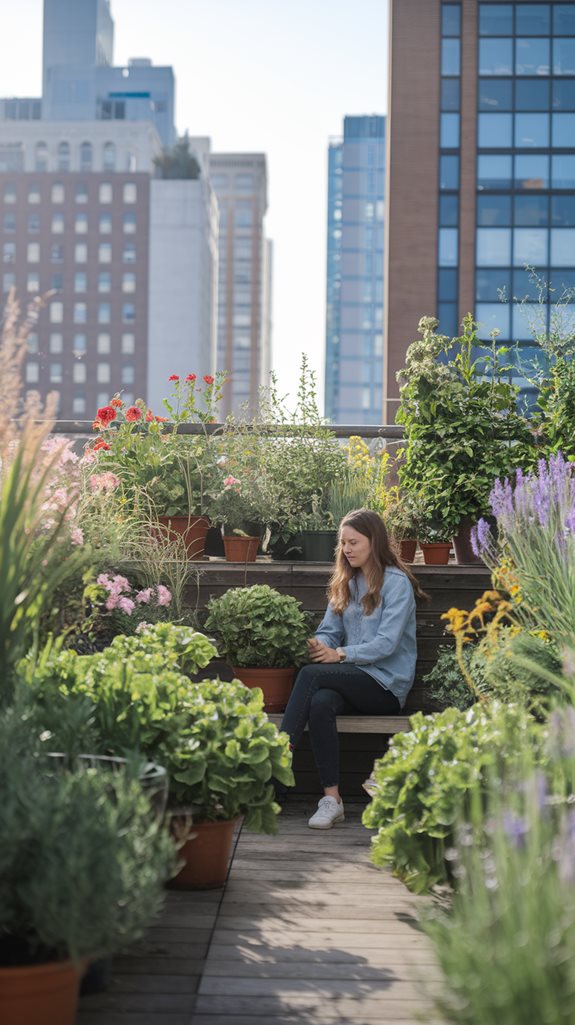
While science increasingly validates what gardeners have long intuited, urban gardening provides quantifiable mental health benefits through multiple neurological pathways. Your brain’s cortisol levels decrease considerably after just 30 minutes of garden interaction, creating a natural stress reduction mechanism that’s accessible without prescription.
- Increases serotonin production through soil microbiome exposure
- Enhances mindfulness by requiring present-moment focus
- Reduces rumination by engaging problem-solving neural circuits
- Improves sleep quality via light exposure and physical activity
- Builds resilience through ongoing plant care challenges
You’ll discover that even in limited urban spaces, the psychological return on investment from maintaining a small garden considerably outweighs the spatial commitment. Additionally, vegetable gardening tips can help optimize your small backyard for both productivity and mental well-being.
Vertical systems and container arrangements maximize this mental health-to-square-footage ratio, making therapeutic horticulture practical regardless of your spatial constraints.
Breaking the Concrete Jungle With Green Spaces
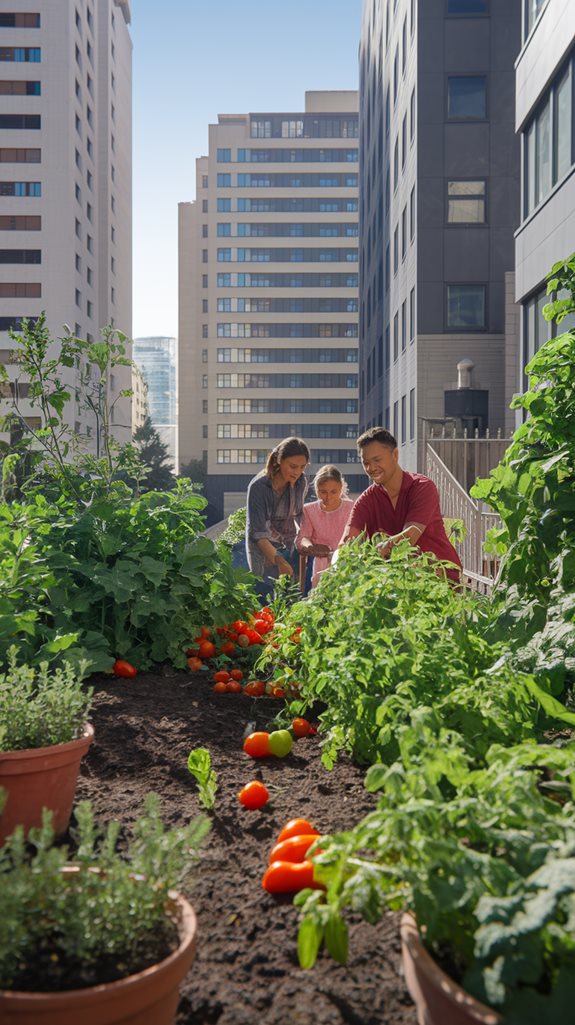
Urban landscapes, dominated by impervious surfaces and structural density, can be systematically transformed through strategic implementation of residential gardens.
You’re creating micro-ecosystems that counteract urban heat island effects while enhancing biodiversity. Every patch of greenery helps cool your immediate surroundings.
Vertical garden installations maximize limited spatial constraints, achieving far greater planting density per square meter than conventional horizontal plots.
Consider permeable hardscaping alongside drought-resistant native species to optimize water infiltration and retention.
Your garden functions as a carbon sequestration unit, annually capturing 4-6kg CO₂ per square meter while simultaneously filtering particulates from urban air.
These green nodes, when networked across neighborhoods, create essential wildlife corridors that fragment the concrete monotony and reestablish ecological connectivity previously severed by development. Additionally, incorporating sustainable design practices can further enhance the resilience and functionality of urban gardens.
Economic Advantages of Growing Your Own Food
Beyond the environmental benefits, your backyard garden transforms into a significant financial asset when strategically planted with edible varieties.
You’ll experience measurable savings on grocery expenses while accessing fresher, nutrient-dense produce without supply chain markups.
- Trim your grocery bill with high-yield crops like tomatoes and herbs
- Eliminate packaging waste costs associated with store-bought produce
- Lower transportation expenses by sourcing food directly from your property
- Convert unused yard maintenance budget into productive growing space
- Create potential micro-enterprise opportunities through surplus harvests
Additionally, growing your own food promotes self-sufficiency and can enhance your overall quality of life.
Sustainable Living and Reduced Carbon Footprint
When you establish a backyard garden, you’re creating a personal carbon sequestration system that measurably reduces your household’s environmental impact. Your plants absorb CO₂, while eliminating food transportation emissions that typically range from 1,500-2,500 miles per item on your plate.
| Eco-Benefit | Impact Measurement |
|---|---|
| Food Miles | 0 for homegrown produce |
| Packaging | No store packaging |
| Carbon Sequestration | Trees and shrubs store carbon as they grow |
Urban gardens transform impermeable surfaces into water-absorbent landscapes that mitigate runoff and reduce urban heat island effects. Each square foot of garden space can absorb approximately one gallon of water during rainfall events.
By composting kitchen scraps, you’re diverting waste from landfills while creating nutrient-rich soil amendments that eliminate the need for petroleum-based fertilizers. Additionally, implementing smart rainwater management techniques can further enhance the sustainability of your gardening efforts.
Building Community Through Shared Garden Knowledge
Gardening knowledge, once shared within neighborhood networks, catalyzes community resilience and social cohesion in urban environments.
You’ll find that exchanging cultivation techniques, seed varieties, and harvest tips creates meaningful connections with neighbors while strengthening local food systems. These interactions transform isolated growing spaces into nodes of collective learning.
- Host seasonal skill-share workshops on composting, vertical gardening, or pest management.
- Establish neighborhood seed libraries for preserving heritage varieties.
- Create digital platforms documenting hyperlocal growing conditions and microclimates.
- Organize harvest exchanges to maximize crop diversity without expanding space requirements.
- Develop intergenerational mentoring pairs connecting elderly gardeners with young urbanites.
Additionally, implementing essential composting tips can significantly enhance the quality of the soil, further improving community gardening efforts.
Space-Efficient Growing Techniques for Small Yards
Limited square footage needn’t constrain your growing potential in urban settings. Vertical gardening maximizes output by utilizing wall space with trellises, pocket planters, and stackable containers.
Install modular systems that expand upward rather than outward.
Consider square-foot gardening—a systematic approach dividing growing areas into 1’×1′ grids. This method enables dense planting while maintaining ideal spacing for each crop type.
Intercropping compatible plants further enhances yield per square foot.
Succession planting keeps beds productive year-round. As one crop finishes, immediately replace it with another. Quick-maturing varieties like radishes and lettuce can produce between slower-growing plants.
For extremely limited spaces, focus on high-value, compact cultivars specifically bred for containers.
Determinate tomatoes, dwarf fruit trees, and cut-and-come-again greens deliver maximum returns from minimal space investment. Additionally, incorporating low-maintenance vertical gardening techniques can simplify upkeep and enhance productivity in busy lifestyles.
Conclusion
You’re not just gardening—you’re launching a micro-scale carbon sequestration project in your urban ecosystem! While your neighbors are busy ordering delivery, you’ve established a self-sustaining nutrient production facility in that 4×4 patch behind your apartment.
Don’t tell them, but you’ve optimized your space-to-calorie ratio better than NASA. Your vertically integrated garden isn’t pretentious—it’s simply the most efficient rebellion against concrete monotony you’ll ever wage.
