

Just as water carves pathways down a mountainside, your sloped backyard demands deliberate lawn care strategies to thrive. You’ll find that conventional flat-terrain techniques simply won’t suffice when gravity becomes a constant force working against soil stability and water retention. By adapting your approach to the unique topographical features of your property, you can transform challenging gradients into sustainable, visually striking landscapes—but you’ll need specialized tools and techniques to make it happen.
On this page
Understanding the Challenges of Sloped Lawn Maintenance
When maintaining a sloped backyard, you’ll face distinct challenges that flat lawns don’t present. Gravity accelerates water runoff, causing topsoil erosion and nutrient depletion while creating dry zones at higher elevations and saturated areas below. This hydrological imbalance affects root development and turf stability.
Mowing presents significant safety hazards, as equipment can slip or tip on inclines exceeding 15 degrees. You’ll need to navigate perpendicular to the slope—never up and down—to maintain stability and achieve even cutting heights.
The angle of sunlight intensifies on south-facing slopes, creating microclimates that may require different grass varieties and watering schedules than north-facing areas.
Additionally, fertilizer application becomes technically complex, as granular products tend to migrate downhill, requiring specialized slow-release formulations or strategic application techniques to guarantee uniform distribution. Implementing budget-friendly lawn care methods can also help manage costs while maintaining your sloped lawn effectively.
Best Grass Types for Hillside Landscapes
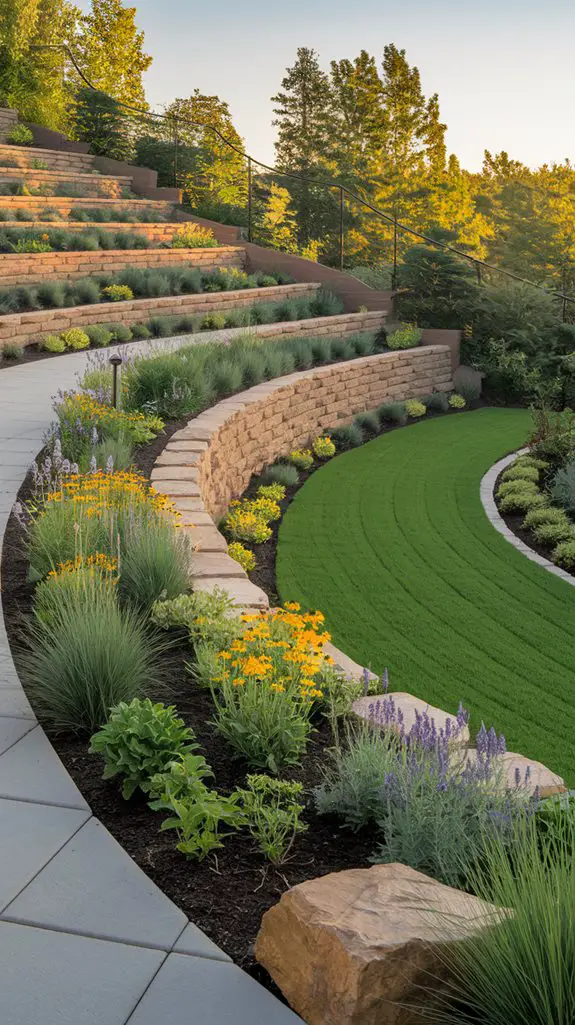
Selecting the ideal grass varieties for sloped terrain requires balancing root structure complexity with adaptability to variable moisture conditions. You’ll need species with aggressive, deep-rooting characteristics to anchor soil effectively against erosional forces.
Consider fine fescues (Festuca spp.) for shaded slopes with their extensive fibrous root systems. For sun-exposed gradients, implement Zoysia or Bermuda varieties, which establish dense lateral growth patterns while maintaining drought resilience.
Buffalo grass presents an excellent native option with minimal irrigation requirements and superior erosion control attributes. Additionally, incorporating eco-friendly landscaping solutions can further enhance the sustainability and resilience of your garden retreat.
In shifting zones, utilize turf-type tall fescue, which combines heat tolerance with year-round coverage. Position crown elevations perpendicular to slope faces during installation to maximize establishment success.
Specialized Mowing Techniques for Sloped Yards
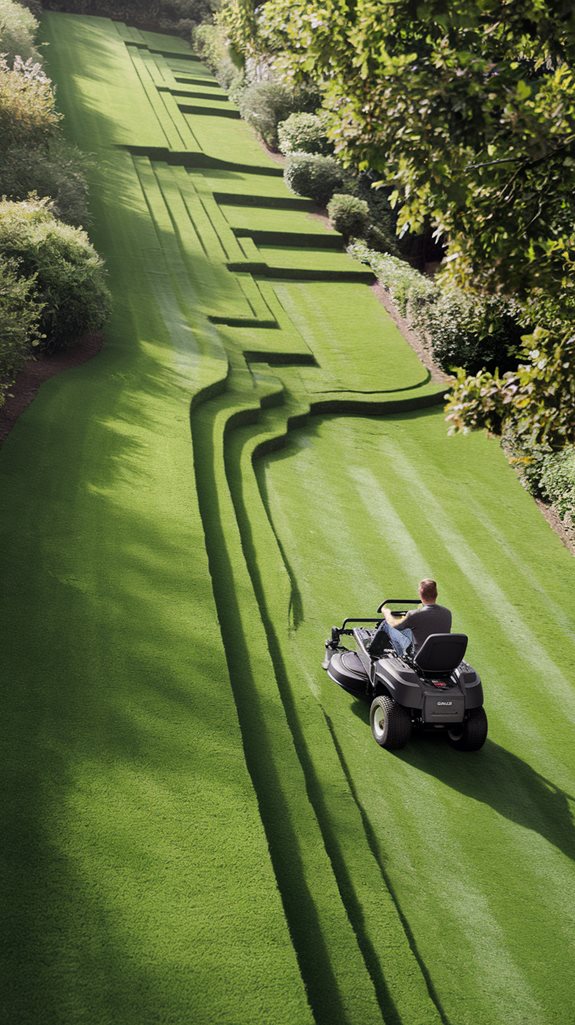
Mowing sloped landscapes requires specialized techniques that differ substantially from standard flat-terrain approaches. Your safety and lawn health depend on proper execution when maneuvering these challenging terrains.
- Mow laterally across slopes with gradients under 15 degrees, maintaining constant elevation rather than moving up and down the incline to prevent tipping hazards.
- Switch to push mowers with robust traction tires on moderate slopes, as ride-on equipment becomes dangerous beyond 10-degree inclines.
- Employ controlled descent techniques by pulling the mower upward when cutting steep sections, allowing gravity’s assistance while maintaining ideal blade contact.
- Alternate mowing patterns weekly between diagonal, horizontal, and checkerboard configurations to prevent soil erosion channels and encourage multidirectional root growth.
Erosion Control Strategies for Inclined Lawns
Effectively managing erosion presents the most critical challenge for sloped lawn maintenance, as unchecked water runoff can quickly devastate even well-established landscapes. You’ll need to implement strategic solutions that slow water flow and stabilize soil structure.
| Strategy | Application | Benefit |
|---|---|---|
| Terracing | Cut horizontal platforms into slope | Reduces runoff velocity |
| Retaining walls | Install at strategic intervals | Creates flat planting areas |
| Ground covers | Plant dense, low-growing species | Establishes root networks |
| Mulch layers | Apply 2-3″ thick organic material | Absorbs impact of raindrops |
For severe slopes exceeding 15% grade, combine multiple approaches simultaneously. Position drainage swales perpendicular to the slope’s fall line to redirect water flow paths. Always incorporate native vegetation that’s adapted to your region’s precipitation patterns.
Irrigation and Drainage Solutions for Sloped Terrain
Because water naturally accelerates as it travels downhill, standard irrigation practices often fail on sloped terrain, leading to runoff waste and uneven moisture distribution.
You’ll need specialized solutions that account for gravitational flow dynamics while maximizing water retention.
- Install drip irrigation systems with pressure-compensating emitters that deliver consistent water volume regardless of elevation changes.
- Position lateral lines across the slope (not up-down) to reduce downward water momentum.
- Create terraced micro-basins around plants using berms that capture irrigation runoff.
- Incorporate smart controllers with soil moisture sensors at different elevations to adjust watering cycles based on actual ground conditions.
For drainage management, integrate swales that redirect excess water horizontally across the slope before guiding it to appropriate collection points.
This prevents channel erosion while maintaining soil integrity throughout your sloped landscape.
Conclusion
You’ll find that managing your sloped lawn becomes notably more manageable when you integrate proper techniques with ecological awareness. Implement terracing, strategic plantings, and cross-cutting mowing patterns to maintain both safety and aesthetics. Properly terraced slopes lose far less soil than unmanaged inclines, demonstrating how structured intervention directly translates to soil preservation while enhancing your backyard’s natural resilience.
