
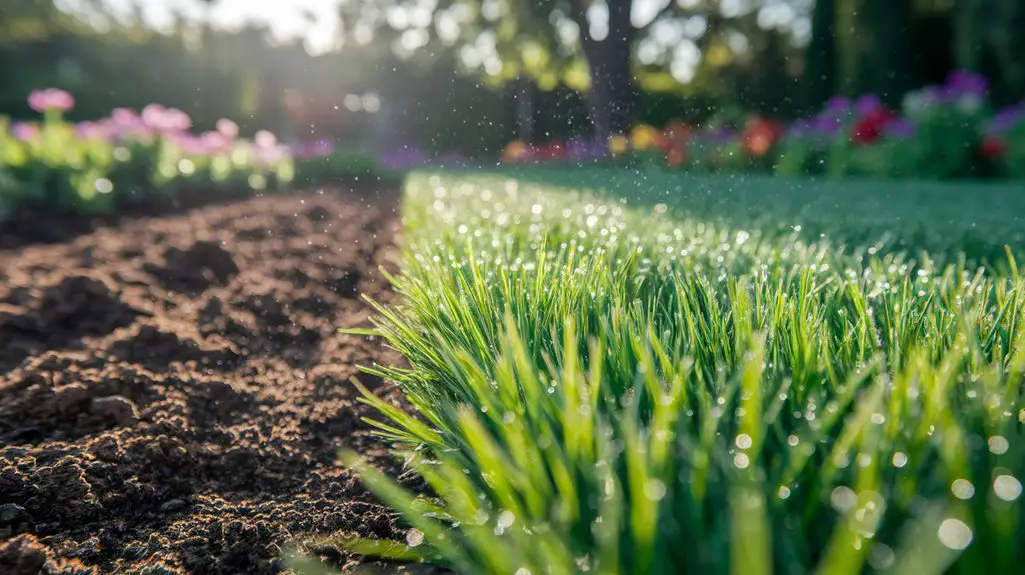
You’re sitting on a gold mine beneath your lawn. Healthy soil—teeming with microorganisms and nutrients—forms the foundation of every vibrant yard. Yet most homeowners focus exclusively on what grows above ground, neglecting the ecosystem that supports it.
By implementing targeted soil health practices, you’ll reduce water needs, cut fertilizer costs, and build natural resistance to pests and disease. The secret to a lush, sustainable lawn doesn’t come in a bottle; it begins with understanding what’s happening underfoot.
On this page
Understanding Your Soil Type and Composition
Before implementing any lawn care regimen, you’ll need to assess your soil’s type and composition through proper testing.
Purchase a soil test kit from your local garden center or contact your county extension office for professional analysis. These tests measure pH levels (ideally 6.0-7.0 for most grasses), macronutrients (N-P-K), and micronutrients essential for growth.
Clay soils retain water but drain poorly, while sandy soils drain rapidly but struggle to retain nutrients. Loam, a balanced mixture of sand, silt, and clay, represents ideal growing conditions.
Identify your predominant soil type by conducting a simple jar test: combine soil and water in a clear container, shake vigorously, and observe how particles settle after 24 hours. Implementing an efficient lawn irrigation system can further optimize water usage based on your soil type.
Understanding your soil’s composition enables targeted amendments—adding organic matter to clay soils improves drainage; incorporating compost into sandy soils enhances nutrient retention.
Essential Soil Testing Methods for Homeowners

Although commercial soil test kits provide valuable information, homeowners should understand several reliable DIY testing methods that offer immediate insights into soil health.
These techniques help you assess pH levels, drainage capacity, and organic content without specialized equipment.
- Jar Test: Mix soil with water in a clear jar, shake vigorously, and observe how particles settle—sand drops first, followed by silt, then clay.
- Penetration Test: Insert a wire flag into moist soil to identify compaction zones.
- pH Paper Test: Mix soil with distilled water, insert pH paper, and compare against color chart.
- Drainage Test: Observe water infiltration rate in a hole 12 inches deep filled with water.
- Ribbon Test: Roll moist soil between fingers; longer ribbons indicate higher clay content.
These assessments enable targeted amendments based on actual soil conditions rather than assumptions. Additionally, understanding soil texture is crucial for determining appropriate care strategies for your lawn.
The Role of Aeration in Promoting Healthy Soil
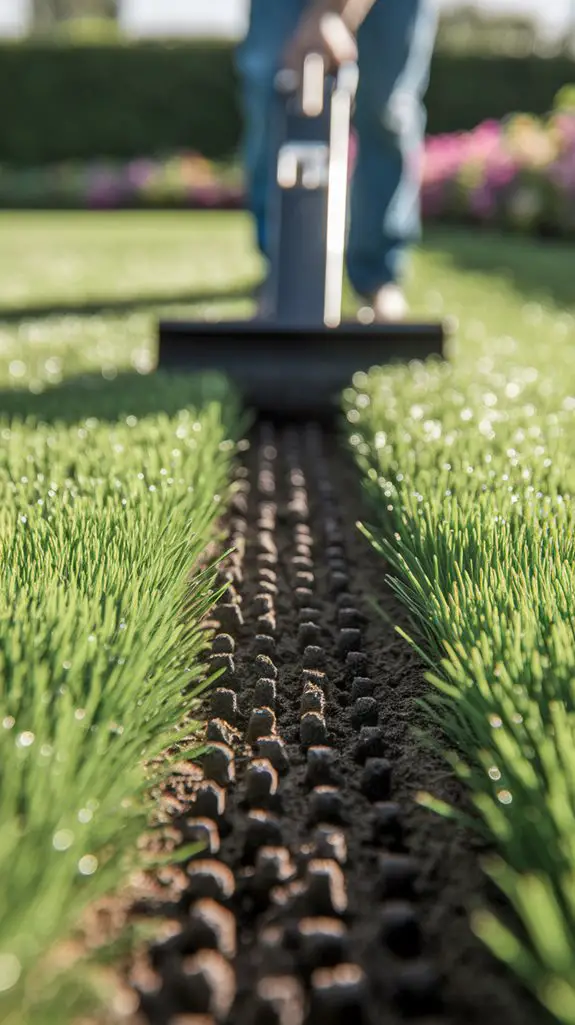
Compacted soil represents one of the most significant barriers to lawn health, creating an environment where grass roots struggle to access essential nutrients, water, and oxygen.
Core aeration, which involves removing small plugs of soil from your lawn, effectively counters this problem by creating channels for resources to reach the root zone.
Aeration boosts microbial activity, which speeds up organic matter decomposition.
You’ll achieve ideal results by aerating cool-season grasses in early fall and warm-season varieties in late spring when roots are actively growing.
The process is most effective when soil is moderately moist—not saturated or bone dry.
For clay-heavy soils, annual aeration is recommended, while sandy soils may only require treatment every 2-3 years.
Follow aeration with topdressing to maximize benefits.
Organic Matter: The Foundation of Vibrant Lawns
Organic matter serves as the cornerstone of soil health, containing approximately 50-60% carbon and providing the essential foundation for nutrient cycling in your lawn ecosystem.
It enhances soil structure, promotes microbial activity, and improves water retention capacity while regulating soil temperature fluctuations.
You’ll work toward healthy organic matter levels (4-6%) with these methods:
- Implement leaf mulching instead of removal, converting fallen leaves into valuable carbon sources
- Apply compost at rates of 1/4-1/2 inch annually to increase humic content
- Practice grasscycling by leaving clippings on the lawn after mowing
- Introduce beneficial soil organisms through quality compost tea applications
- Minimize synthetic fertilizers that diminish microbial populations over time
Lawns with enough organic matter need less watering and tend to resist disease better. Additionally, maintaining an eco-friendly lawn can significantly contribute to local biodiversity and ecosystem health.
Natural Fertilization Strategies for Long-Term Soil Health
Natural fertilization approaches extend beyond organic matter incorporation, focusing on nutrient cycling systems that mimic established ecological processes.
Consider implementing grass cycling by leaving clippings on your lawn, which returns nitrogen to the soil while reducing waste output.
Introduce beneficial microorganisms through compost tea applications, which deliver concentrated microbial populations that solubilize bound nutrients.
Monthly applications during growing seasons maximize effectiveness.
Cover crops like white clover establish symbiotic relationships with nitrogen-fixing bacteria, providing 2-3 pounds of nitrogen per 1,000 square feet annually.
Additionally, integrate rock minerals (azomite, greensand) to replenish trace elements depleted through leaching.
Monitor pH levels quarterly, adjusting with sulfur to lower or lime to raise as needed, maintaining the ideal 6.0-7.0 range where nutrient bioavailability peaks.
This integrated approach builds resilience against disease and drought stress. Furthermore, incorporating natural weed control strategies can enhance soil health by reducing competition for nutrients and water.
Managing Soil Ph for Optimal Grass Growth
Soil pH serves as the foundation for nutrient availability in turfgrass ecosystems, directly influencing the efficiency of fertilization programs and root development patterns.
Most lawn grasses thrive in slightly acidic conditions (pH 6.0-7.0), where essential macronutrients maintain ideal bioavailability. You’ll need to test your soil biannually using a calibrated pH meter for precise measurements.
To adjust soil pH effectively:
- For acidic soils (pH <6.0): Apply dolomitic limestone at 40-50 lbs/1000ft² to raise pH
- For alkaline soils (pH >7.0): Incorporate elemental sulfur at 5-10 lbs/1000ft² to lower pH
- Schedule applications during fall for maximum integration before growing season
- Water thoroughly post-application to accelerate chemical reactions
- Monitor pH changes quarterly after significant amendments
Proper pH management enhances microbial activity, improves nutrient uptake efficiency, and increases drought resistance in established lawns.
Sustainable Watering Practices That Enhance Soil Structure
While pH management establishes the chemical foundation for lawn health, intelligent watering practices determine both soil structure integrity and water conservation efficacy.
Deep, infrequent irrigation encourages deeper root development, with 1-1.5 inches weekly applied during early morning hours to minimize evaporation. You’ll optimize uptake by watering between 4-10 AM when wind speed is minimal.
Implement cycle-soaking techniques—dividing watering into three shorter sessions spaced 30-60 minutes apart—to prevent runoff and maximize infiltration, particularly on clay soils or slopes. This approach allows water to percolate through soil micropores, strengthening aggregate stability.
For sandy soils, incorporate organic matter to increase water-holding capacity.
Monitor infiltration rates by observing how quickly 1 inch of water penetrates your lawn—healthy soils absorb water within 10-15 minutes without pooling.
Seasonal Soil Maintenance Calendar for Year-Round Health
Effective lawn management requires a systematic approach to soil maintenance that changes with the seasons.
Timing these steps well gets the most out of your soil and your resources.
Your annual soil maintenance calendar should include:
- Spring (March-May): Apply lime if pH < 6.0; core aerate compacted soils; incorporate thin layer of compost (¼"); apply slow-release organic fertilizer
- Summer (June-August): Maintain 3-4″ grass height; leave clippings as nitrogen source; limit irrigation to 1″ weekly
- Fall (September-November): Test soil; apply potassium for winter hardiness; overseed thin areas; incorporate fallen leaves via mulching
- Winter (December-February): Minimize traffic on dormant lawn; plan amendments based on soil test results; clean and maintain equipment
This temporal approach to soil care enhances microbial activity and nutrient cycling throughout the year. Additionally, implementing lawn care tips for pathways can further improve the overall health and appearance of your outdoor spaces.
Conclusion
By implementing these research-backed soil health practices, you’ll transform your lawn’s ecosystem from the ground up. Properly aerated lawns absorb far more water and nutrients than compacted soil, which cuts runoff and encourages deeper roots. Commit to this soil-first approach, and you’ll not only reduce maintenance costs but also create a resilient outdoor space that thrives despite environmental stressors.
