
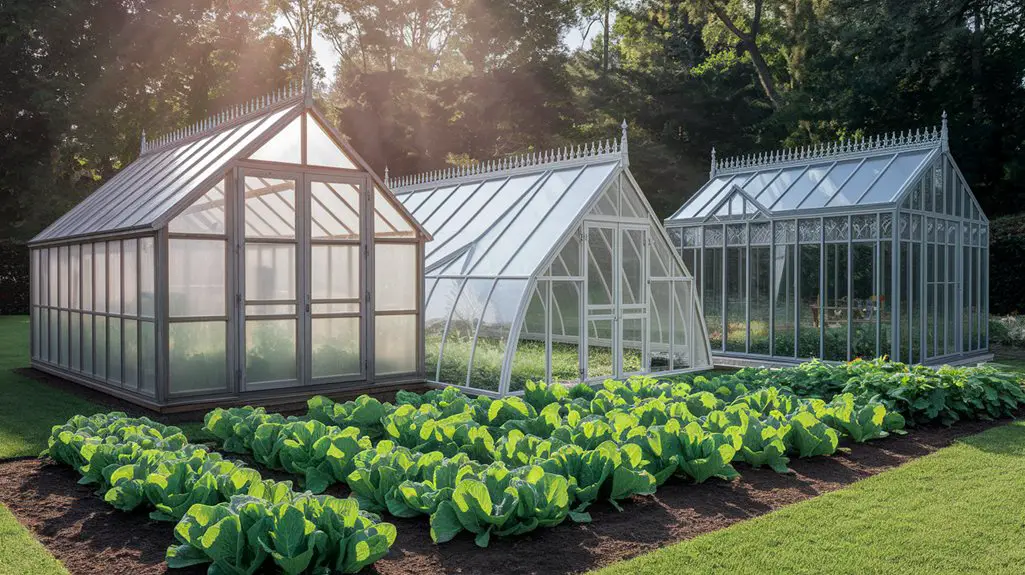
Greenhouse options bloom like possibilities in a seed catalog when you’re ready to extend your growing season. You’ll find several structures that can transform your backyard vegetable production, each with distinct advantages for different gardening situations.
From portable mini polytunnels to geodesic domes that maximize light capture, the right choice depends on your space constraints, budget, and growing ambitions. Let’s examine which protective environment might best nurture your garden dreams.
On this page
Mini Polytunnel Greenhouses for Small Spaces
When space constraints limit your gardening options, mini polytunnel greenhouses provide an efficient solution for year-round cultivation.
These compact structures typically measure 1-2 meters in length and 0.5-1 meter in width, featuring flexible PVC or polyethylene coverings stretched over semi-circular hoops.
Mini polytunnels offer significant microclimate benefits despite their size. They’ll raise internal temperatures 5-10°C above ambient conditions, extending both ends of your growing season.
You’ll find they’re particularly effective for starting seedlings, protecting cold-sensitive crops, and hardening off transplants.
Installation requires minimal tools: simply position the frame, secure anchor points, and attach the covering material.
For peak performance, position your polytunnel with its length oriented north-south to maximize light penetration, and incorporate ventilation points to prevent excessive humidity buildup during warmer periods.
Walk-In Hoop Houses for Seasonal Protection
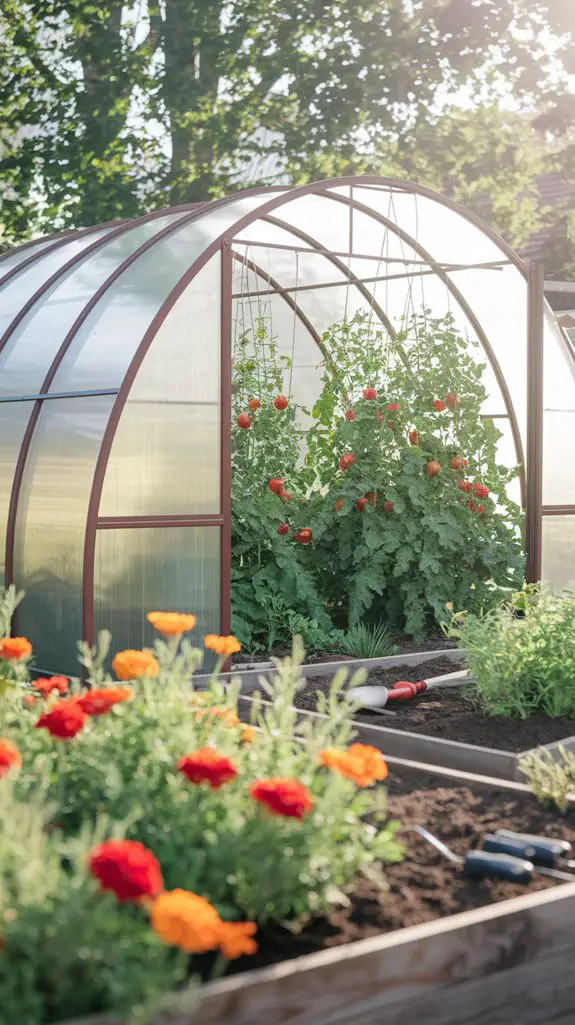
Moving beyond miniature options, walk-in hoop houses represent the next tier in greenhouse versatility. These curved-frame structures, typically covered with polyethylene film, provide sufficient height for standing while offering extensive plant protection at moderate cost.
You’ll find they’re ideal for extending growing seasons in spring and fall without permanent installation.
Construction involves these fundamental components:
- Frame Assembly – Galvanized steel or PVC pipes bent into arches, secured to ground anchors at 4-foot intervals
- Covering System – 6-mil greenhouse-grade polyethylene with UV inhibitors, attached using wiggle wire channels or specialized clips
- Ventilation Design – Roll-up sides with locking mechanisms or end-wall vents to regulate temperature
Walk-in hoop houses accommodate multiple planting rows, allowing for efficient crop rotation and diversification.
They’re transportable when needed, resist moderate wind loads, and provide sufficient thermal retention for cool-season crops.
Lean-To Greenhouse Models for Home Attachment
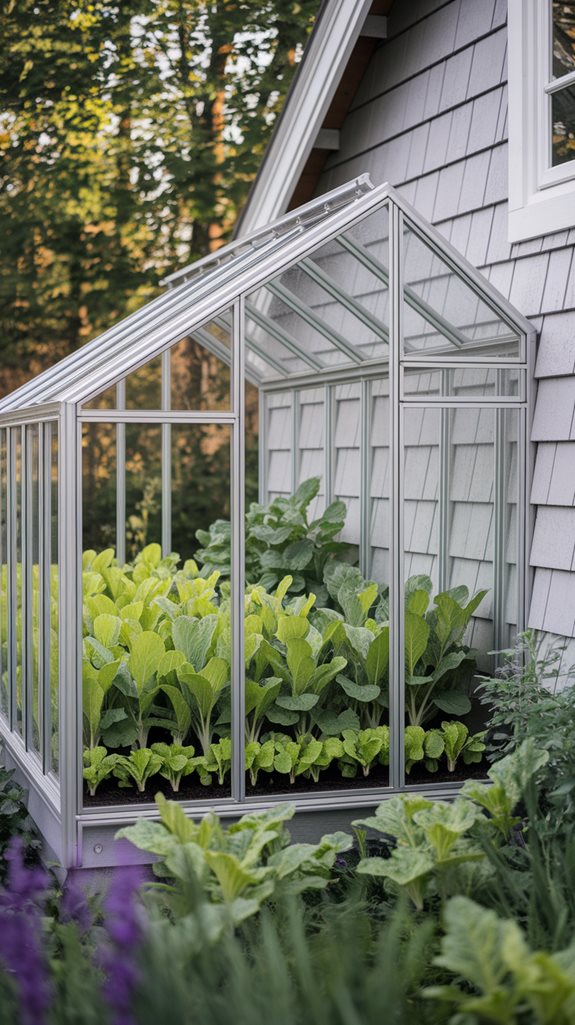
For homeowners seeking both space efficiency and convenience, lean-to greenhouse models provide an ideal solution by attaching directly to an existing structure.
These greenhouses utilize your home’s southern, eastern, or western wall for structural support and thermal mass, reducing construction costs while enhancing heat retention.
You’ll need to select between aluminum or wood framing systems.
Aluminum offers durability and minimal maintenance, while wood provides superior insulation and aesthetic appeal.
Consider polycarbonate panels for excellent light diffusion and heat retention versus traditional glass.
Installation requires securing the greenhouse to your home’s foundation and wall while ensuring proper flashing to prevent water infiltration.
Incorporate a threshold-level entrance for accessibility and automated vents to regulate temperature fluctuations.
Most models include built-in shelving systems that maximize vertical growing space without compromising walkways.
Cold Frame Greenhouses for Year-Round Seedlings
Cold frame greenhouses represent a simpler, more economical option compared to lean-to structures while still extending your growing season considerably.
These low-profile units typically feature a transparent angled top that captures sunlight and a base that retains heat, creating a microclimate that’s warmer than the surrounding air.
When implementing cold frames for year-round seedling production, focus on:
- Orientation – Position your cold frame facing south with a 40-45° lid angle to maximize winter sun exposure
- Ventilation – Install automatic vent openers that respond to temperature fluctuations to prevent overheating
- Insulation – Line interior walls with reflective material and apply straw bales around exterior during extreme cold
You’ll find cold frames particularly effective for hardening off seedlings in spring, cultivating cold-hardy greens through winter, and protecting root vegetables from freezing.
Geodesic Dome Greenhouses for Maximum Light Exposure
Geodesic dome greenhouses stand apart from traditional designs through their multifaceted, spherical structure consisting of interconnected triangular elements.
These domes capture ideal sunlight throughout the day due to their geometry, which allows light to strike the surface at perpendicular angles regardless of the sun’s position.
You’ll find that dome greenhouses offer superior structural integrity while using less building material for the space they enclose.
The aerodynamic profile withstands high winds effectively, making them suitable for exposed locations.
Their volume-to-surface-area ratio provides excellent heat retention during winter months.
When installing a geodesic dome, prioritize proper ventilation systems—typically consisting of automatic roof vents and side wall louvers—to prevent overheating.
For vegetable production, the even light distribution eliminates shadowed areas, promoting uniform plant growth throughout the interior space.
Conclusion
You’ll find greenhouse selection directly impacts vegetable yield by modifying microclimate variables. A well-sited greenhouse can add several weeks to your growing season, especially with thermal mass inside.
When selecting your configuration, systematically evaluate space constraints, solar exposure coefficients, and structural durability factors. Each greenhouse typology offers distinct cultivation advantages. By methodically matching greenhouse architecture to your specific cultivation objectives, you’ll maximize production efficiency regardless of regional climatic limitations.
