
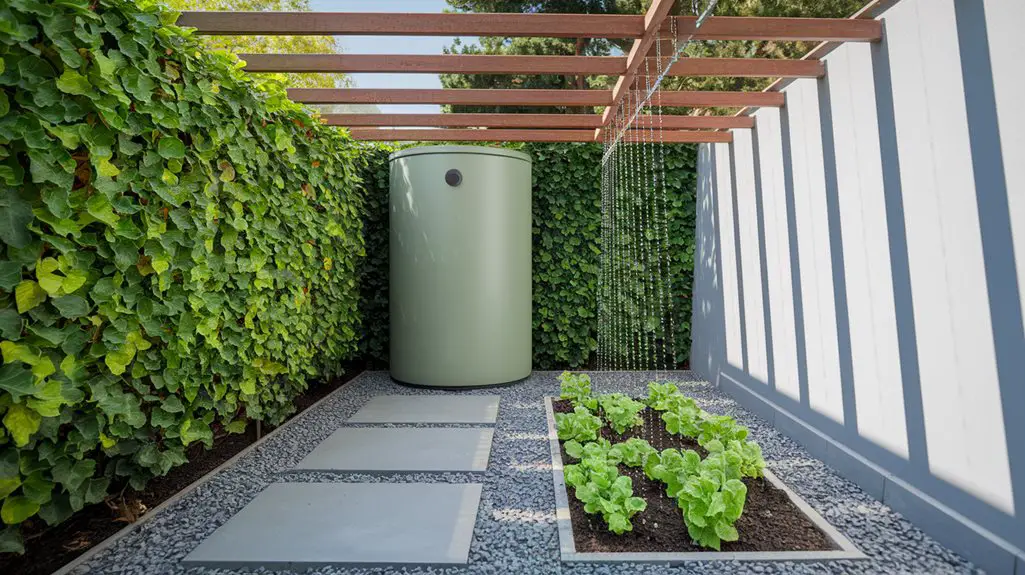
Like the proverbial ant preparing for winter, you’ll need to maximize every drop in your limited outdoor space. You’re facing unique challenges when implementing rainwater collection in small backyards—from spatial constraints to aesthetic considerations.
Efficient systems must balance functionality with form while delivering sufficient capacity for your specific needs. The right solution combines appropriate storage volume, minimal footprint, and seamless integration with your existing landscape. What approach will work best for your particular constraints?
On this page
Assessing Your Small Space Rainwater Collection Needs
How effectively you harness rainwater depends on accurately evaluating your collection capacity and usage requirements.
Begin by calculating your catchment area—typically your roof’s square footage—and multiplying it by your region’s average annual rainfall. This yields your theoretical maximum collection volume.
Next, quantify your water needs by listing specific applications: garden irrigation, container plants, or washing outdoor equipment. Measure these areas precisely and estimate their water consumption rates. For gardens, calculate 0.5 gallons per square foot weekly during the growing season.
Consider seasonal variations in both rainfall and usage patterns. Summer months often bring increased demand but reduced precipitation, requiring storage capacity planning.
Analyze soil composition and drainage characteristics as these factors influence irrigation efficiency and supplemental water requirements. Additionally, utilizing seasonal tips for rainwater harvesting can help optimize your collection strategy throughout the year.
Slim-Profile Rain Barrels That Maximize Limited Areas
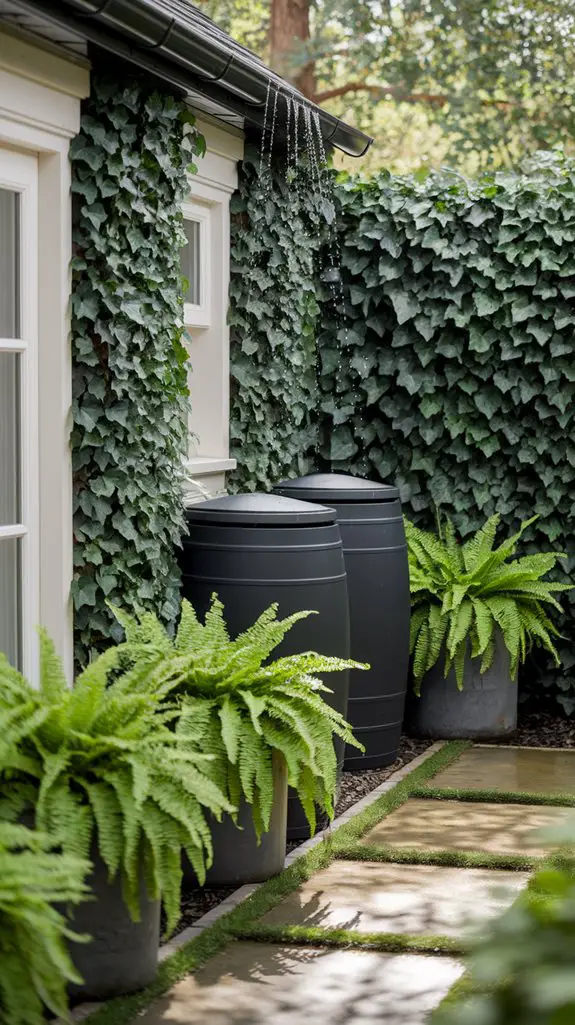
When planning your rainwater collection system, selecting appropriate containers becomes the next priority after evaluating your needs. Slim-profile rain barrels offer space-efficient solutions for urban settings, typically featuring rectangular designs that align flush with walls and fences.
- Flat-back models take up less space than traditional cylindrical barrels while holding 50-100 gallons.
- Modular stacking systems enable vertical expansion, increasing collection volume without extending footprint.
- Side-channel overflow mechanisms redirect excess water without requiring additional clearance space.
- Integrated filtration screens prevent debris accumulation and reduce maintenance requirements.
These specialized containers optimize your collection capacity-to-space ratio by utilizing vertical dimensions effectively. Additionally, implementing a rainwater system can significantly enhance the sustainability of your backyard design.
You’ll find most slim-profile units incorporate UV-resistant materials to prevent algae growth and extend operational lifespan.
Vertical Rainwater Harvesting Solutions for Tight Spaces
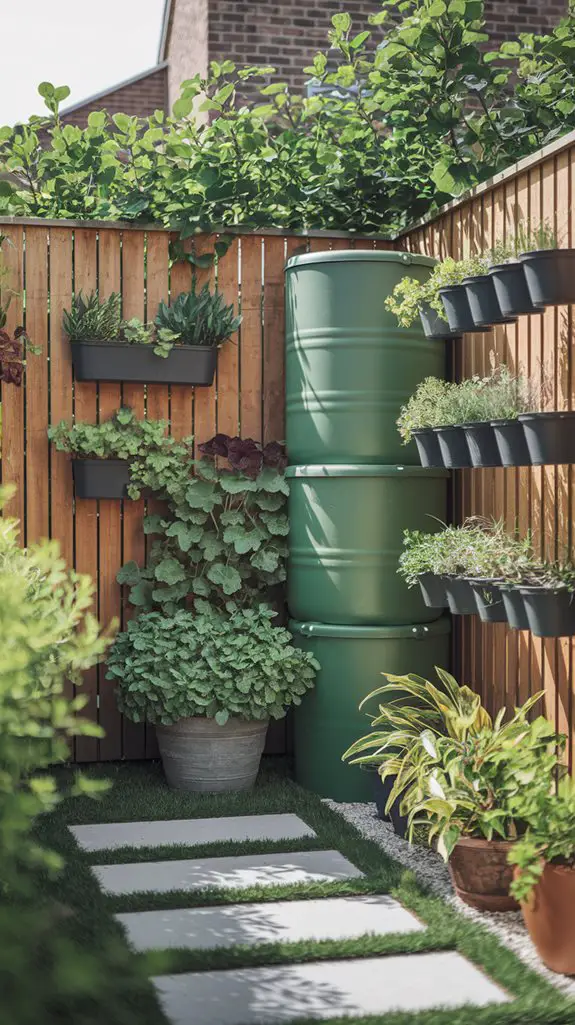
Vertical rainwater harvesting systems transform limited urban spaces into efficient water collection zones by utilizing height rather than horizontal area.
These systems typically integrate stackable containers or modular components that connect to your downspouts while maintaining a minimal footprint.
You’ll find wall-mounted solutions particularly effective, as they attach directly to exterior surfaces without consuming ground space. Many feature integrated filtration systems that remove debris before water enters the storage chambers.
For maximum space efficiency, consider multi-tiered designs that distribute collected water across several interconnected reservoirs.
These systems often incorporate gravity-fed irrigation outlets at varied heights to accommodate different watering needs.
The most advanced vertical systems include smart regulators that monitor water levels and automatically divert overflow during heavy rainfall, preventing potential structural damage while ensuring peak capacity utilization. Additionally, these eco-friendly systems contribute to sustainable water management by reducing reliance on traditional water sources.
Underground Storage Options for Invisible Water Collection
Underground rainwater storage systems offer the ultimate space-efficient solution while maintaining your property’s aesthetic appeal. These subterranean tanks collect precipitation through downspouts connected to filtration units, enabling significant water conservation without visual disruption to your landscape.
- Polyethylene tanks provide cost-effective storage with capacities ranging from 300-5,000 gallons, requiring minimal maintenance.
- Concrete cisterns offer superior durability and structural integrity, supporting vehicular traffic when installed beneath driveways.
- Modular crate systems allow customizable configurations for irregular spaces, with 95% void space for maximum water storage.
- Infiltration tanks combine storage with groundwater recharge, directing overflow into surrounding soil to replenish aquifers. Implementing rainwater harvesting systems can greatly enhance your drought resilience.
You’ll need professional excavation services for installation, with costs varying based on soil conditions and accessibility.
Integrating Rain Gardens in Compact Landscapes
Rain gardens provide a dual-purpose solution for compact urban environments where both stormwater management and aesthetic appeal are priorities.
You’ll need to position these shallow depressions strategically at least 10 feet from your foundation to collect runoff from downspouts and impervious surfaces.
Select native plants with varying root depths—shallow fibrous roots for initial filtration and deeper taproots for groundwater recharge.
Species like Black-Eyed Susan, Switchgrass, and Blue Flag Iris thrive in the fluctuating moisture conditions of rain gardens while requiring minimal maintenance.
For small spaces, consider a tiered design with the deepest section (6-8 inches) at the center.
A properly sized rain garden should handle the first inch of rainfall from your property’s impervious surfaces—typically 20-30% of your runoff-generating area. Additionally, implementing rainwater harvesting techniques can enhance water accessibility for your vegetable garden.
DIY Rainwater Systems That Fit Any Budget
While commercial rainwater harvesting systems can be costly, constructing your own collection apparatus offers significant savings without compromising functionality.
You’ll need minimal materials to implement basic catchment solutions that divert precipitation from downspouts into storage vessels.
- Repurpose food-grade 55-gallon drums ($15-30) with spigot attachments for accessible water dispensing
- Install mesh screens at collection points to filter debris and prevent mosquito breeding
- Implement first-flush diverters to redirect initial runoff containing contaminants
- Connect multiple barrels with PVC manifold systems to increase capacity incrementally
Calculate your potential harvest using the formula: 0.62 gallons × roof area (sq. ft.) × inches of rainfall.
This quantifies collection efficiency and helps determine appropriate storage capacity for your specific precipitation patterns. Additionally, utilizing multiple barrels can significantly enhance your overall water storage capability.
Smart Technology for Optimizing Small-Scale Collection
Although traditional harvesting systems serve basic collection needs, integrating smart technology greatly enhances efficiency for small-scale rainwater harvesting operations.
Smart controllers with rain sensors can automatically divert first-flush water, preventing contaminants from entering your storage tanks. These systems monitor water levels in real-time, providing data through smartphone apps that track collection rates and usage patterns.
You’ll benefit from automated filtration systems that self-clean when sensors detect reduced flow rates.
Flow meters integrated with weather APIs can predict collection volumes based on forecast data, allowing you to optimize storage capacity. Some advanced systems incorporate UV sterilization that activates only when water quality sensors detect bacterial presence, conserving energy.
For maximum efficiency, consider pressure-sensing pumps that activate only when needed, reducing electricity consumption while maintaining consistent water pressure throughout your distribution system. Additionally, implementing rainwater filtration solutions can further improve the quality of the harvested water by removing sediments and pollutants effectively.
Seasonal Maintenance Tips for Efficient Rainwater Systems
Keeping your rainwater harvesting system operating at peak efficiency requires consistent seasonal maintenance throughout the year.
Implement quarterly inspections tailored to seasonal challenges to prevent component failure and maximize collection capacity.
- Spring: Clear gutters of winter debris and inspect downspouts for blockages; check first-flush diverters and clean filters to prepare for heavy rainfall periods.
- Summer: Monitor algae growth in storage tanks; calibrate automated systems and inspect UV filters if utilizing rainwater for potable purposes.
- Fall: Remove accumulated leaf debris from collection surfaces; verify proper function of overflow mechanisms before winter precipitation.
- Winter: Insulate exposed pipes to prevent freezing; disconnect and drain non-frost-resistant components in regions with sustained sub-freezing temperatures.
Conclusion
By implementing these space-efficient rainwater solutions, you’ll transform your small backyard into a sustainable water management system. A 1,000-square-foot roof sheds approximately 600 gallons of water from just 1 inch of rainfall. You’re not just conserving valuable resources; you’re creating a self-sufficient ecosystem that reduces municipal water dependency while optimizing your limited outdoor space for maximum environmental benefit.
