
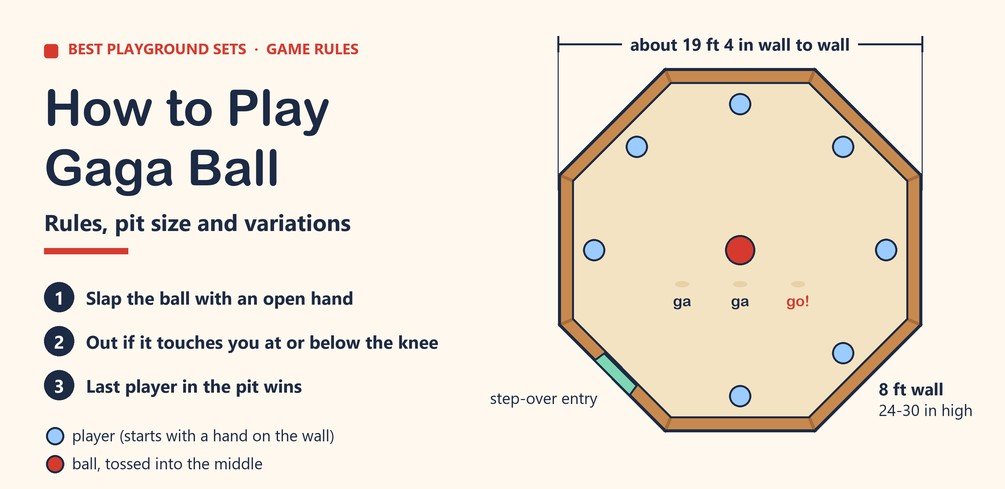
Gaga ball is a gentler kind of dodgeball played inside a walled pit, usually an eight-sided one. You slap the ball with an open hand and try to make it touch other players at or below the knee. Anyone it touches there is out, and the last player left in the pit wins the round.
There’s no governing body, so house rules vary. The core rules below appear on nearly every school, camp and Scouting rule sheet. The Gaga Center in New York says a game lasts no more than five minutes.
On this page
What You Need
- A pit. Walls keep the ball in play. Most pits are octagons or hexagons, and portable panel and inflatable pits work on driveways and in gyms.
- A soft ball, 8 to 10 inches across. Pit maker Coach Cliff’s GaGa Ball Pits says the usual ball is an 8 to 10-inch vinyl or inflatable one. Scouting America says to skip hard balls like soccer balls.
- A forgiving floor. Kids fall a lot in gaga. Scouting America says to avoid concrete and suggests wood chips or sand, not rocks or pebbles.

If I were buying one ball for a backyard pit, it would be a plain 8.5-inch playground ball such as the Champion Sports Rhino. It has a two-ply cover over a nylon-wound build and ships flat, so you’ll need a ball pump, which isn’t included. For preschoolers or indoor play, a coated foam ball is gentler still.
How Big Is a Gaga Pit?
There’s no official size. Scouting America says pits are typically octagons 20 to 25 feet across. Portable panel and inflatable pits run from about 10 to 20 feet.
If you build your own, the wall length sets the size. In a regular octagon, the distance from one wall straight across to the opposite wall is the wall length times 2.414:
| Wall length | Wall to wall | Corner to corner |
|---|---|---|
| 6 ft (1.8 m) | 14 ft 6 in (4.4 m) | 15 ft 8 in (4.8 m) |
| 8 ft (2.4 m) | 19 ft 4 in (5.9 m) | 20 ft 11 in (6.4 m) |
| 10 ft (3.0 m) | 24 ft 2 in (7.4 m) | 26 ft 2 in (8.0 m) |
Kit makers quote a bit more, since posts and brackets add a few inches: Coach Cliff’s calls 8-foot boards about a 20-foot pit and 10-foot boards about 25 feet.
Which size: bigger isn’t better for little kids, because a pit that’s too large slows the game down. Coach Cliff’s recommends 8-foot walls for younger or mixed-age groups, and 10-foot walls for players 13 and up or for a pit that needs room for wheelchairs. For a backyard, I’d stop at 8-foot walls.
Wall height: Coach Cliff’s says 30 inches is the most common height and 24 inches suits younger or smaller players. Some camp plans go to 36 inches to keep more balls in play. Add a low cut-out or gate so kids who are out can step through instead of climbing over.
How to Play Gaga Ball
Starting a Round
- Everyone in the pit puts one hand on a wall.
- One player or an adult tosses the ball into the middle.
- Everyone shouts “Ga!” on the first two bounces and “Go!” on the third. Some schools make the ball live right after the second bounce.
- Let go of the wall and play. Under Medford Public Schools’ rules in Massachusetts, letting go early gets you out.
Hitting the Ball
Slap the ball with an open palm and aim low, at the other players’ legs. You can’t hold it, scoop it or pick it up and throw it. It’s the same palm control you use to steer the ball in tetherball, just aimed at the ground.
Some rule sheets allow a closed fist, including the Gaga Center’s and the City of Bangor, Maine’s. Medford’s don’t, and Scouting America encourages open hands. With kids, I’d play open hand only.
What Gets You Out
- The ball touches you at or below the knee, even if you hit yourself.
- You hit the ball out of the pit. The last player to touch it is out.
- You hit it twice in a row without it touching a wall or another player in between (a “double touch”).
- Someone catches your hit on the fly. Under the Gaga Center’s and Medford’s rules, the hitter is out, not the catcher. Some groups ban catching altogether.
- You kick it, since your foot is below the knee anyway.
- Under Medford’s rules: sitting or jumping on the wall to dodge, crouching low to guard your legs, or hitting with two hands or a fist.
A ball that hits you above the knee doesn’t count, and play goes on. Players who are out leave the pit right away instead of sitting on the wall.
Winning
The last player left wins, and everyone climbs back in. If two careful players stall the game, variations 2 and 3 below end it.
Gaga Ball Variations
These come from school, camp and pit-maker rule sheets. Pick one or two and agree on them before the first toss.
1. Rotation Gaga
Medford’s schools play this at recess. Up to 15 kids start in the pit and the rest line up by the entry.
When a player gets out, they go to the back of the line and the next kid jumps in. It’s the version I’d pick for a backyard birthday party, where kids show up at different times.
2. Two-Ball Finish
When only a few players are left, toss in a second ball. Anyone either ball touches low is out. The Gaga Center and pit seller Practice Sports both list it.
3. Countdown Finish
When two players are left, everyone counts down from 10. If nobody is out by zero, it’s a tie and a new game starts.
That’s Medford’s rule. Practice Sports suggests a 20-second countdown whenever play gets too slow.
4. Team Gaga
Split the pit into two or more teams. Teammates protect each other while getting the other side out, and the last team with a player left wins. Coach Cliff’s suggests it to get kids passing and calling plays.
5. Freeze Gaga
Gaga crossed with freeze tag. A player hit at or below the knee freezes in place instead of leaving, and gets back in with high-fives from two teammates (in a free-for-all, any two players). It keeps younger kids in the game longer.
6. King or Queen
One player is the royal. Anyone else who gets hit becomes a guard instead of leaving.
Guards can’t hit the ball, but they can block it. The round ends when the royal is out or is the last player standing.
7. Easier or Harder Outs
Move the target line to fit the group. Practice Sports uses below the waist as its standard, and some groups play below the ankle for a harder out.
Gaga Ball Safety Tips
Most of these come from Scouting America’s gaga ball safety guidance.
- Keep an adult watching every game.
- Soft ball, open hands. No hard balls, and encourage open-hand hits over fists.
- Match the ages. Keep players within about two years of each other.
- Stay off the walls. No sitting, standing or climbing on them.
- Check the pit before you play. Look for loose walls, nails or screws sticking out, and holes or mud in the floor. Sand down splinters on wood walls.
- Mind the drainage. Put the pit where water drains, or it turns into a mud pit. Wood chips outside the walls soften a fall for kids stepping over.
- Inflatable pits: follow the maker’s instructions for staking, blower placement and the wind limit.
One house rule I’d add for young kids: if a hit flies up at someone’s face, the hitter sits out the next round.
Frequently Asked Questions
Why is it called gaga?
Most accounts say the game was invented in Israel, and the name comes from the Hebrew for “touch touch.” Israeli counselors brought it to Jewish summer camps in the United States, and it spread from there to other camps and school playgrounds.
Can you play gaga ball without a pit?
You need walls of some kind, or the ball just rolls away. Portable panel kits and inflatable pits set up on a lawn, driveway or gym floor and pack away afterward.
What age is gaga ball for?
There’s no set age. Playing with kids close in age matters more, and Scouting America suggests a two-year age span.
Final Thoughts
Gaga’s rules fit on one hand: open-hand hits, low hits only, last one in wins. Settle the house rules before the first toss, and keep the ball soft and the walls smooth.
Next, read my capture the flag variations for a big-group game that uses the whole yard.
Please be careful and use at your own risk
None of the authors, contributors, administrators, or anyone else connected with BestPlaygroundSets, in any way whatsoever, can be responsible for your use of the information contained in or linked from these web pages.
