
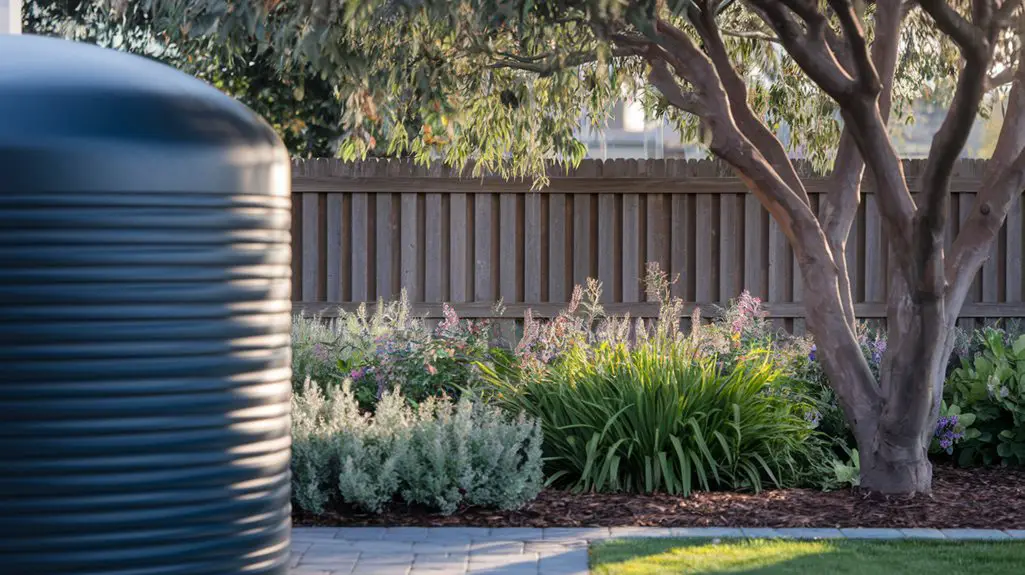
Rainwater harvesting offers environmental benefits while potentially slashing your water bills. You’re not just making an eco-friendly choice; you’re investing in a practical solution that adapts to your specific yard constraints.
Whether you have a spacious garden or a compact courtyard, the perfect rainwater tank exists—but selecting it requires careful consideration of space, aesthetics, capacity needs, and local rainfall patterns. The right tank will seamlessly integrate with your outdoor design while maximizing collection efficiency.
On this page
Assessing Your Yard Space and Rainfall Patterns
Where you position your rainwater tank is just as critical as which type you select.
Begin by measuring your available space, noting dimensions and clearances from structures. You’ll need to take into account access points for maintenance and proximity to downspouts for efficient collection.
Analyze your local rainfall patterns using historical weather data. Note seasonal variations, monthly averages, and intensity of typical storm events. These metrics will determine your ideal tank capacity—typically calculated as 0.62 gallons per square foot of roof area per inch of rainfall.
Don’t overlook topographical features that affect water flow. A slight gradient (1-2%) away from foundations assists drainage, while natural low points might determine perfect tank placement.
For sloped properties, think about terraced installations or retention walls to maximize collection efficiency. Incorporating eco-friendly rainwater harvesting practices can significantly enhance your landscape’s sustainability.
Common Rainwater Tank Materials and Durability
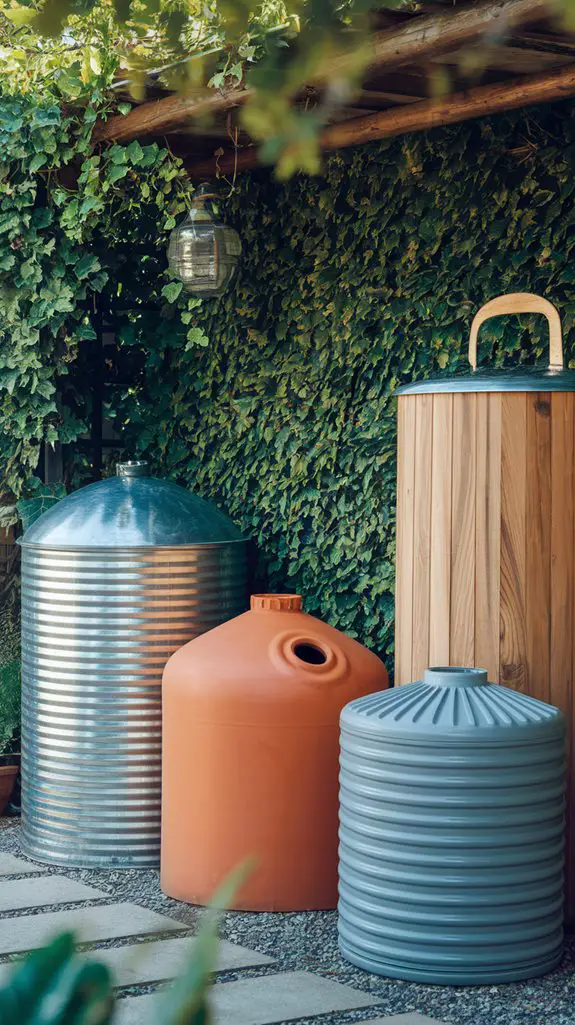
When selecting a rainwater tank, you’ll encounter several material options, each with distinct properties that affect longevity, maintenance requirements, and overall performance.
Understanding these differences helps you make an informed investment that withstands your local climate conditions while meeting your water harvesting needs.
- Polyethylene – Lightweight plastic tanks offer UV resistance, affordability, and 15-20 year lifespan, though they may warp in extreme heat.
- Stainless Steel – Premium option providing excellent durability (30+ years), fire resistance, and sleek aesthetics despite higher initial cost.
- Concrete – Extremely durable underground option that naturally alkalizes water but requires professional installation.
- Fiberglass – Mid-range choice combining lightweight properties with impressive strength, minimal maintenance, and resistance to corrosion and temperature fluctuations.
Above-Ground vs. Underground Tank Options
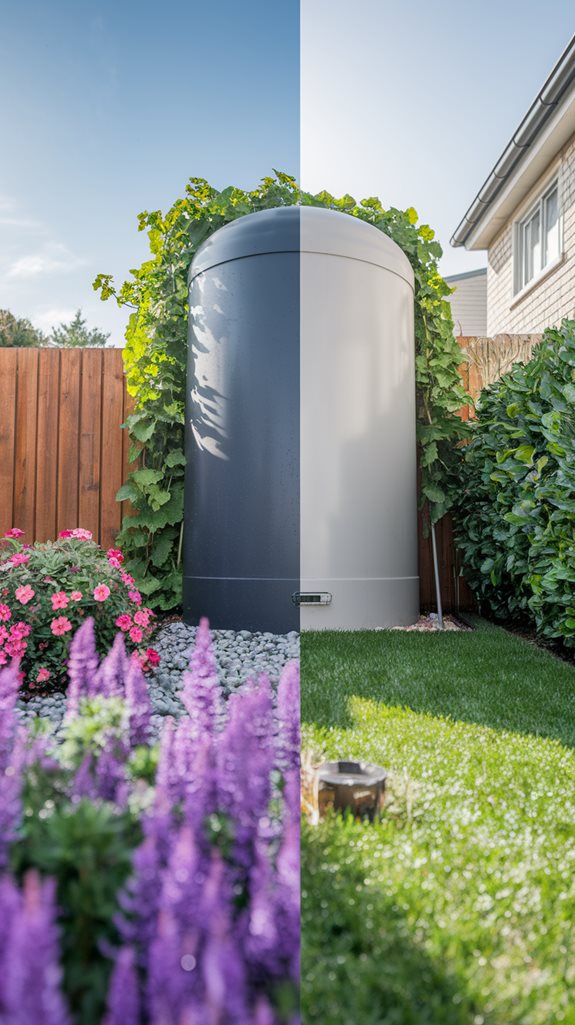
How you position your rainwater tank on your property greatly impacts its functionality, aesthetics, and long-term performance.
Above-ground installations offer cost-effective solutions with straightforward maintenance access, but they occupy visible yard space and may be vulnerable to UV degradation and temperature fluctuations.
Underground tanks preserve your landscape’s appearance and protect water from light exposure and freezing. They’re ideal for limited spaces and provide naturally cooler water temperatures.
However, they require significant excavation, professional installation, and specialized equipment for maintenance access. Their higher installation costs include excavation equipment and additional waterproofing measures.
Your decision should balance practical considerations like budget constraints and maintenance preferences with aesthetic priorities and available space.
Local regulations may also restrict certain installation types, particularly in areas with high water tables.
Size and Capacity Considerations for Home Water Needs
Selecting the appropriate tank size for your rainwater harvesting system requires careful calculation of both your household’s water demands and your property’s collection potential.
Consider your region’s rainfall patterns, roof catchment area, and intended water uses to determine ideal capacity.
- A 1,000-2,000 gallon tank typically suits supplemental garden irrigation for standard residential lots.
- 5,000+ gallon systems can support multiple household needs including toilet flushing and laundry.
- Each 1,000 square feet of roof area can collect approximately 620 gallons from 1 inch of rainfall.
- Factor in a 20% reserve capacity to accommodate unexpected dry spells and system maintenance.
For maximum efficiency, match your tank’s dimensions to available space while ensuring sufficient capacity to bridge the gap between rainfall events in your climate zone. Additionally, understanding rainwater harvesting systems can help you optimize your setup for better water conservation.
Aesthetic Designs That Complement Your Landscape
While functional in purpose, rainwater tanks needn’t sacrifice visual appeal in your outdoor space. Modern designs offer sleek cylindrical tanks in muted earth tones that blend seamlessly with garden environments, while decorative options feature timber cladding or stone veneers to disguise utilitarian plastic containers.
For contemporary homes, consider slim-profile tanks that mount flush against walls or fences, maximizing space efficiency while minimizing visual impact. Traditional properties benefit from terra cotta-inspired designs or corrugated metal tanks that evoke rustic charm.
You’ll find underground systems that preserve your landscape’s visual integrity, with only a discrete access point visible. Additionally, incorporating rainwater systems can enhance your overall backyard design while promoting environmental sustainability.
Integrate your tank into landscape design by surrounding it with complementary plantings or incorporating it into a garden feature like a trellis structure or raised bed foundation.
Installation Requirements and Cost Factors
Before starting a rainwater harvesting project, you’ll need to evaluate several installation requirements that impact both feasibility and budget.
Professional installation typically costs $800-$3,000, while DIY approaches can reduce expenses considerably if you have the necessary skills.
Your total investment depends on several key factors:
- Foundation requirements – Tanks need level, stable surfaces like concrete pads or compacted gravel that can support weights exceeding 8,000 pounds when full.
- Plumbing connections – Costs increase with complex filtration systems, multiple downspout connections, or pumps for pressure delivery.
- Permitting fees – Many municipalities require permits ranging from $50-$200 for rainwater collection systems.
- Accessibility considerations – Site preparation may require equipment rental if your installation location has limited access.
Annual maintenance costs remain minimal, typically under $100 for filter replacements and occasional system inspections.
Maintenance Needs for Different Tank Types
Once your rainwater harvesting system is installed, you’ll need to follow specific maintenance protocols based on your tank material and design.
Polyethylene tanks require minimal care—just annual cleaning and occasional inspection of fittings and seals.
Concrete tanks benefit from interior sealing every 3-5 years to prevent cracks and leaching.
Metal tanks demand vigilance against rust, particularly at seams and connection points. Apply rust-inhibiting paint every 2-3 years to extend lifespan.
For wooden tanks, check annually for warping and treat with non-toxic wood preservatives.
All tank types require regular gutter cleaning, first-flush diverter maintenance, and mosquito prevention measures.
Install filters and screens at inlets, inspecting quarterly for debris accumulation.
Monitor water clarity and odor monthly as indicators of system health.
Connecting Your Tank to Irrigation and Household Systems
Connecting your rainwater tank to existing irrigation and household systems requires careful planning to maximize efficiency and comply with local regulations.
You’ll need to install appropriate filters, pumps, and backflow prevention devices to guarantee water quality and system integrity. Consider your household’s specific water needs when determining connection types.
- Install a first-flush diverter to prevent initial runoff contaminants from entering your tank
- Use food-grade plumbing components for connections intended for potable water use
- Incorporate a pressure pump (1/2 to 1 HP) for consistent water delivery to sprinklers and appliances
- Set up a switched automatic system that defaults to mains water when tank levels fall below specified thresholds
For irrigation-only systems, simpler gravity-fed connections may suffice, while household integration demands more sophisticated filtration and pressure regulation components.
Conclusion
Choosing your ideal rainwater tank doesn’t need to feel like finding a needle in a haystack. By carefully evaluating your yard’s dimensions, local rainfall patterns, and household needs, you’ll identify the perfect solution. Whether you select a sleek above-ground model or discrete underground system, the right tank balances functionality with aesthetics while delivering long-term water security and sustainability for your property.
