
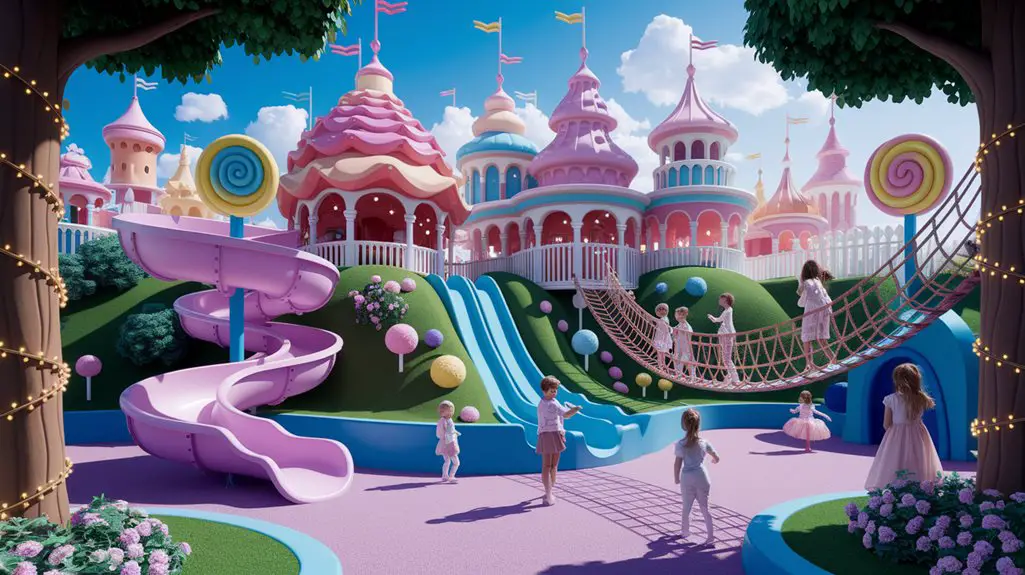
When you design a play space for children, you’re creating more than just an area for physical activity—you’re building a world where imagination thrives. The right theme transforms ordinary play into extraordinary adventures that captivate young minds and foster essential developmental skills.
From enchanted forests to underwater domains, thoughtfully themed environments invite children to become storytellers, explorers, and problem-solvers. What magical worlds could you create that would spark both joy and learning in your little ones?
On this page
Enchanted Forest Adventure Zones
When designing an enchanted forest adventure zone, you’ll transform ordinary play spaces into magical woodland domains that spark imagination and wonder. Incorporate tree-like structures with hidden nooks, rope bridges, and leafy canopies where children can explore freely.
Use wood chips or rubber mulch at the CPSC’s recommended depth beneath climbing elements; bark-colored chips keep the forest look. Add whimsical touches like oversized mushroom seats, fairy doors on tree trunks, and gentle woodland sounds playing in the background.
Consider interactive elements that reward exploration—hidden buttons that trigger nature sounds or light up pathways. Integrate sensory experiences with textured bark panels, aromatic plants, and water features mimicking forest streams. Additionally, creating designated backyard zones for pets can enhance the overall experience, allowing family pets to enjoy the space alongside the children.
These enchanted spaces encourage role-play, physical development, and nature appreciation while providing the perfect backdrop for children to create their own woodland adventures.
Pirate Ship Playgrounds With Hidden Treasures
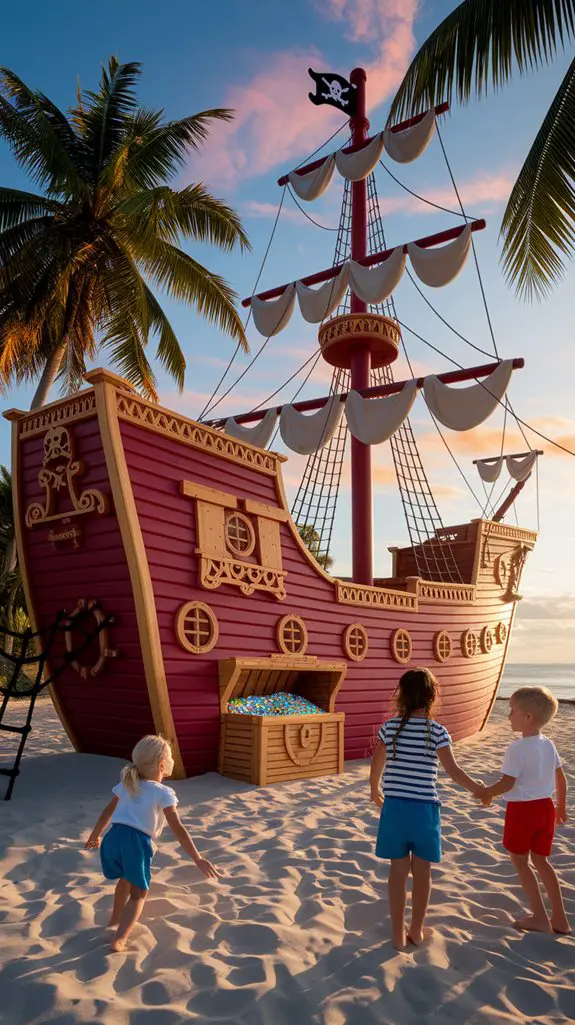
Transforming your outdoor space into a pirate ship playground captivates children’s imaginations while developing essential motor and social skills. Your little adventurers will navigate the high seas, search for buried treasure, and develop critical thinking as they solve clues and follow maps.
| Feature | Developmental Benefit |
|---|---|
| Rope ladder | Builds upper body strength |
| Treasure map station | Enhances spatial awareness |
| Hidden compartments | Develops problem-solving skills |
| Crow’s nest lookout | Improves balance and coordination |
| Buried treasure pit | Encourages cooperative play |
Include weatherproof containers with costume pieces like eye patches and bandanas to enhance imaginative play. Create a simple pulley system for raising and lowering the ship’s flag, teaching cause and effect relationships.
Remember, the best pirate playgrounds balance structured elements with open-ended play opportunities that grow with your child’s developing abilities. Additionally, incorporating creative DIY ideas can further enrich the play experience and stimulate children’s creativity.
Outer Space Exploration Stations

Blast off into the galaxy with an outer space exploration station that fuels children’s cosmic curiosity while supporting their physical and cognitive development.
Create a rocket ship climbing structure with slides that mimic re-entry to Earth, or install moon-rock stepping stones to enhance balance skills.
You’ll want to include a mission control panel with buttons, knobs, and screens where kids can practice fine motor coordination while role-playing as astronauts.
Add constellation identification games that teach astronomy concepts, and meteor shower ball pits that develop spatial awareness.
For sensory input, incorporate textured surfaces that represent different planets. Creating a sensory haven in your backyard can enhance the overall play experience.
Don’t forget to design low-gravity suspension areas where children can experience altered movement.
These cosmic play elements encourage problem-solving, scientific thinking, and imaginative play while building strength and coordination.
Dinosaur Dig and Prehistoric Playlands
Journey back millions of years with prehistoric playlands that engage children in paleontological adventures while building critical developmental skills.
Create sand pits where kids can unearth fossils, developing fine motor skills and scientific curiosity. Add dinosaur footprints that encourage hopping and balancing to enhance gross motor coordination.
Stock your prehistoric zone with paleontologist tools like brushes and magnifying glasses to promote detailed observation and patience.
Consider life-sized dinosaur models that children can climb on, fostering both physical strength and imaginative play. Incorporate a fossil identification station where youngsters match discoveries to charts, building cognitive pattern recognition.
For added sensory experiences, include textured dinosaur eggs and squishy “tar pits” that develop tactile discrimination.
These prehistoric elements transform ordinary play into an immersive learning environment that excites while educating.
Fairy Tale Castle Kingdoms
Magical castle kingdoms transport children into a world where fairy tales come alive through purposeful play design. You’ll create spaces where little knights and princesses develop social skills through collaborative storytelling and imaginative role-play.
| Feature | Developmental Benefit |
|---|---|
| Throne room | Decision-making, leadership skills |
| Secret passages | Problem-solving, spatial awareness |
| Drawbridge entrance | Shift cues, boundary understanding |
| Tower lookout | Perspective-taking, visual scanning |
Include fabric canopies and pennants in bright colors to define different play zones. Add tactile elements like plush thrones and textured “stone” walls to engage sensory exploration.
Mirrors encourage self-expression as children try on different characters and roles. These purposeful elements transform ordinary play into rich developmental opportunities where children construct their identities through fantasy.
Safari and Jungle Expedition Areas
Wild safari and jungle expedition areas invite children to explore untamed habitats while developing essential physical and cognitive skills through adventure-based play.
Transform your space with towering artificial trees, realistic animal figures, and suspended vines that encourage climbing and swinging. Include safari jeeps or boats that spark imaginative journeys through the savanna or down winding rivers.
Add sensory elements like textured surfaces resembling different terrains, animal track imprints, and gentle nature sounds. Consider low-maintenance artificial grass and soft rubber surfaces resembling mud or water.
These themed areas naturally promote wildlife education while children develop gross motor skills through “animal movement” activities.
They’ll practice balance on stepping stones, build strength swinging from vines, and enhance coordination maneuvering through bamboo obstacles—all while developing an early appreciation for biodiversity and conservation.
Underwater Ocean Discovery Worlds
Underwater ocean discovery worlds transport children to mesmerizing aquatic environments where imagination flows as freely as the simulated currents around them.
These immersive spaces feature vibrant sea creature replicas, bubbling water features, and textured surfaces mimicking coral reefs and ocean floors.
You’ll find sensory-rich elements like wave-inspired climbing structures, shell-shaped seating, and submarine playhouses that promote both gross and fine motor skills.
Consider incorporating interactive elements such as fishing games, water tables with sea creatures, and discovery zones with marine facts.
Blue and green lighting creates an authentic underwater ambiance, while fish mobiles dangling from ceilings complete the immersive experience.
These environments not only entertain but educate children about marine ecosystems, fostering environmental awareness while they develop essential social and physical skills through imaginative play.
STEM-Inspired Building and Maker Spaces
STEM-inspired building and maker spaces transform play areas into interactive laboratories where children become young scientists, engineers, and innovators. These environments foster critical thinking and problem-solving while children play with purpose.
You’ll witness your child’s curiosity explode as they explore materials and test ideas in a hands-on setting designed for discovery. Engaging in activities like fun vegetable gardening can also provide kids with an opportunity to learn about biology and sustainability while having fun in nature.
| Area Type | Skills Developed | Key Materials |
|---|---|---|
| Building Zone | Spatial reasoning | Blocks, LEGO, magnets |
| Coding Corner | Logical thinking | Robots, simple coding games |
| Science Station | Observation | Magnifiers, measurement tools |
| Engineering Lab | Problem-solving | Gears, pulleys, levers |
| Invention Hub | Creativity | Recyclables, craft supplies |
Include open-ended questions and rotating challenges that encourage children to hypothesize, test, and refine their ideas—the true essence of STEM learning through play.
Miniature Village and Role-Play Communities
Miniature villages and role-play communities bring the wider world down to child scale, creating environments where kids can step into adult roles and make sense of societal interactions.
When you design these spaces, include diverse buildings like post offices, grocery stores, and restaurants with child-sized equipment that mimics real functionality.
Stock these areas with props that support imaginative play—mail bags, play money, menus, and uniforms. You’ll notice children naturally practicing social skills, language development, and problem-solving as they negotiate roles and scenarios.
For maximum engagement, rotate themed elements seasonally and incorporate cultural diversity in your village design.
Consider adding wheelchair-accessible features and multilingual signage to promote inclusivity. These thoughtful additions guarantee your miniature community becomes a rich laboratory for social learning and emotional development.
Sports Arena and Active Play Zones
Sports arenas and active play zones transform ordinary play spaces into dynamic environments where children can develop gross motor skills while experiencing the joy of movement and friendly competition.
When designing your active play zone, focus on versatility and safety while encouraging physical development. You’ll notice children naturally gravitate toward spaces where they can run, jump, and test their abilities.
- Mini basketball courts with adjustable-height hoops for different ages
- Soft foam obstacle courses that can be reconfigured regularly
- Climbing walls with varying difficulty levels and colorful handholds
- Balance beam pathways that improve coordination and confidence
- Dedicated areas for yoga, dance, or martial arts practice
These active zones don’t just build physical strength—they foster teamwork, problem-solving, and emotional regulation through physical outlets and structured play opportunities. Additionally, incorporating family-friendly backyard entertainment options can enhance the overall experience and engagement for children and parents alike.
Conclusion
Whichever theme you choose, you’ll notice how your child’s development flourishes through purposeful play. They’ll build confidence scaling the castle towers, develop problem-solving skills in maker spaces, and strengthen social bonds in miniature villages. The theory holds true: when children engage in immersive, themed environments, they don’t just play—they learn, grow, and develop essential life skills while creating magical childhood memories.
