
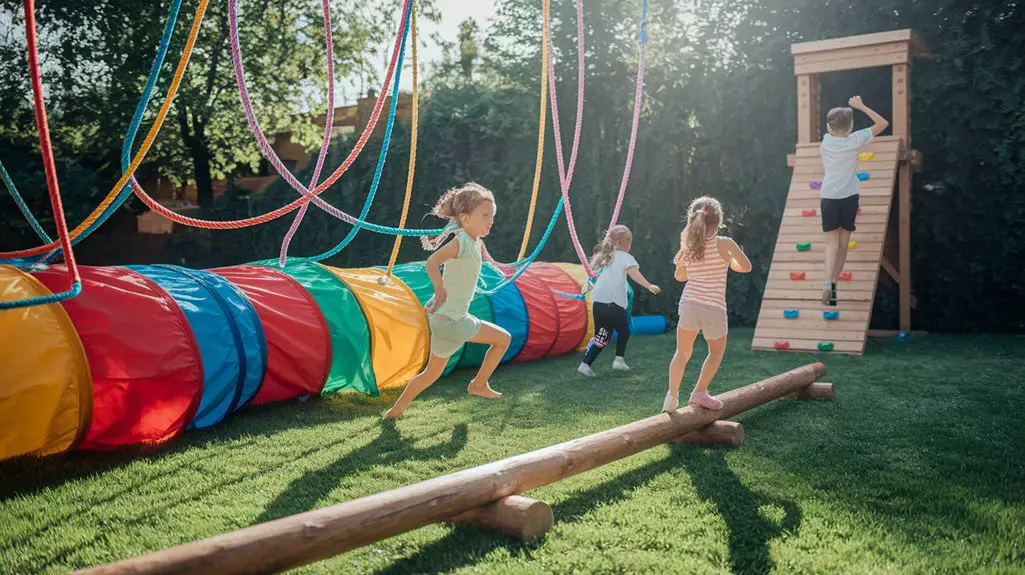
Like a playground waiting to be discovered, your backyard holds unlimited potential for your child’s development. You’ll find that obstacle courses transform ordinary outdoor spaces into adventure zones where kids can build strength, coordination, and problem-solving skills simultaneously.
These physical challenges can build confidence and give kids plenty of movement and sensory input. Ready to learn which obstacles will best suit your child’s age and abilities while maintaining proper safety standards?
On this page
The Benefits of Backyard Obstacle Courses for Child Development
While many parents focus on traditional playground equipment, backyard obstacle courses offer exceptional developmental benefits for children of all ages.
These dynamic play environments enhance gross motor skills through climbing, balancing, and jumping activities that strengthen core muscles and improve coordination.
Your child’s cognitive development also flourishes as they navigate courses, solving spatial problems and developing executive functioning skills. They’ll learn to assess risks appropriately while building resilience through challenging physical tasks.
Socially, obstacle courses create natural opportunities for cooperation when children design courses together or cheer each other on. This collaborative play builds communication skills and emotional intelligence.
For ideal development, incorporate varied textures, heights, and movement patterns that challenge your child’s proprioception and vestibular processing—critical systems for sensory integration.
DIY Tire and Rope Challenge Course

Creating a DIY tire and rope challenge course transforms ordinary backyard items into a therapeutic movement playground that supports your child’s physical development.
This sensory-rich environment builds proprioception, balance, and motor planning skills while providing heavy work input that calms and organizes the nervous system.
- Bury tires halfway in the ground to create stable stepping platforms with varied heights to challenge balance.
- Suspend a horizontal tire swing at knee height for crawling through, which develops cross-body coordination.
- Install a rope ladder between two trees at a 45-degree angle to improve hand strength and bilateral coordination.
- Add vertical rope climbs with knots every 12 inches for grip, anchored at both the top and bottom so the rope can’t loop around a child’s neck.
- Create a balance beam using a sturdy 4×4 post anchored firmly at a safe height of 12 inches.
Water-Based Obstacle Courses for Summer Fun

Summer heat provides the perfect opportunity to incorporate water elements into your backyard obstacle course, offering sensory regulation benefits alongside cooling relief. Create a sequence of water stations that challenge balance, coordination, and tactile processing while maintaining safety protocols. Additionally, implementing backyard activities can enhance children’s playtime experiences and keep them engaged.
| Water Station | Therapeutic Benefit | Safety Tip |
|---|---|---|
| Sponge Relay | Fine motor skills, hand strength | Non-slip surface underneath |
| Water Balloon Hurdles | Proprioceptive input, timing | 3-foot clearance between obstacles |
| Sprinkler Zigzag | Sensory integration, body awareness | Secure hoses away from running paths |
Always supervise children during water play and adjust difficulty based on developmental levels. For children with sensory sensitivities, introduce water elements gradually and provide towels nearby for comfort. Keep obstacle heights appropriate for your child’s physical capabilities.
Natural Element Courses Using Logs, Stones and Trees
Natural environments provide ideal settings for sensory-rich obstacle courses that support vestibular development and gross motor planning. When designing your course, incorporate elements that challenge balance, coordination, and spatial awareness while maintaining safety.
- Position flat rocks as stepping stones with appropriate distances based on your child’s stride length.
- Create balance beams using fallen logs secured firmly to prevent rolling.
- Designate trees for weaving patterns that develop spatial orientation skills.
- Stack smaller logs as hurdles at heights appropriate for your child’s developmental stage.
- Arrange large stones in clusters that require careful climbing with three-point contact.
Incorporating natural elements can also attract beneficial insects that enhance the overall health of your garden environment.
Always inspect natural elements for stability before use. Remove sharp edges from logs and verify trees used for activities are healthy with no dangerous branches.
Supervise younger children closely while encouraging older ones to assess risks independently.
Ninja Warrior-Inspired Backyard Challenges
Why not transform your backyard into a Ninja Warrior training ground where kids can develop upper body strength, coordination, and problem-solving skills?
Start with age-appropriate challenges like suspended rings, climbing ropes, and balance beams set at safe heights with proper landing surfaces.
Install a salmon ladder with adjustable pegs for older children to practice controlled jumping movements. Add timer elements to encourage self-improvement rather than competition.
Stepping stones and low balance obstacles help develop proprioception and vestibular function.
Always use impact-absorbing materials beneath climbing elements. Check equipment integrity daily and teach proper technique before attempting challenges.
For children with sensory processing differences, introduce obstacles gradually with guided support. These activities build confidence while strengthening core muscles essential for classroom posture and focus. Additionally, incorporating water features in play areas can provide a fun sensory experience that enhances physical activity.
Budget-Friendly Obstacle Course Ideas Under $100
Creating backyard obstacle courses doesn’t require expensive commercial equipment or elaborate setups. With some creativity and household items, you can design engaging activities that promote your child’s gross motor skills, balance, and coordination while keeping costs low.
- Use pool noodles ($1-2 each) as hurdles, balance beams, or slalom poles by securing them with garden stakes.
- Transform cardboard boxes ($0) into tunnels, stepping stones, or crawl-through challenges.
- Repurpose old tires ($0-5) as jumping stations or climbing elements (wash thoroughly first).
- Create balance challenges with 2×4 lumber scraps ($5-10) safely secured at ground level.
- Use playground balls ($5-10) for various skill stations like rolling, throwing, or carrying activities.
Always supervise children during play and check equipment stability before each use.
Seasonal Obstacle Course Variations for Year-Round Play
Keeping obstacle courses fresh throughout the year helps maintain children’s interest while developing different skills as seasons change. Adapt your backyard challenge with weather-appropriate modifications that guarantee safety while maximizing developmental benefits.
| Season | Activities | Developmental Focus |
|---|---|---|
| Spring | Puddle jumps, seed sack races | Balance, coordination |
| Summer | Water balloon tosses, slip-n-slide | Cooling strategies, sensory play |
| Fall | Leaf pile jumps, pumpkin rolling | Weight management, core strength |
| Winter | Snowball targets, snow tunnels | Cold tolerance, spatial awareness |
| Indoor | Pillow hurdles, taped floor paths | Adaptability, following directions |
Remember to examine all seasonal elements for safety hazards. Remove sharp sticks from leaf piles, verify snow structures are stable, and always supervise water activities. Seasonal changes provide natural opportunities to discuss weather safety while keeping physical activity consistent year-round.
Safety Considerations for Backyard Adventure Zones
When designing backyard adventure zones, safety must remain your top priority while still encouraging healthy risk-taking and exploration.
Create boundaries that protect children while allowing them to develop vital motor skills and confidence through appropriate challenges.
- Install proper surfacing materials like wood chips or rubber mulch under all climbing equipment (minimum 9-inch depth)
- Verify all structures are sturdy and regularly inspected for loose parts, splinters, or rust
- Create age-appropriate zones that separate toddler activities from more challenging obstacles for older children
- Remove hazards like low-hanging branches, protruding roots, or sharp edges in the play area
- Establish clear rules with your children about proper obstacle course usage and supervision requirements
Incorporating safe play zones can enhance children’s overall experience while minimizing the risk of injury.
Remember that safety doesn’t mean eliminating all risk—rather, it’s about creating an environment where children can safely test their limits.
Age-Appropriate Course Designs From Toddlers to Teens
As children develop at different rates, backyard obstacle courses must evolve to match their changing physical abilities, cognitive skills, and interest levels.
For toddlers (1-3), design simple pathways with soft surfaces, low balance beams (2-3 inches), and crawl-through tunnels.
Preschoolers (3-5) benefit from stepping stones, tire walks, and rope bridges under 12 inches high.
Elementary-aged children (6-10) can handle climbing walls (4-5 feet), swinging rope challenges, and timed race elements.
Add complexity with direction changes and multi-step obstacles.
Tweens and teens (11-17) need genuine physical challenges—ninja warrior-style components, cargo nets, and advanced balance elements.
Include competitive timing systems or cooperative elements requiring teamwork. Creative DIY Ideas can inspire unique design elements that enhance play and learning.
Always supervise appropriate to age, with constant supervision for youngest participants and periodic check-ins for teenagers.
Incorporating Learning Elements Into Physical Challenges
Physical activity and cognitive development can complement each other beautifully in backyard obstacle courses that deliberately incorporate learning elements.
You’ll enhance your child’s whole-brain development by designing challenges that exercise both body and mind simultaneously.
- Create stations with alphabet hurdles where kids must identify letters before jumping over them.
- Include counting activities such as “do five jumps on the balance beam, then seven hops through tires.”
- Add color-matching challenges where children collect and sort objects while maneuvering through the course.
- Incorporate directional instructions (left, right, forward, backward) to build spatial awareness.
- Design problem-solving elements where kids must figure out the correct path or sequence to proceed.
Always supervise these activities and adjust difficulty based on your child’s developmental stage to maintain both safety and engagement.
Conclusion
As you watch your child navigate these backyard challenges, you’re witnessing more than play—you’re seeing their personal journey unfold. Like the balance beam that steadies wobbly steps, these courses provide the foundation for development.
They’ll cross these small bridges now, building confidence that’ll carry them across life’s larger obstacles later. Create this safe haven where they’ll grow strong, capable, and resilient—one triumphant climb at a time.
