
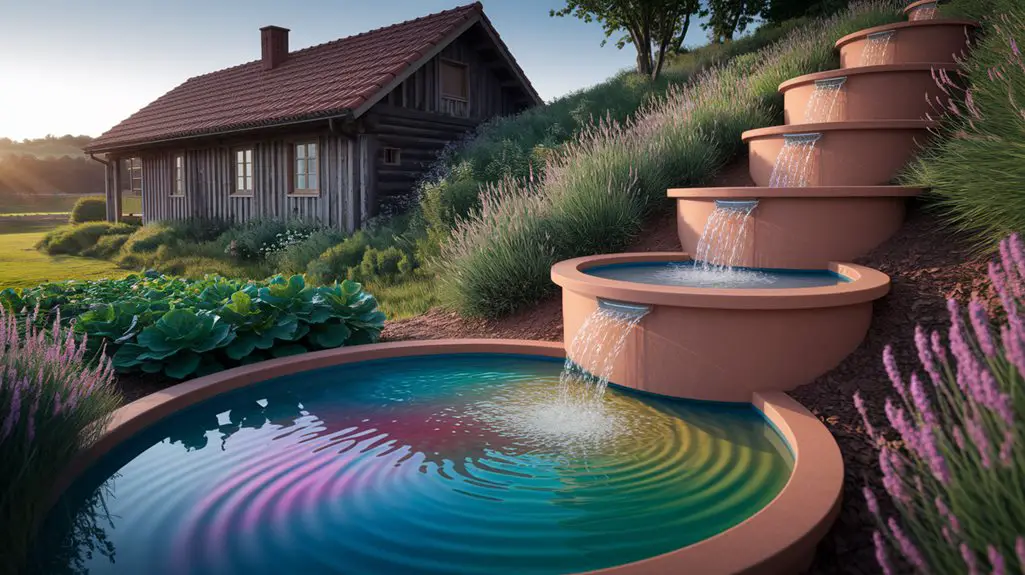
You’re facing rising water bills and increasing water restrictions while witnessing climate instability firsthand. Implementing a rainwater harvesting system offers a practical solution with real benefits: lower water costs, decreased municipal supply dependence, and enhanced environmental stewardship.
Every 1,000 square feet of roof sheds about 600 gallons per 1″ of rainfall—water that’s currently washing away. What specific applications could this free resource serve in your household ecosystem?
On this page
Understanding the Benefits of Rainwater Collection Systems
When implemented correctly, rainwater collection systems offer multiple quantifiable benefits for residential and commercial properties alike.
You’ll use less municipal water, lowering your utility bills. A 2,000-square-foot roof can collect approximately 1,200 gallons from just 1 inch of rainfall.
These systems provide water security during drought conditions and reduce stormwater runoff, lowering erosion and flooding risks.
Your harvested rainwater has no added chlorine and is naturally soft, which makes it ideal for irrigation.
Additionally, you’ll experience decreased infrastructure strain on aging municipal systems.
Modern collection systems with good filters produce water suitable for most non-potable uses with minimal maintenance. Furthermore, rainwater systems can enhance the overall aesthetic and functionality of your backyard, creating a sustainable landscape.
Essential Components for an Effective Harvesting Setup
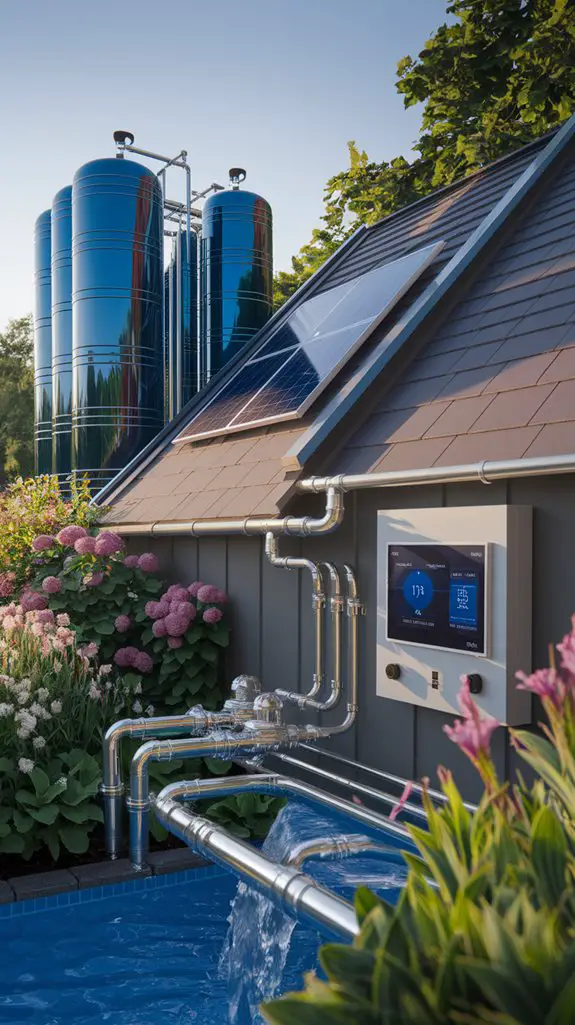
To establish a fully functional rainwater harvesting system, you’ll need several interconnected components working in precise coordination.
The primary collection surface—typically your roof—requires proper pitch (minimum 2°) and non-toxic materials to optimize water capture quality.
Your conveyance system must include properly sized gutters (5-6″ diameter for residential applications) and downspouts to channel water efficiently.
First-flush diverters send the dirtiest first runoff away from your tank, improving water quality.
Storage options range from polyethylene tanks (500-5000L capacity) to underground cisterns, with filtration consisting of: primary screening (1-5mm mesh), secondary filtration (20-50 microns), and optional UV purification for potable applications.
Distribution systems utilize gravity (1psi per 2.31 feet of elevation) or pumps (0.5-1.5HP) for pressurized delivery, while overflow mechanisms prevent system damage during heavy precipitation events.
DIY Installation Guide for Backyard Rain Barrels
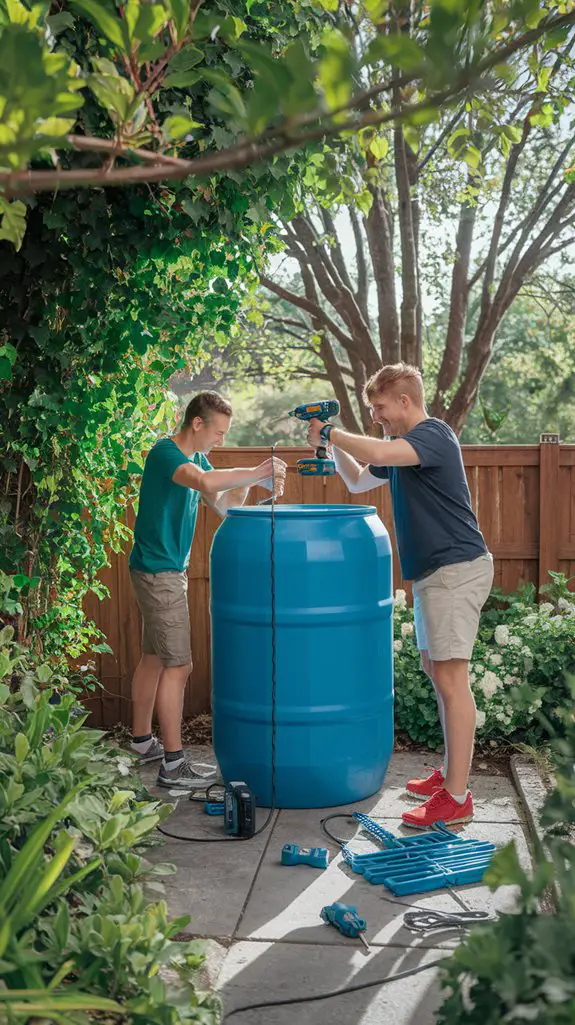
Installing a functional rain barrel system requires methodical planning and precise execution to achieve maximum collection efficiency.
Begin by selecting a location that captures runoff from your largest downspout, typically yielding 0.6 gallons per square foot of roof area during a 1-inch rainfall.
Position your barrel on a level, elevated platform (12-24 inches high) to increase water pressure and stability.
Prepare the downspout by measuring 4 inches above your barrel’s height, then cut and attach a diverter using stainless steel screws.
Install a tight-fitting lid with 1/8-inch mesh screen to prevent mosquito breeding and debris infiltration.
Connect a spigot 3-4 inches from the barrel’s base, applying silicone sealant around fittings.
Incorporating a rain barrel into your landscape can also enhance the beauty of your garden by creating a rain garden.
Test your system by checking for leaks during the next rainfall.
Creative Storage Solutions for Collected Precipitation
Beyond conventional rain barrels, how can homeowners maximize their precipitation storage capacity?
Consider subterranean cisterns (500-5,000 gallons), which utilize otherwise unused space while maintaining consistent water temperatures. These systems save yard space compared to above-ground alternatives.
Modular tank systems offer expandability with interconnected units (50-100 gallons each), allowing incremental capacity increases as needed.
For limited spaces, slim-profile tanks (24″ depth) can be installed against walls, capturing 2.3 gallons per square foot of footprint.
Repurposed IBC totes (275-330 gallons) provide cost-effective solutions at $0.30-$0.45 per gallon of capacity.
Decorative options include rainwater columns (30-75 gallons) and bench-integrated storage (50-150 gallons), which serve dual purposes while maintaining aesthetic appeal.
Additionally, incorporating rainwater filtration systems can enhance the quality of stored water, making it suitable for various household uses.
Practical Applications for Harvested Water Around Your Home
Harvested rainwater provides numerous practical applications throughout residential properties, extending its utility far beyond mere collection and storage.
You’ll find it ideal for irrigation, cutting municipal water use when implemented systematically. Garden applications yield excellent results as rainwater’s slightly acidic pH (around 5.5-6.5) enhances plant nutrient absorption compared to chlorinated municipal water.
For household usage, harvested precipitation can supply toilets and washing machines, two of the biggest indoor water uses, where local plumbing codes allow it. Properly filtered rainwater is suitable for showering and, with advanced purification systems, even drinking water in compliant jurisdictions.
Vehicle washing, outdoor cleaning, and pool maintenance represent additional high-volume applications, collectively saving 1,500-2,500 gallons monthly for average households—significantly reducing utility costs while efficiently utilizing a naturally renewable resource. Implementing effective rainwater filtration ensures that your harvested water meets safety standards for various uses.
Conclusion
By embracing rainwater harvesting, you’re not just collecting water—you’re tapping into nature’s reservoir that flows freely above your home. Using rainwater can trim your water bill, and each 1,000 square feet of roof sheds roughly 600 gallons in a one-inch rain that you can keep out of the storm drain. Implement these techniques now to transform your property into a self-sustaining ecosystem within your local watershed network.
