Hopscotch rules are simple: toss a marker into square 1, hop through the court without landing in that square, and pick the marker up on the way back. Hop on one foot in single squares and land with one foot in each side-by-side square. Step on a line, lose your balance or miss the toss and your turn ends. The first player to finish squares 1 through 10 wins.
It works for one player or a whole group, and kids can start at about age 3. All you need is chalk, a flat patch of pavement and a marker for each player.
On this page
What You Need
- Chalk to draw the court. A stick in the dirt works too.
- A marker for each player. A beanbag, a flat stone or a bottle cap. Playworks, the recess nonprofit, uses beanbags, and so would I: a beanbag lands and stays put instead of bouncing out.
- Smooth, flat pavement away from cars, like a patio (see the safety tips).

Any washable sidewalk chalk works. I’d pick a jumbo set in a bucket with a handle, like the one above: thick sticks draw lines kids can see, and the bucket makes cleanup quick.
How Big Is a Hopscotch Court?
There’s no official size. WebMD suggests squares of about 1 foot, and school courts are smaller than most parents expect: two playground-painting stencils measure 100 by 30 and 106 by 31 inches, about 8 to 9 feet long and 2½ feet wide.
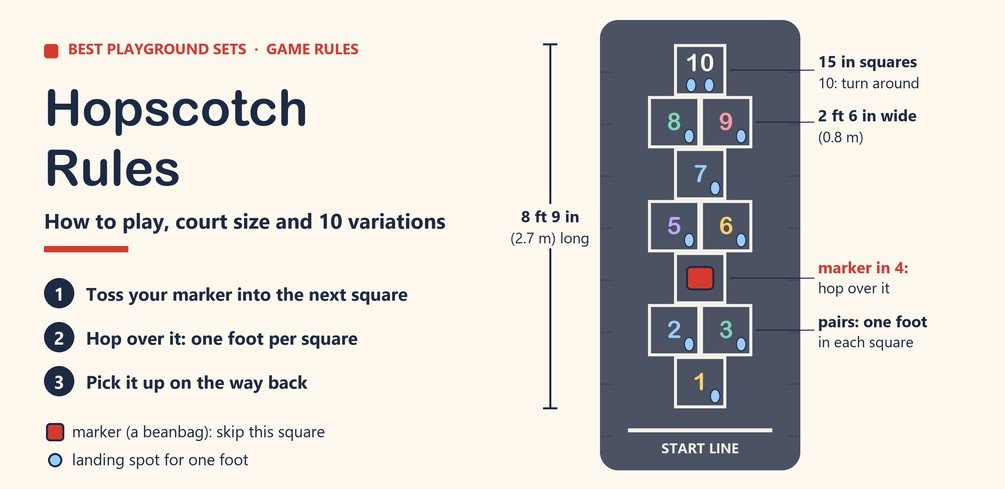
The diagram at the top shows the classic layout: 1, then 2 and 3 side by side, 4, then 5 and 6, 7, then 8 and 9, and 10 at the end. That’s seven rows, so one square’s size sets the whole court:
| Square | Court length | Court width |
|---|---|---|
| 12 in (30 cm) | 7 ft (2.1 m) | 2 ft (0.6 m) |
| 15 in (38 cm) | 8 ft 9 in (2.7 m) | 2 ft 6 in (0.8 m) |
| 18 in (46 cm) | 10 ft 6 in (3.2 m) | 3 ft (0.9 m) |
I’d use 15-inch squares for most kids, 12 inches for preschoolers and 18 inches for older kids and grown-ups. Draw a start line a step in front of square 1.
Some courts add a half-circle “home” past 10 for turning around. Here, 10 does that job.
How to Play Hopscotch
Taking a Turn
- Stand behind the start line and toss your marker into square 1. It has to land inside the square without touching a line or bouncing out. Some rule sheets give you two tries.
- Hop over the square with the marker. You never land in it.
- Hop up the court: one foot in each single square, and one foot in each half of a side-by-side pair. If the marker is in half of a pair, hop on one foot into the other half.
- At 10, put both feet down, turn around and hop back the same way.
- Stop in the square just before your marker, pick it up while balancing, and hop the rest of the way out.
- On your next turn, toss the marker into square 2, then 3, and so on up to 10.
What Ends Your Turn
- Your marker lands on a line, outside the court or in the wrong square.
- You step on a line or outside the court.
- You lose your balance, or put two feet or a hand down in a single square.
- You land in a square that holds a marker, yours or anyone else’s.
When your turn ends, the next player goes. Next time, you toss for the square you missed.
Winning
The first player to clear all 10 squares wins. For a harder game, anyone who misses starts back at square 1.
10 Hopscotch Variations
These ten come from recess programs, a Brooklyn museum and hopscotch’s many national versions.
1. No-Marker Hopscotch
Playworks’ easiest version: skip the marker and just hop the court, turn at 10 and hop back. A chalk court also makes a good balance station in a backyard obstacle course.
2. Speed Hopscotch
Another Playworks idea: set a time limit, or time each run and try to beat it. I’d keep the line rule, or it turns into a sprint.
3. Kick the Stone
In Iran’s laylay, you kick a flat stone or peg into the next square as you hop, and if the stone or your foot lands on a line, your turn is over. With kids, I’d kick a beanbag instead.
4. Heaven and Hell
In Germany, Austria and Switzerland it’s Himmel und Hölle. The first square is Earth, the second-to-last is Hell and the last is Heaven. You kick the stone forward square by square, and neither you nor the stone may stop in Hell.
5. Escargot (Snail Hopscotch)
The French snail court is a chalk spiral of numbered spaces, 1 on the outside and a blank “safe” space in the middle. Hop on one foot to the center, rest, and hop back out without switching feet.
A clean trip earns your initials in any one space: you can put both feet down there, but everyone else must hop over it. Play until nobody can get through. Whoever owns the most spaces wins.
6. Piko
The Filipino version is played on a court shaped like a cross, a person or four petals, and players capture boxes that become off-limits to everyone else. My piko game rules cover the pamato toss and how players claim their homes.
7. Kith-Kith
This Indian version has two columns, 1 and 2 side by side up to 7 and 8, then a long home space. Right-hand squares take your right foot and left-hand squares your left.
Where two open squares sit side by side, land with one foot in each. Wrong foot, and your turn is over.
8. Days of the Week
A Dutch version, as the Old Stone House museum in Brooklyn teaches it: a blank start square, then Monday through Sunday, with Thursday and Friday side by side. Call out each day as you land, and a wrong day ends your turn. You can rest on two feet in Sunday, except when your marker is there.
9. Category Hopscotch
Write a category in each square, like ice cream flavors, and shout an example as you land in each one. The UNBORED Adventure book’s version, potsy (an old New York name for hopscotch), adds a ball bounce in every square. Poland’s klasy has no marker at all: players name colors or flowers as they jump.
10. Hopscotch Math
The University of Minnesota’s Math and Numeracy Lab suggests chalking question marks in place of a few numbers, so kids call out the missing number as they land. Another of its courts uses triangles in groups of three, and kids pick up the marker at every third number: counting by threes without calling it homework.
Hopscotch Safety Tips
- Keep the court away from cars. Safe Kids Worldwide says to choose play areas away from parked or moving vehicles, and if kids do play in the driveway, to block it off with trash cans or cones.
- Put the chalk away afterward. Safe Kids lists chalk among the toys to clear off the driveway so it doesn’t lure kids back, and says to walk all the way around the car before you drive.
- Check the surface. Flat and dry, with no gravel or big cracks. In the fall I’d sweep the court first, because wet leaves are slick.
- Beanbags around little ones. The American Academy of Pediatrics lists coins and marbles as choking hazards, and most children who die from choking are under 5.
One house rule I’d add: kids who are waiting stand behind the start line, not beside the court, so nobody lands on a foot.
Frequently Asked Questions
Can you play hopscotch indoors?
Yes. Mark the court with masking or painter’s tape on a hard floor or carpet, and use a beanbag or a rolled-up pair of socks as the marker. It’s an easy game for a cold or rainy afternoon.
What age can kids start hopscotch?
Around 3. The Genius of Play, from the Toy Association, lists it for ages 3 and up. Start with the no-marker version and add the toss once they can hop a few times on one foot.
Why is it called hopscotch?
Not because of Scotland. “Scotch” is an old word for a line scratched into the ground. English records from the late 1600s call the game “Scotch-hoppers.” Stories that Roman soldiers played it have no evidence behind them, and the game can’t be traced back before the 1500s.
Final Thoughts
Chalk a 1-to-10 court, hand out beanbags and agree on the house rules before the first toss. Once kids have the classic game down, the snail court and Heaven and Hell are the two I’d try next.
Next, read my capture the flag variations for a game that uses the whole yard.
Please be careful and use at your own risk
None of the authors, contributors, administrators, or anyone else connected with BestPlaygroundSets, in any way whatsoever, can be responsible for your use of the information contained in or linked from these web pages.
