
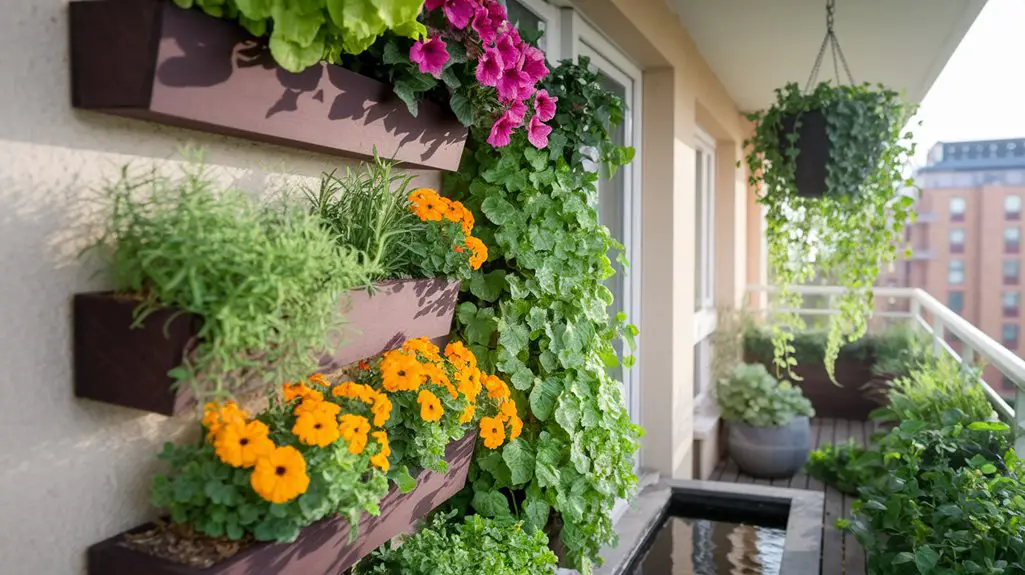
Limited garden space needn't restrict your growing ambitions. You'll find that vertical gardening transforms unused wall areas, railings, and corners into productive cultivation zones. By directing plant growth upward rather than outward, you're maximizing photosynthetic surface area while minimizing footprint.
Modern vertical systems accommodate everything from culinary herbs (Thymus vulgaris, Ocimum basilicum) to decorative specimens (Epipremnum aureum, Hedera helix). The following five techniques offer scientifically-sound solutions for constrained environments.
On this page
Wall-Mounted Pocket Planters for Herbs and Greens
When spatial constraints limit traditional gardening options, wall-mounted pocket planters provide an efficient solution for cultivating culinary herbs and leafy greens. These vertical systems maximize photosynthetic potential while minimizing footprint requirements. Additionally, incorporating stunning vertical garden ideas can enhance the overall aesthetic appeal of your outdoor space.
Select fabric pockets with moisture-resistant backing to prevent wall damage. Position your installation where plants will receive 4-6 hours of direct light for Mediterranean herbs like Rosmarinus officinalis (rosemary) and Thymus vulgaris (thyme). North-facing installations benefit shade-tolerant species such as Mentha (mint) varieties and Melissa officinalis (lemon balm).
For best growth, implement a drip irrigation system with timer controls. This guarantees consistent soil moisture levels—critical for shallow-rooted species like Ocimum basilicum (basil) and Lactuca sativa (lettuce).
Employ a diluted hydroponic nutrient solution (1:4 ratio) weekly to compensate for limited soil volume.
Hanging Basket Systems for Trailing Plants
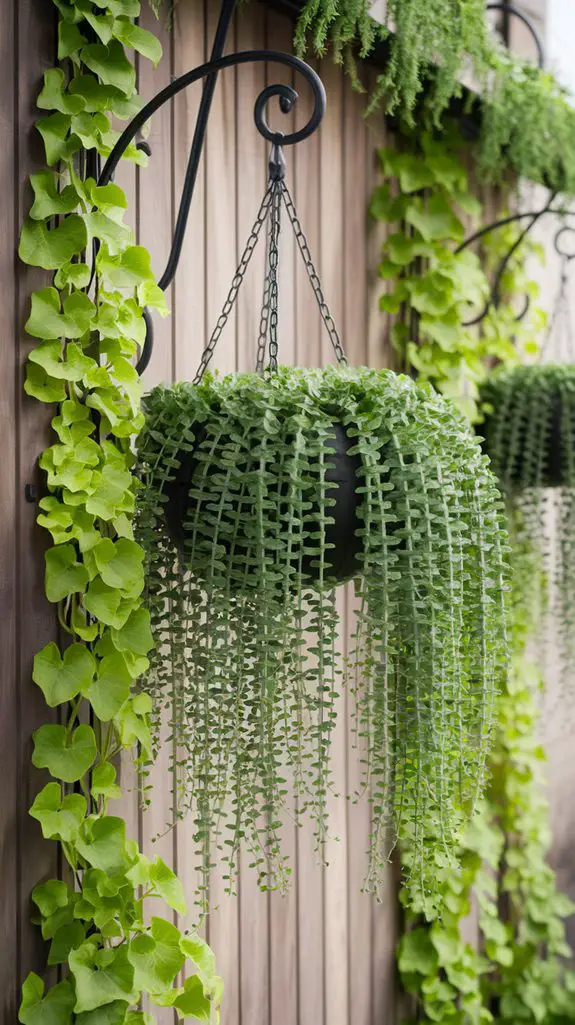
Hanging basket systems offer three distinct advantages for cultivating trailing plant species in spatially restricted environments. They utilize vertical airspace, create cascading visual aesthetics, and provide ideal drainage conditions for epiphytic specimens.
You'll maximize photosynthetic potential by positioning baskets at varying heights, ensuring each Tradescantia, Senecio rowleyanus, or Epipremnum aureum receives appropriate light exposure.
Select mesh or wire containers for superior aeration of root systems and prevention of pathogenic fungi proliferation.
For ideal performance, implement a tiered arrangement with drought-tolerant species (Dischidia, Hoya) positioned highest, while moisture-loving varieties (Columnea, Aeschynanthus) remain at lower elevations to capitalize on gravitational water distribution.
Incorporate slow-release fertilizer pellets within coconut coir substrate to maintain nutritional equilibrium without frequent intervention. Additionally, consider the vertical gardening techniques that can enhance your overall design and plant health.
Vertical Pallet Gardens: Upcycling for Urban Spaces
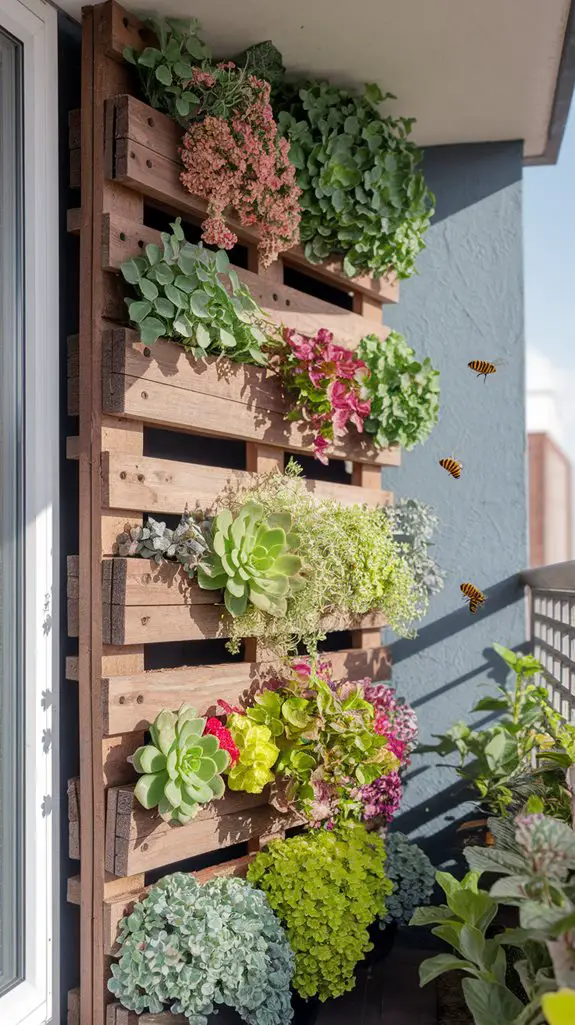
Wooden pallets, once relegated to industrial shipping applications, now serve as ideal structures for vertical cultivation systems in constrained urban environments.
You'll need to sanitize reclaimed pallets with a 10% bleach solution to eliminate potential pathogens before installation. The vertical orientation enhances photosynthetic efficiency while minimizing spatial requirements.
For successful pallet gardening implementation:
- Select shallow-rooted cultivars such as *Lactuca sativa* varieties, *Fragaria* species, and drought-tolerant *Sedum* specimens.
- Install microirrigation systems with pressure-compensating emitters (2L/hour) to guarantee uniform moisture distribution.
- Apply time-release fertilizer (14-14-14 NPK) at 50% standard application rate due to restricted root volume.
Position your completed structure against south-facing surfaces in northern hemispheres to maximize photosynthetically active radiation exposure, enhancing optimal plant metabolic processes. Additionally, incorporating vertical garden solutions can further enhance your balcony's aesthetic and functional appeal.
Trellises and Climbing Plant Supports for Vines
Trellises and climbing supports represent advanced vertical cultivation infrastructure that maximizes three-dimensional growing space while complementing the aesthetic appeal of confined environments.
These structures facilitate natural tendril attachment mechanisms through specialized components like twine grids, metal lattices, and bamboo frameworks.
You'll find that hedera helix (English ivy) performs best on moss-lined structures, while cucurbitaceae species require robust frameworks capable of supporting substantial fruit weight.
Install diamond-pattern wire mesh against walls for passiflora (passion flower) cultivation, ensuring 1-2 cm gaps for tendril attachment. For leguminous climbers, implement tension wire systems with 15 cm vertical spacing.
When selecting materials, consider plant-specific requirements: copper wire inhibits fungal proliferation but may cause toxicity in certain species; untreated bamboo provides sustainable support but necessitates annual replacement. Additionally, vertical gardening techniques can offer innovative solutions for maximizing space even further in small yards.
Stackable Container Gardens for Maximum Yield
Stackable container systems offer three distinct advantages for spatial efficiency: vertical stratification, modular reconfiguration, and graduated light optimization.
You'll maximize your growing potential by leveraging vertical space while maintaining accessibility for plant maintenance. These systems particularly benefit shallow-rooted crops like lettuce (Lactuca sativa), strawberries (Fragaria × ananassa), and herbs.
- Soil Volume Management – Allocate substrate depth according to root morphology; 4-6 inches for herbs, 8-12 inches for fruiting plants.
- Hydration Dynamics – Implement gravitational irrigation systems where upper containers drain into lower receptacles, so water from the top level also waters the plants below.
- Photosynthetic Positioning – Arrange sun-loving Solanaceae at superior levels, shade-tolerant Lamiaceae at median positions, and Apiaceae at lower tiers.
You'll need to rotate containers periodically to guarantee uniform growth patterns across all stratification levels. Additionally, vertical gardening techniques can significantly enhance your ability to grow a diverse range of plants in limited spaces.
Conclusion
Vertical gardening systems maximize your cultivation potential through strategic spatial utilization. You'll enhance growth by selecting appropriate structures for each plant's morphology: herbs in pocket planters, vining species on trellises, trailing specimens in hanging baskets, shallow-rooted varieties in pallets, and diverse taxa in stackable containers.
As Capability Brown might text, "LOL, vertical's the only way to maximize photosynthetic efficiency in confined urban environments." Implement these techniques to achieve peak yield despite spatial constraints.
