

You’re considering diatomaceous earth for your pest control needs, but effectiveness hinges on proper technique. This natural silica-based powder works through physical action rather than chemical toxicity, making it an appealing option for environmentally-conscious homeowners.
DE’s microscopic sharp edges damage insects’ exoskeletons upon contact, yet many applications fail due to three common mistakes. Understanding the science behind correct application methods, strategic placement, and necessary safety protocols will determine whether your DE treatment succeeds or disappoints.
On this page
Proper Application Methods for Effective Pest Management
While diatomaceous earth (DE) offers significant pest control benefits, improper application methods can substantially reduce its efficacy against target organisms. You’ll achieve ideal results by applying DE as a thin, even layer rather than in thick piles. Target application zones include cracks, crevices, and pest pathways where insects travel.
For indoor applications, use a powder duster to distribute DE in a fine coating of 1-2mm thickness.
When treating outdoor perimeters, apply during dry conditions, as moisture renders DE temporarily ineffective by compromising its desiccant properties.
Reapplication is necessary after precipitation events or household cleaning. Always wear respiratory protection during application, as DE’s silica particles can irritate lung tissue.
For crawling insects, create complete barrier lines they can’t circumvent, ensuring thorough coverage along baseboards, window sills, and door thresholds.
Strategic Placement in High-Traffic Pest Areas
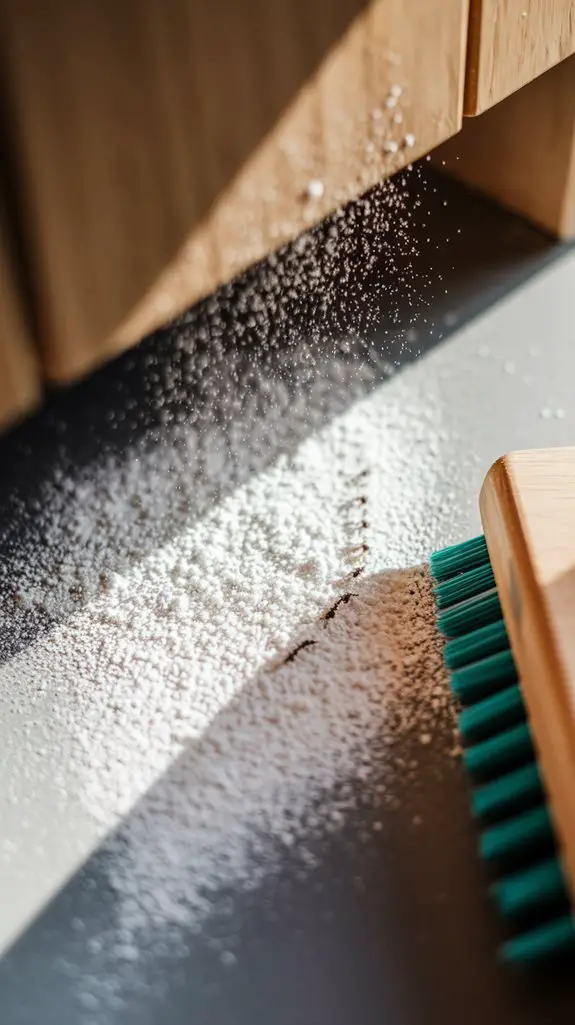
Although diatomaceous earth provides broad-spectrum pest control capabilities, strategic placement in high-traffic pest areas greatly enhances its effectiveness. Focus your application on known pest entry points, including doorway thresholds, window sills, foundation cracks, and utility line penetrations.
Identify pest pathways by monitoring for droppings, grease marks, or disturbed dust. Apply DE in thin, continuous lines (1/16″ to 1/8″ depth) along baseboards, behind appliances, under sinks, and around garbage receptacles. For crawling insects, create perimeter barriers around targeted zones rather than broadcasting throughout the space.
Ensure placement in dry locations, as moisture compromises DE’s mechanical action. Reapply after cleaning or when powder becomes visibly disturbed.
Target application during nocturnal pests’ inactive daylight hours for maximum contact probability during their active periods.
Safety Considerations When Using Diatomaceous Earth

Properly implementing safety protocols is paramount when working with diatomaceous earth, regardless of its natural origin. Always wear an N95 respirator when applying DE to prevent inhalation of crystalline silica particles, which can irritate lung tissue with prolonged exposure.
Don protective gloves and eye protection to minimize direct contact with skin and mucous membranes. Apply DE when air movement is minimal to prevent airborne dispersion. Keep children and pets away from treated areas until the powder has settled.
Use food-grade DE for indoor applications, particularly in kitchens or areas where food is prepared. Store unused product in airtight containers in dry locations away from moisture, which reduces its efficacy.
When removing applications, vacuum with a HEPA filter rather than sweeping to minimize respiratory exposure. Wash hands thoroughly after handling, even when using protective equipment.
Conclusion
You’ll achieve ideal pest control by applying DE in 1-2mm layers, targeting pest pathways with precision. Haven’t you observed how strategic placement dramatically enhances effectiveness?
Always prioritize safety protocols—wearing an N95 respirator prevents silica inhalation and potential respiratory complications. For sustained efficacy, implement a systematic reapplication schedule following precipitation or cleaning procedures, and maintain consistent monitoring to quantify pest population reduction and adjust application methodology accordingly.
