
Narrow spaces challenge your landscaping creativity, but they don’t have to compromise style or function. You’ll find that thoughtful walkway design transforms these tight areas into enchanting pathways that feel more spacious than they truly are.
Whether you’re working with a side yard, urban garden, or slim entrance corridor, several design approaches can maximize both visual appeal and practicality. The right combination of layout, materials, and optical elements will turn your narrow passage from an afterthought into a standout feature.
On this page
Straight-Line Paths for Maximum Efficiency
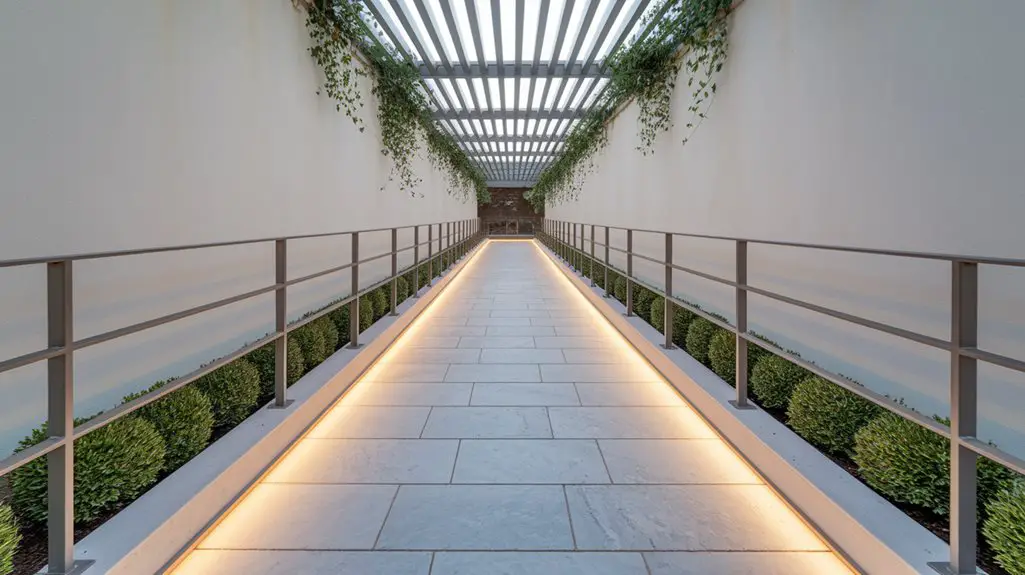
When maneuvering through narrow spaces, straight-line paths deliver the most efficient solution for walkway design.
You’ll maximize usable square footage while creating a clean, unobstructed route from point A to point B.
For ideal functionality, maintain a consistent width of at least 30 inches throughout the path, ensuring wheelchair accessibility where possible.
Select materials that visually elongate the space—linear pavers, narrow planks, or continuous concrete strips all reinforce directional flow.
Incorporate subtle lighting along path edges to enhance safety without consuming valuable width.
Consider integrating vertical elements like tall, slim plants or wall-mounted features that draw the eye upward, creating an illusion of spaciousness.
Remember that every curve sacrifices space, so in narrow corridors, embrace linearity to preserve both function and form. Additionally, opting for low-maintenance materials can help busy homeowners keep their walkways looking pristine without additional effort.
Diagonal Patterns to Create Depth Illusion
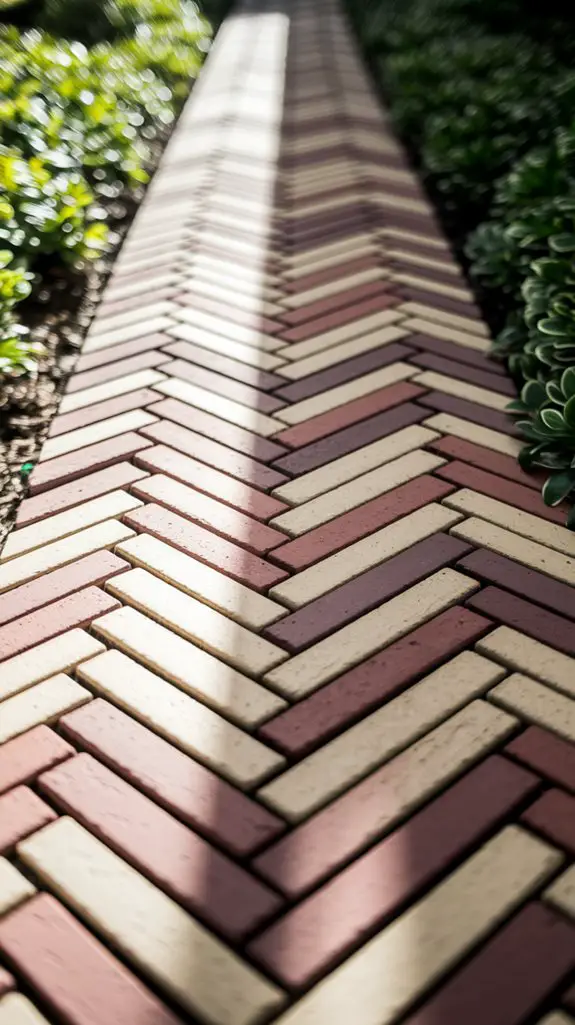
Unlike straight paths, diagonal patterns can visually expand narrow walkways by tricking the eye into perceiving greater width and depth.
When you install pavers or tiles at a 45-degree angle to the path’s main direction, you create dynamic sightlines that extend beyond the physical boundaries.
For maximum effect, choose elongated materials like plank pavers or rectangular stones. The diagonal orientation forces visual movement across the walkway rather than straight down it, making the space appear broader than its actual dimensions.
Enhance this illusion by incorporating contrasting border materials that frame the diagonal pattern. Light-colored materials will amplify the effect, especially in shaded areas.
Consider herringbone or chevron arrangements for sophisticated variations that maintain the optical advantages while adding textural interest to your narrow passageway. Additionally, using creative garden pathway design ideas can further enhance the aesthetic appeal and functionality of your outdoor space.
Curved Walkways for Visual Interest
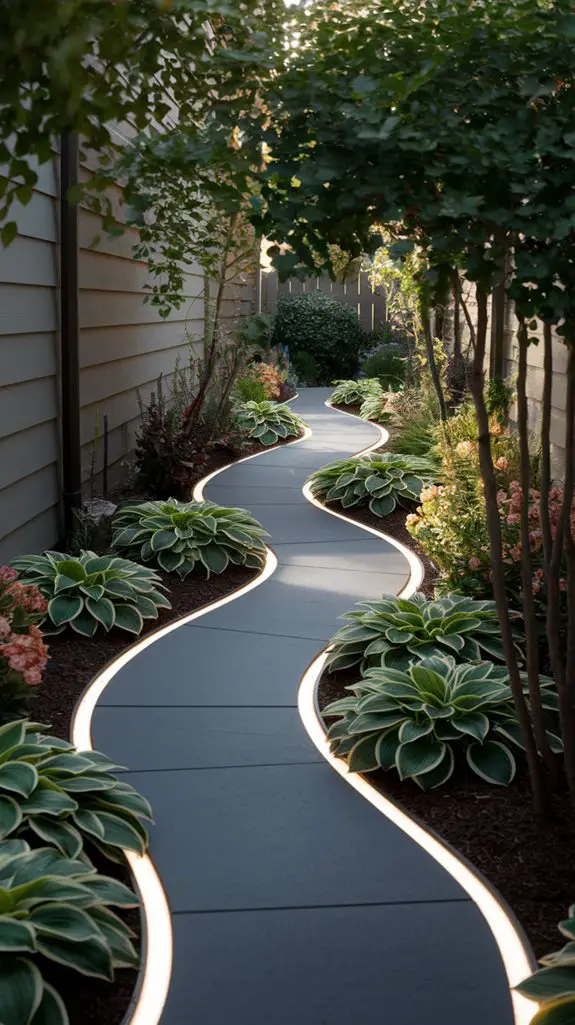
While straight pathways efficiently connect points A and B, curved walkways transform narrow spaces into journeys of discovery. These gentle arcs create visual rhythm that draws the eye forward while making the area appear wider than it truly is.
You’ll find that S-curves work particularly well in confined spaces, as they slow movement and encourage appreciation of surrounding plantings. Position focal points at curve junctions to maximize this effect.
Consider materials that enhance the fluidity—rounded cobblestones, flexible metal edging, or bordered gravel. For tight passages between buildings, a subtle curve of just 15-20 degrees can break monotony without sacrificing functionality.
Integrate low lighting along the inner curve to amplify spatial depth at night, effectively doubling the walkway’s visual interest. Additionally, incorporating decorative gravel can create a striking contrast that enhances the overall aesthetic of the pathway.
Stepping Stone Designs for Narrow Gardens
Stepping stones offer an elegant solution for narrow garden pathways where continuous paving might overwhelm the space.
You’ll find they create visual rhythm while preserving more ground area for planting between each step.
Place stones 24-28 inches apart for comfortable walking cadence, adjusting slightly for your stride length.
Circular stones create a playful feel, while rectangular or irregular shapes can establish more formal or naturalistic aesthetics respectively.
For stability, set each stone on a 2-inch sand base and guarantee they’re level with surrounding soil.
Consider materials that complement your home’s architecture—bluestone for traditional settings, cast concrete for modern spaces, or reclaimed materials for eco-friendly designs.
Install low-growing groundcover between stones—creeping thyme or Irish moss—to soften edges and create an integrated look within your narrow garden landscape.
Vertical Elements to Complement Slim Pathways
When designing narrow walkways, incorporating vertical elements creates essential dimension that draws the eye upward, effectively countering spatial limitations. Vertical features add visual interest while maximizing your limited horizontal footprint. Additionally, choosing eco-friendly options for vertical elements can further enhance the sustainability of your garden pathways.
| Element | Benefits | Installation Difficulty | Cost |
|---|---|---|---|
| Trellises | Privacy, plant support | Medium | $$$ |
| Wall-mounted planters | Space-saving greenery | Low | $$ |
| Slim arbors | Defined junction points | High | $$$$ |
| Vertical lighting | Safety, evening drama | Medium | $$$ |
Select vertical elements that complement your pathway’s function and aesthetic. Wall-mounted fixtures work exceptionally well along fences or buildings. For freestanding paths, consider flanking with narrow columnar trees or ornamental grasses that provide movement and seasonal interest without encroaching on walking space.
Material Combinations for Narrow Space Appeal
Material selection becomes critical in narrow walkway design, where thoughtfully combined textures and surfaces can create visual interest without overwhelming limited space.
You’ll want to balance complementary materials that visually expand the corridor while maintaining cohesion with surrounding architecture.
Consider these dynamic pairings for maximum impact:
- Contrasting borders: Frame light-colored pavers with dark stone edging to create definition and perceived widening.
- Alternating patterns: Incorporate herringbone brick sections between concrete segments to break visual monotony.
- Textural shifts: Blend smooth flagstone with crushed gravel portions to signal different functional zones.
When selecting materials, prioritize permeability for drainage solutions in confined spaces. Additionally, using light-reflecting surfaces positioned strategically between darker elements creates rhythm and movement, drawing the eye forward through the pathway rather than focusing on its width limitations.
Lighting Solutions for Tight Walkways
Lighting transforms narrow walkways from potentially hazardous corridors into inviting pathways that guide movement while creating an illusion of expanded space.
When selecting fixtures, prioritize low-profile options like LED strip lights recessed into side walls or step edges to eliminate trip hazards while providing directional illumination.
Consider strategic placement of downlights at regular intervals rather than a single bright source that creates harsh shadows. Motion-activated lighting conserves energy while ensuring your path illuminates exactly when needed.
For maximum spatial benefit, install uplights against walls to draw the eye upward, effectively “lifting” the perceived ceiling of your outdoor space.
Solar-powered options eliminate the need for complex wiring in retrofit situations, while color-temperature selection (warm 2700K for cozy ambiance, cooler 4000K for security) lets you customize the walkway’s nighttime character.
Space-Saving Border Ideas for Garden Paths
Beyond illuminating your pathway, the right borders can maximize narrow walkway functionality without consuming precious space.
Select vertical elements that create definition while maintaining the path’s visual width. Implement borders that serve dual purposes—containing your walkway materials while adding aesthetic appeal.
- Living edges – Plant low-growing, compact species like creeping thyme or dwarf mondo grass that stay within bounds while softening hardscape shifts.
- Embedded lighting – Install flush-mounted solar markers or recessed strip lights that define borders without physical barriers.
- Slim retainers – Use metal edging, narrow brick soldiers, or embedded stone slivers set flush with ground level to create clean lines without width-consuming barriers.
Choose materials in colors that complement your pathway, creating cohesive flow through tight spaces. Additionally, consider incorporating eco-friendly solutions that enhance both functionality and sustainability in your garden path design.
Optical Tricks to Visually Widen Narrow Walkways
When dealing with confined walkways, visual perception can be manipulated to create an illusion of greater width.
Implement horizontal patterns in your paving materials—stripes or rectangular pavers laid perpendicular to the path’s direction draw the eye outward, suggesting expansiveness.
Lighting plays an essential role.
Install low-level fixtures along both sides to illuminate the full width, or use uplighting on adjacent features to create depth.
Consider integrated LED strips along the walkway edges to define boundaries while expanding perceived space.
Color manipulation is equally effective—lighter pavers reflect more light and create openness.
Incorporate mirrors or reflective elements at path endpoints to extend visual perspective.
Finally, graduate the width subtly from entrance to exit, creating a forced perspective that tricks the eye into perceiving uniform width throughout. Additionally, incorporating rustic pathway options can enhance the charm of your narrow walkway while maintaining functionality.
Conclusion
With these narrow walkway designs, you’ll transform constricted areas into functional, visually appealing pathways. By implementing straight lines for efficiency, curves for interest, or diagonals for perceived depth, you’re maximizing limited space.
Haven’t you noticed how stepping stones and vertical elements create dimension without overwhelming? Strategic material selection, thoughtful lighting, and clever optical illusions further enhance your pathway’s functionality while creating an illusion of width that complements your overall landscape design.
