

While thousands of households embrace rainwater harvesting, many systems fail due to neglect rather than design flaws. You’re investing in both environmental sustainability and financial savings when you collect rainwater, so proper maintenance is vital to protect that investment.
Regular cleaning, consistent water quality monitoring, and seasonal inspections form the foundation of an effective maintenance routine. Let’s examine these three key practices that can extend your system’s life and guarantee you’re harvesting clean, usable water year-round.
On this page
Regular Cleaning and Debris Removal
Because debris accumulation can greatly impair your rainwater harvesting system’s efficiency, regular cleaning is essential for ideal performance.
Inspect gutters and downspouts monthly, removing leaves, twigs, and sediment that block water flow. During heavy foliage seasons, increase inspection frequency to biweekly.
Clean first-flush diverters quarterly to prevent contamination of your main storage. Remove and rinse filtration screens, checking for tears or damage that might compromise filtration integrity.
For tank maintenance, drain completely annually to remove bottom sediment that harbors bacteria and reduces capacity.
Install gutter guards and mesh screens at key intake points to minimize debris entry.
Document your cleaning schedule with dated photographs to track problem areas and establish effective maintenance intervals tailored to your specific environmental conditions. Implementing eco-friendly rainwater harvesting practices not only enhances system performance but also contributes to sustainable landscaping.
Water Quality Monitoring and Treatment
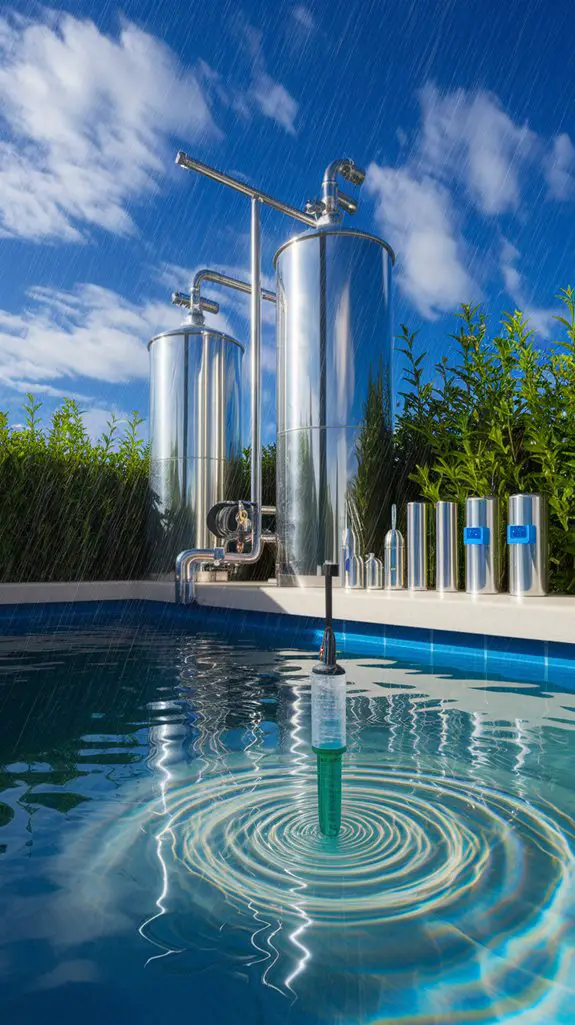
While regular cleaning addresses physical contamination, monitoring water quality represents the next line of defense for your rainwater harvesting system. Test your water quarterly using readily available test kits that measure pH, bacterial content, and dissolved solids. Maintain pH levels between 6.0-8.0 for ideal system performance.
| Parameter | Testing Frequency | Action Required |
|---|---|---|
| pH | Monthly | Adjust with lime (high) or vinegar (low) |
| Bacteria | Quarterly | UV filtration or chlorination |
| Turbidity | Monthly | Additional filtering |
| Heavy Metals | Annually | Carbon filtration |
| Nitrates | Bi-annually | Reverse osmosis if detected |
For non-potable applications, you’ll need basic filtration only. Potable uses require more rigorous treatment processes including UV sterilization, reverse osmosis, or chlorination systems—each requiring regular maintenance according to manufacturer specifications.
Seasonal System Inspection and Upgrades

As seasons change throughout the year, your rainwater harvesting system requires systematic inspection and strategic upgrades to maintain ideal performance.
Conduct pre-winter inspections to insulate exposed pipes and drain unused components to prevent freeze damage.
In spring, examine gutters for winter debris accumulation and clear first-flush diverters.
Summer maintenance should focus on mosquito prevention by checking screens and seals while monitoring evaporation rates in open storage systems.
Fall demands thorough gutter cleaning and trimming overhanging branches before leaf drop.
Consider annual upgrades to improve efficiency: install automated filtration systems, integrate smart monitoring technology, or expand storage capacity based on previous year’s data collection. Implementing rainwater collection techniques can significantly enhance your system’s functionality.
Document all inspections in a maintenance log to track system performance and identify recurring issues requiring permanent solutions.
Conclusion
You’ll extend your system’s life through these maintenance practices, while neglecting them leads to component failures. Regular cleaning prevents costly blockages, whereas quality monitoring safeguards your water supply.
Implement seasonal inspections when temperatures rise, not when problems emerge. By contrasting proactive maintenance with reactive repairs, you’ve positioned yourself for peak system performance and significant cost savings over your harvesting system’s operational lifespan.
