

Natural stone offers unparalleled durability and aesthetic appeal for your outdoor spaces. You’ll find a variety of options including granite, quartzite, and sandstone, each with specific applications from pathways to outdoor kitchens.
When selecting materials, consider both environmental impact and regional climate compatibility to guarantee longevity. Proper design, installation techniques, and ongoing maintenance determine whether your stone elements will merely function or truly transform your landscape into an enduring outdoor sanctuary.
On this page
Types of Natural Stone for Outdoor Applications
Several natural stone varieties possess properties suitable for outdoor installations.
Granite, with its crystalline structure, offers exceptional durability and resistance to freeze-thaw cycles, making it ideal for pathways and patios.
Limestone provides a softer aesthetic with moderate durability, though you’ll need to seal it regularly to prevent acid rain damage.
Sandstone’s natural slip resistance makes it appropriate for pool surroundings, while slate’s distinct layering creates textural interest for vertical applications like retaining walls.
Quartzite delivers superior hardness (7 on Mohs scale) and withstands harsh weather conditions without fading.
For water features, consider bluestone—a dense sandstone variant that doesn’t become slippery when wet.
Each stone type requires specific installation techniques and maintenance protocols to maximize longevity in external environments.
Environmental Benefits of Choosing Stone Materials
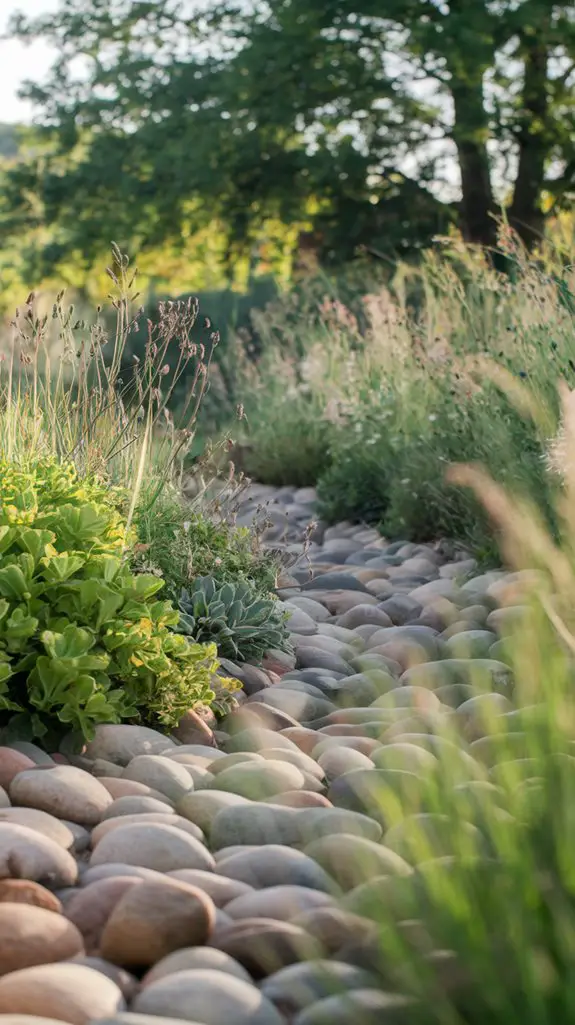
While synthetic materials dominate many landscaping projects, natural stone offers substantial environmental advantages that merit consideration.
Stone requires no manufacturing process, eliminating the carbon emissions associated with synthetic material production. Your selection of locally-sourced stone further reduces transportation-related environmental impacts.
Natural stone’s durability translates to longevity—often lasting centuries—which decreases replacement frequency and associated resource consumption.
You’ll find stone contributes to improved thermal regulation in outdoor spaces, absorbing heat during daytime hours and releasing it gradually at night, potentially reducing adjacent building cooling costs.
Additionally, stone’s permeability allows for proper water drainage, reducing runoff concerns.
When your project concludes its lifecycle, stone can be reused or crushed for fill, returning to the earth without environmental harm.
Stone Pathways and Walkway Design Ideas
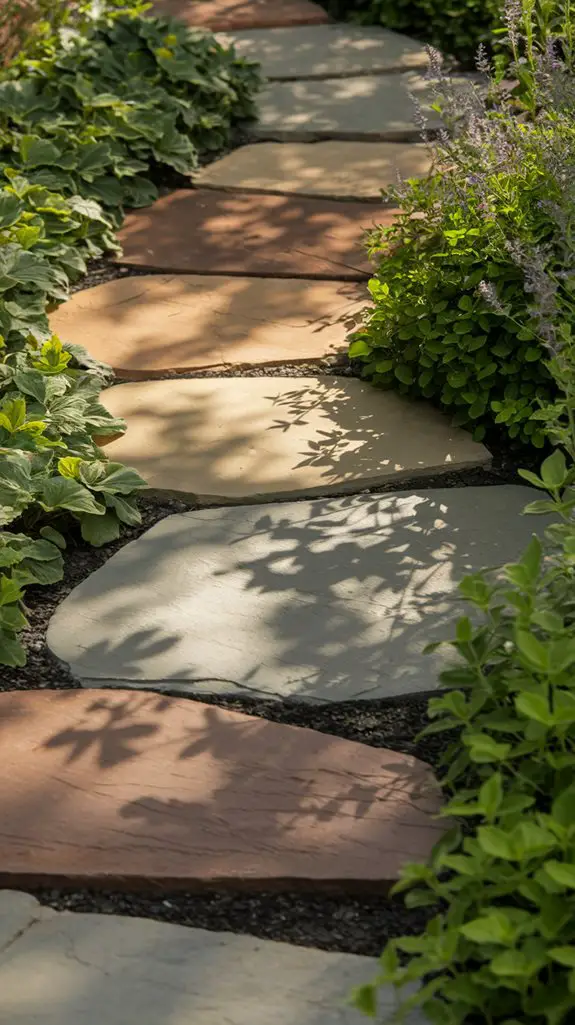
Moving from the ecological advantages of stone to its practical applications, stone pathways represent one of the most transformative hardscape elements in outdoor design.
You’ll find four primary configuration options: random flagstone, cut dimensional pavers, stepping stones, and crushed aggregate surfaces—each offering distinct aesthetic and functional properties.
For formal landscapes, consider rectilinear bluestone or granite pavers set in a running bond or herringbone pattern.
Informal settings benefit from irregular flagstone with thyme or moss planted between joints.
When designing your pathway, maintain a minimum 36-inch width for primary walkways and incorporate proper drainage with a 1-2% cross-slope.
Material thickness matters considerably: use 1.5-2 inches for pedestrian paths and 2.5-3 inches for vehicular traffic.
Select stone that complements your region’s climate and your home’s architectural vocabulary. Additionally, choosing low-maintenance materials can significantly reduce upkeep for busy homeowners.
Creating Stunning Stone Retaining Walls
Beyond their functional purpose of preventing soil erosion and managing grade changes, stone retaining walls serve as commanding architectural elements that define outdoor spaces with strength and permanence.
When designing your wall, consider structural integrity first—gravity walls under 3′ tall can be dry-stacked, while taller installations require mortar and proper drainage systems with perforated pipe.
Select stone varieties based on load requirements; granite and limestone offer superior compressive strength for significant earth retention.
Incorporate stepped designs for visual interest, integrating built-in planters at various heights.
Installation demands precision: establish a level base trench filled with 4-6″ of compacted gravel, then lay each stone with its longest face into the slope for stability.
Backfill progressively with crushed stone behind each course to guarantee proper drainage and prevent hydrostatic pressure buildup.
Natural Stone Patios: Materials and Installation
Natural stone patios represent the cornerstone of sophisticated outdoor living spaces, forming the foundation upon which your exterior environment rests. When selecting materials, consider both aesthetic integration with your landscape and technical performance factors.
| Stone Type | Characteristics | Installation Complexity |
|---|---|---|
| Bluestone | Dense, uniform texture; cool blue-gray hues | Moderate; requires precise cutting |
| Travertine | Porous with natural pitting; warm earth tones | High; needs sealing and careful subflooring |
| Granite | Exceptionally durable; varied crystalline patterns | High; heavy material requiring robust base preparation |
Installation requires meticulous base preparation—excavate to 8″ depth, install 4″ of compacted gravel, followed by 1″ of sand. Set stones in modified mortar for permanent installations or dry-lay for more permeable, flexible applications. Ascertain a 1-2% slope away from structures for proper drainage.
Water Features Enhanced With Stone Elements
While water elements create dynamic focal points in any landscape design, incorporating natural stone transforms these features into seamless extensions of the surrounding environment.
You’ll find limestone, granite, and slate particularly suitable for water features due to their durability when consistently exposed to moisture.
Consider integrating flat stacked stone for contemporary waterfall designs, or weathered boulders for naturalistic streams.
Position larger anchor stones at water entry points to minimize splash erosion while creating auditory interest. For pond perimeters, install capstones with a slight outward angle to prevent water loss during heavy rainfall.
When selecting stone for submerged applications, avoid high-calcite varieties that will deteriorate in chlorinated environments.
Instead, opt for dense quartzite or basalt, which maintain structural integrity despite constant water exposure and temperature fluctuations. Additionally, modern water features can be enhanced by incorporating varying stone textures to create visual interest and depth.
Outdoor Kitchen Countertops: Stone Selection Guide
Selecting appropriate stone for outdoor kitchen countertops requires careful consideration of several critical performance factors unique to exterior applications.
Focus on materials with low porosity, such as granite, quartzite, or soapstone, to resist moisture penetration and prevent freeze-thaw damage.
Your countertop must withstand UV exposure without fading or deteriorating. Darker stones typically absorb more heat, potentially causing thermal expansion issues. Select materials with a thermal reflectivity index appropriate for your climate zone.
Consider finish options carefully—honed or leathered surfaces provide superior slip resistance when wet compared to polished varieties.
For durability, choose stones with Mohs hardness ratings of 6-8. Additionally, assess resistance to acidic foods and cooking oils, as these substances can etch calcium-based stones like marble or limestone, compromising both aesthetics and functionality.
Maintenance Requirements for Outdoor Stone Features
Properly maintaining outdoor stone features requires implementing a thorough care regimen to address environmental stressors that accelerate deterioration.
You’ll need to perform regular cleaning with pH-neutral cleaners specifically formulated for natural stone to prevent etching and discoloration. Apply high-quality penetrating sealers every 1-3 years, depending on your stone type and exposure conditions.
Remove organic debris promptly to prevent staining and moisture retention. Address spills immediately, particularly acidic substances like wine or citrus juice that can etch calciferous stones.
Inspect for cracks or loose joints quarterly, applying appropriate caulking or mortar repairs before water infiltration causes freeze-thaw damage. In winter, avoid deicing chemicals containing sodium chloride; instead, use calcium magnesium acetate products that won’t compromise stone integrity.
Implement proper drainage solutions to prevent water pooling against stone bases.
Regional Stone Choices for Climate Compatibility
As regional climate conditions directly affect natural stone performance and longevity, choosing geologically compatible materials becomes a critical design consideration for outdoor installations.
You’ll maximize durability by selecting stone varieties aligned with your specific climate parameters.
- In freeze-thaw regions, opt for dense granite, quartzite, or bluestone with low absorption rates (<0.4%).
- Mediterranean and coastal areas benefit from limestone and travertine that withstand salt exposure without deterioration.
- Arid regions require heat-resistant stones like sandstone or slate that won’t expand excessively.
- High-precipitation environments demand non-porous materials such as granite or certain slates.
- Urban environments with pollution exposure require acid-resistant stones like granite or quartzite.
Select stones that historically perform well in your region’s climate regime rather than solely basing decisions on aesthetic preferences.
Cost Comparison of Different Stone Materials
Natural stone materials present a spectrum of cost considerations that extend beyond the initial purchase price.
Granite commands premium pricing ($15-30/sq.ft.) but offers superior durability that minimizes replacement costs. Limestone presents a mid-range option ($10-20/sq.ft.) with adequate longevity in temperate climates, while sandstone provides an economical alternative ($8-15/sq.ft.) despite requiring more frequent maintenance.
You’ll need to factor installation expenses, which vary by material density. Granite’s weight adds to labor costs compared to lighter alternatives.
Consider maintenance requirements in your total cost analysis—sandstone may demand annual sealing ($1-2/sq.ft.), while granite typically requires treatment only every 5-10 years.
Regional availability greatly impacts pricing; locally sourced materials cut transportation costs, making otherwise premium stones more accessible for your outdoor applications.
Conclusion
As you commence your journey with earth’s eternal artwork, you’ll discover natural stone transforms outdoor sanctuaries beyond mere aesthetic enhancement. When properly selected, installed, and maintained, these geological treasures will serve your landscape with unwavering loyalty for generations. The initial investment may represent significant resource allocation; however, the durability, sustainability, and timeless appeal of properly implemented stone elements ultimately yield exceptional returns in both functionality and property valuation.
