
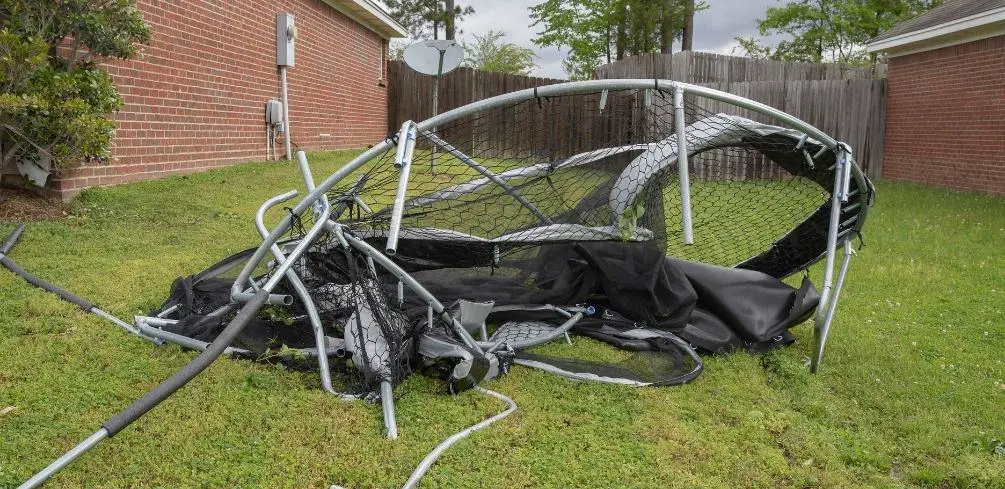
The trampoline is a great toy for kids and adults alike. Unfortunately, it often ends up blowing away when the wind picks up.
This can be frustrating, to say the least! Luckily, there are many ways that you can keep your trampoline from flying away in all but the most extreme of conditions.
This article will discuss 14 different things that you can do to keep your trampoline from blowing away in high winds or storms and look like the one above.
In a hurry?
If you don’t have much time trampoline anchors work great, here are the 3 best trampoline anchors.
On this page
How to Keep Trampoline from Blowing Away in 14 Ways
1. Tie weights to each leg of the trampoline with a string
This is one of the easiest and best ways to keep your trampoline from flying away. It can be done in a matter of minutes, and it doesn’t require much work at all!
You have to tie some weights on each leg with string or twine. This will help anchor it in place and prevent it from flying away.
Just make sure that they are strong enough to hold up against the conditions outside. It’s also a good idea to use weights that are weather-resistant.
2. Tie the trampoline down with straps
Another easy way to keep your trampoline from blowing away is to tie it down with straps. This can be done quickly and easily, and it doesn’t require any special tools or skills.
Just make sure that the straps are strong enough to hold the trampoline in place during high winds or storms. You can find straps at most hardware stores or home improvement stores.
All you have to do for this method is place some standard nylon webbing around each trampoline leg and tie it off to something sturdy. It can be a tree, post, or even an anchor point on your house!
Just make sure that the straps are strong enough for what you need them to do, and then secure them as tightly as possible. If they aren’t anchored down well enough, this could lead to some pretty severe injury in the case of a storm.
3. Pile dirt or sandbags around the trampoline
Another great way to keep your trampoline from flying away is by piling dirt or sandbags around it. Put the bags of dirt on the ground next to each leg and pile them up to touch one another.
You will need several, but this could be a very effective method for keeping your trampoline in place if high winds are a problem in your area.
Just make sure that the dirt or sandbags are strong enough to hold up against the conditions outside. It’s also a good idea to use weather-resistant materials for this method, like plastic bags filled with some heavy material.
4. Use stakes, anchors, or rope
This is another great way to keep your trampoline from flying away in high winds or storms. All you have to do for this method is place some stakes around the trampoline and tie it to something sturdy with rope.
This will help anchor it in place and prevent it from flying away. Just make sure that the stakes are strong enough to hold up against the conditions outside.
It’s also a good idea to use weather-resistant materials for this method, like galvanized steel stakes or auger anchors. We actually have the perfect ones picked out for you, check out our best trampoline anchors.
5. Build a fence around the trampoline
A fence is a great idea to keep your trampoline from flying away in high winds or storms since it acts as a windbreak. All you have to do is build a fence around the trampoline and secure it so that nothing can get in or out!
This will help protect your trampoline from the wind and ensure it stays in place during storms. Just make sure that the fence is tall enough, sturdy enough, and anchored down well enough for what you need it to do.
6. Use bungee cords
Another great way to keep your trampoline from flying away in high winds or storms is to use bungee cords. All you have to do for this method is place a few bungee cords around each trampoline leg and then secure them in place.
This will help keep it from blowing away in high winds or storms. Just make sure that the bungee cords are strong enough to hold up against the conditions outside.
7. Take tarps and loose covers off before a storm
A tarp or loose cover over the trampoline catches the wind and can help lift it, so take tarps, loose covers, ladders and toys off before high winds or storms.
Store them somewhere they won’t blow around, and put them back once the weather settles.
8. Use a tie-down kit
This is another great way to keep your trampoline from flying away in high winds or storms. All you have to do for this method is use a tie-down kit and then fasten it around each leg of the trampoline.
This will help keep it from blowing away in high winds or storms. Just make sure that the tie-down kit is strong enough to hold up against the conditions outside.
9. Bring it inside
The best way to keep your trampoline from flying away in high winds or storms is to bring it inside. All you have to do for this method is move it inside your house or garage.
This will protect it from the wind and prevent it from flying away. Just make sure you have room to store it.
10. Take the safety net down in a storm
An enclosure net catches the wind like a sail, so in high winds or storms, unhook the net or take the enclosure down if your model allows it.
Put it back up and check the poles and fasteners before anyone jumps again.
11. Install a trampoline cover
A fitted weather cover protects the mat and springs from sun and rain, but it doesn’t anchor the trampoline, so use it along with anchors.
Strap it down tight, or take it off before a storm if it isn’t secured.
12. Install guy wires
Guy wires are another way to help keep your trampoline from blowing away. To do this, install guy wires around the trampoline and then attach them securely to something solid, like a tree or pole.
This will help protect it from the wind and prevent it from flying away. Just make sure that the guy wires are strong enough to hold up against the conditions outside.
13. Trim nearby trees and shrubs to reduce wind resistance
If you have trees or shrubs around your trampoline, it is best to trim them back. This will help reduce the wind resistance and make it less likely for your trampoline to blow away in high winds or storms.
Just be careful not to trim them too much, or you may not have any trees or shrubs left!
14. Tighten loose bolts and screws
Finally, make sure to check all of the bolts and screws on your trampoline for loose ones. If you find any, then tighten them up as best as possible.
This will help keep your trampoline from blowing away in bad weather conditions.
Frequently Asked Questions About Trampoline
Can I still use my trampoline if it is not anchored?
You can still use your trampoline without anchoring, but you may find that pieces break off or fly away during bad weather conditions. This will make it more difficult to enjoy using the trampoline and could result in injury.
How do you make a trampoline less bouncy?
Most backyard trampolines have no bounce adjustment, and their springs can’t be tightened with a wrench. If the bounce feels off, check the mat and springs for wear.
Replace worn parts with the maker’s parts rather than improvising.
What are better outdoor or indoor trampolines?
Outdoor trampolines are better for sunny days, while indoor trampolines are great for rainy days. Indoor models are usually small fitness trampolines, and the AAP’s advice that children under 6 shouldn’t jump applies to them too.
Outdoor trampolines are generally more sturdy, though, so it just depends on your preference!
Where is the best place to put my trampoline?
The best place to put your trampoline is in an open area with plenty of room for you to jump. Avoid putting it near trees or other objects that could cause the trampoline to bounce off in a different direction.
Also, make sure that there is enough space on all sides so that wind can flow through freely.
What is the best trampoline for small kids?
The American Academy of Pediatrics says children under 6 shouldn’t jump on trampolines at all; for older kids, pick a round one with safety netting and an enclosure. It should also have wide legs to give it more stability and durable materials that can withstand plenty of use over time.
This will help keep your kids safer as they jump around.
What are the safety guidelines for using a trampoline?
Allow only one person on the trampoline at a time, which is what the American Academy of Pediatrics recommends. Avoid flips or other dangerous stunts, and always land on your feet.
Never use the trampoline on a hard surface, and make sure to secure the enclosure with stakes if it is not permanently attached. Make sure everyone takes their shoes off before they jump (more on wearing shoes on a trampoline).
How high should a trampoline be off the ground?
The frame height is set by the design, and lower is generally safer, which is why in-ground trampolines reduce fall height. If you are using an enclosure, it should be six feet high or taller.
This will help keep your kids safe while they jump around.
How far should the legs of a trampoline be from the frame?
The legs attach at fixed points on the frame, so follow the maker’s assembly instructions; changing that spacing weakens the frame.
Ensure that all leg tips are pointed towards the outside, so they don’t sink into the ground over time.
Conclusion
Keeping your trampoline from blowing away in bad weather is difficult, but it will be much easier if you follow these steps. As long as you check on the hardware regularly to make sure that everything is still secure, then your trampoline can last for years without any problems!
It is very important to make sure you have one of the above or even trampoline anchors to protect your backyard playground.
Please be careful and use at your own risk
None of the authors, contributors, administrators, or anyone else connected with BestPlaygroundSets, in any way whatsoever, can be responsible for your use of the information contained in or linked from these web pages.
