
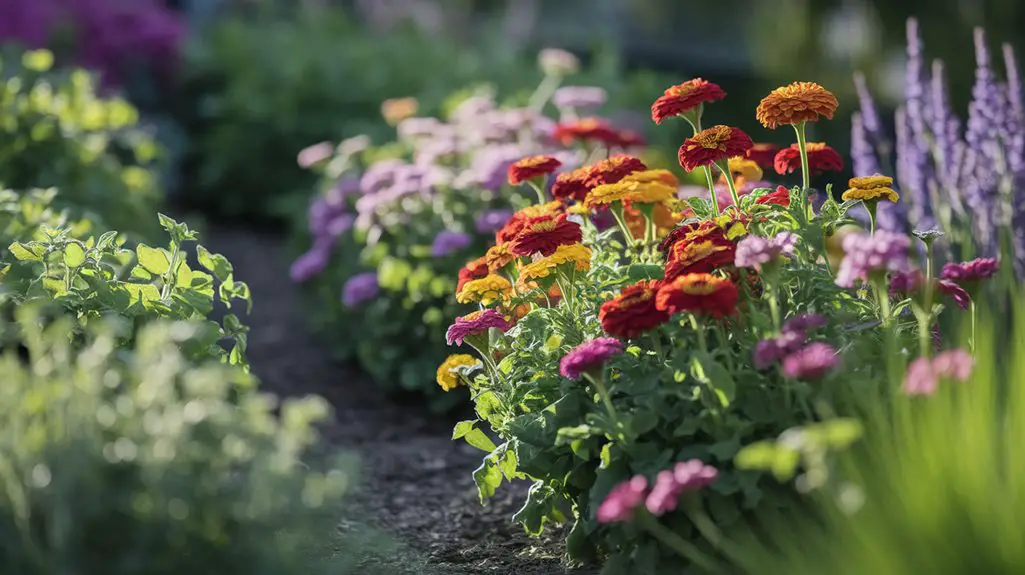
When you plan your herb garden, you're often focused on culinary or medicinal utility. Yet, incorporating colorful flowers transforms this utilitarian space into a thriving ecosystem. These strategic additions don't merely beautify—they work as functional components in your garden's biology.
Flowers attract beneficial insects that prey on herb pests, create microclimates that foster growth, and establish companion relationships that enhance flavor profiles. The science behind these plant communities reveals sophisticated interactions you'll want to understand.
On this page
Natural Pest Control Benefits of Companion Flowers
While cultivating a thriving herb garden requires attention to soil health and proper irrigation, incorporating companion flowers serves as a strategic approach to natural pest management.
These flowering plants attract beneficial predatory insects that target common herb pests.
Marigolds release thiopene, a compound that repels nematodes, while nasturtiums act as trap crops for aphids, drawing them away from your herbs.
You'll find that borage attracts pollinators while repelling tomato hornworms, and the strong scent of calendula deters asparagus beetles and tomato worms.
The bright blooms of cosmos and zinnias attract parasitic wasps, which lay eggs inside caterpillars and aphids.
Additionally, using natural weed control strategies alongside these companion flowers can further enhance the health and productivity of your herb garden.
Enhancing Pollination With Strategic Flower Placement
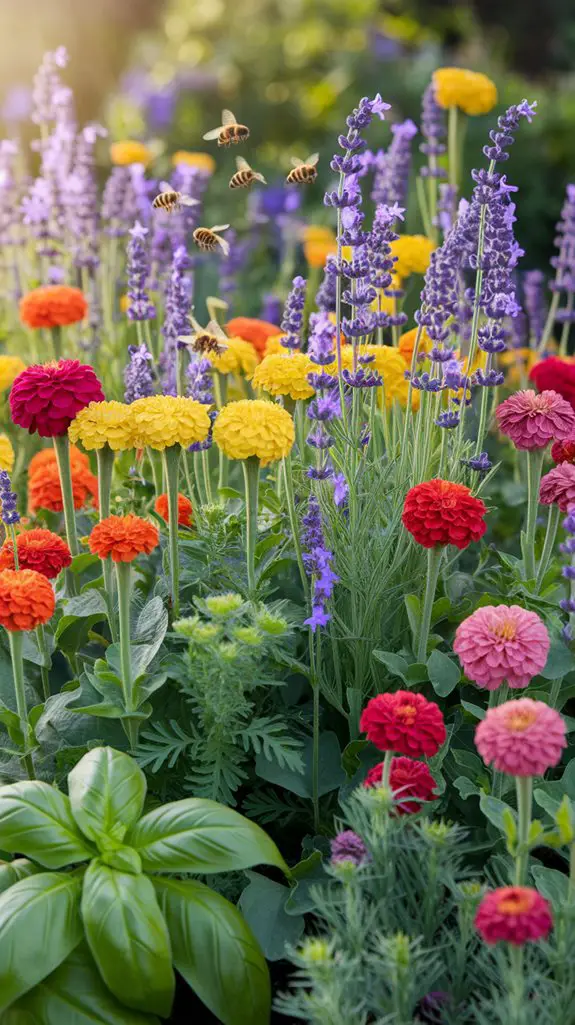
Strategic placement of flowering plants within your herb garden greatly impacts pollination rates, complementing the pest management benefits previously discussed.
Position nectar-rich blooms like lavender, borage, and echinacea in clusters rather than isolated specimens to create visible "pollination hubs" that attract diverse bee species.
Incorporate flowers with various bloom periods—early (crocus, hellebore), mid-season (coneflower, bee balm), and late (sedum, aster)—to guarantee continuous pollinator presence throughout your growing season.
Plant taller flowering species on the north side of herbs to prevent shading while still allowing insect movement patterns to intersect with essential culinary herbs.
For best results, keep a mix of flowers near herbs such as sage, thyme, and basil so visiting pollinators move between them. Additionally, planting natural flowers that repel pests can help protect your herbs from unwanted insects while promoting a healthy ecosystem.
Flowers That Improve Herb Flavor and Growth
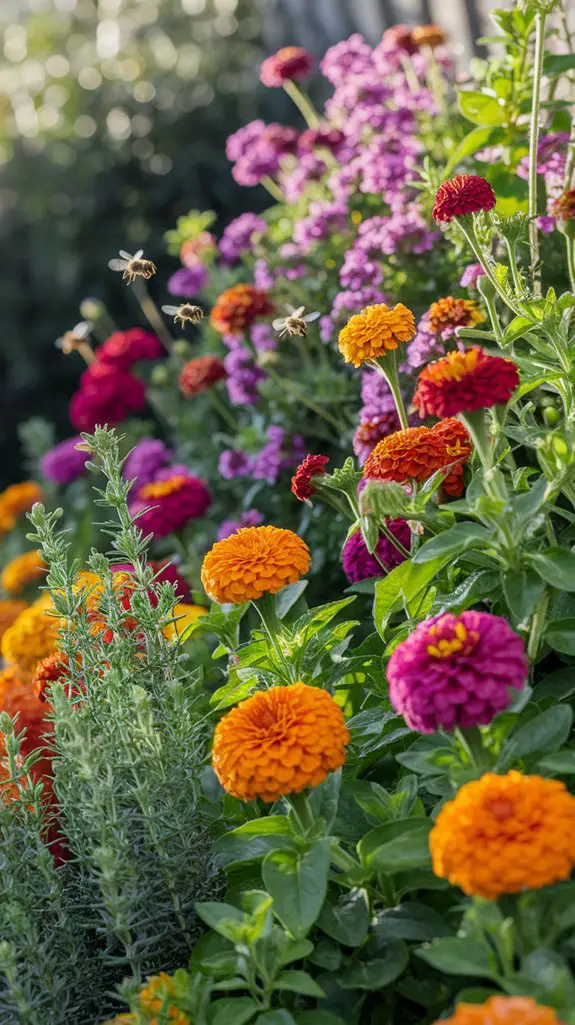
Beyond their aesthetic appeal, certain companion flowers actively influence the biochemical profiles of neighboring herbs through allelopathic interactions and volatile organic compound exchanges.
These symbiotic relationships can enhance both culinary qualities and overall vigor of your herb garden.
- Nasturtiums release airborne compounds that intensify the essential oil production in basil and oregano, resulting in more robust flavor profiles while simultaneously deterring aphids.
- Calendula exudes root exudates that stimulate mycorrhizal fungal development, enhancing nutrient uptake in neighboring thyme and sage plants.
- Borage attracts beneficial microorganisms to the rhizosphere while its high mineral content—particularly potassium—improves aromatic compound synthesis in adjacent herbs.
- Chamomile contains high levels of coumarin that, when released through root systems, increases the production of volatile oils in nearby mint and melissa.
Additionally, incorporating edible landscaping ideas can further enhance the diversity and productivity of your herb garden.
Creating Visual Appeal in Functional Herb Gardens
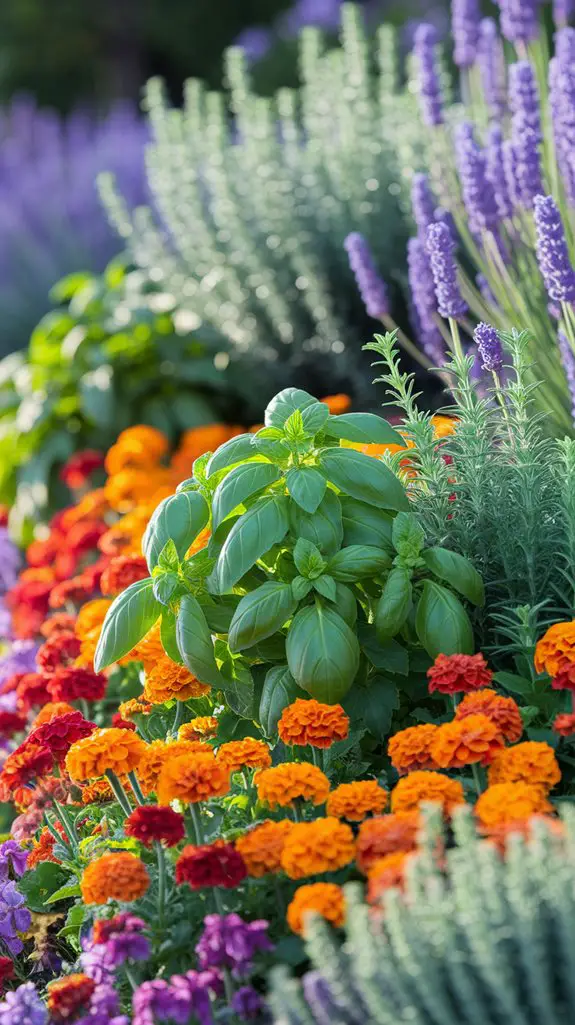
Thoughtful design transforms functional herb gardens into enchanting horticultural displays while maintaining their utilitarian purpose. You'll achieve visual harmony by incorporating strategic height gradation, texture variation, and chromatic contrast. Position taller specimens like flowering dill and fennel as backdrop elements, with compact flowering herbs in the foreground.
| Plant Category | Visual Contribution | Seasonal Interest |
|---|---|---|
| Aromatic Herbs | Textural diversity | Spring-Summer |
| Edible Flowers | Color punctuation | Summer-Fall |
| Ornamental Alliums | Vertical accent | Late Spring |
| Flowering Herbs | Pollinator attraction | Summer |
| Ground Covers | Negative space definition | Year-round |
Consider creating focal points using specimen plants with distinctive morphological characteristics—perhaps variegated sage or purple basil. Implement repetition of form and color to establish rhythm throughout the planting scheme, ensuring your herb garden remains visually compelling throughout phenological changes. Incorporating fragrant herb gardens can further enhance the sensory experience of your outdoor space.
Seasonal Planning for Continuous Color and Harvests
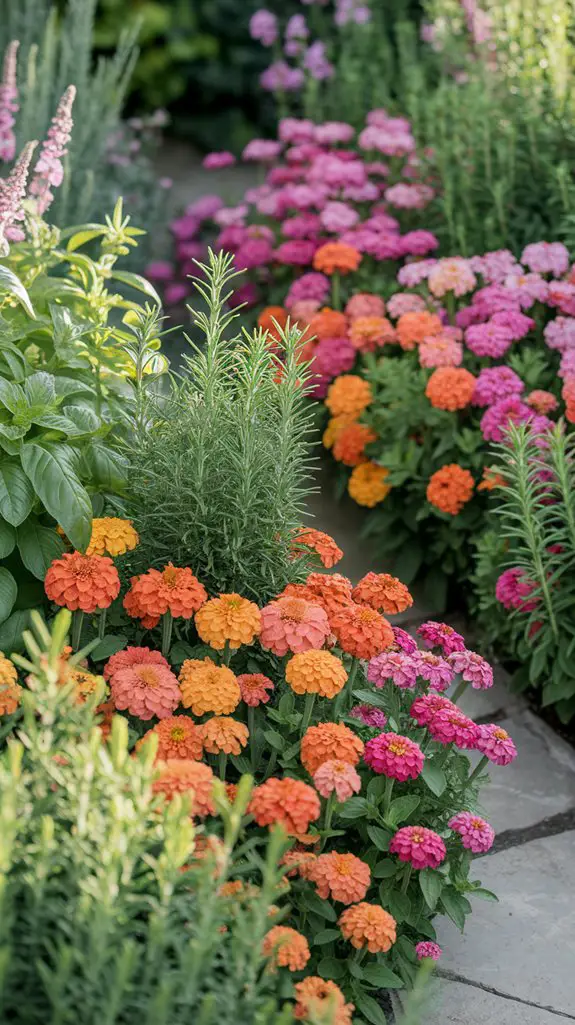
Successful herb gardens flourish year-round when you've meticulously planned for sequential bloom cycles and ideal harvest windows.
By orchestrating plantings according to phenological indicators rather than calendar dates, you'll maintain continuous visual interest while optimizing phytochemical concentrations at harvest.
- Early Spring: Incorporate ephemeral bloomers like viola tricolor alongside emerging perennial herbs—chives (Allium schoenoprasum) and sorrel (Rumex acetosa)—for immediate post-dormancy color.
- Summer Solstice Period: Layer heat-tolerant annuals—calendula and nasturtium—with flowering culinary herbs like oregano (Origanum vulgare) and thyme (Thymus vulgaris).
- Autumnal Shift: Introduce aster varieties among late-blooming herbs such as Mexican tarragon (Tagetes lucida).
- Winter Interest: Position evergreen herbs—rosemary (Rosmarinus officinalis) and winter savory (Satureja montana)—adjacent to ornamental kales. Additionally, incorporating year-round herb gardens can enhance your garden's biodiversity and aesthetic appeal.
Design Patterns for Integrating Herbs and Blooms
While traditional herbaceous borders separate ornamental from utilitarian species, sophisticated integration patterns maximize both aesthetic appeal and cultivation efficiency in contemporary herb gardens.
Consider implementing a spiral design where sun-loving flowering plants like echinacea and yarrow occupy outer rings, while shade-preferring herbs like mint inhabit inner sections. Alternatively, employ companion planting matrices—nasturtiums deter aphids from sage, while borage attracts pollinators to enhance basil's vigor. Incorporating beneficial insects into your garden can significantly improve pest control and pollination rates.
For formal aesthetics, you'll find success with geometric knot gardens where lavender, germander, and santolina create structural outlines around centrally positioned calendula or chamomile.
In cottage-style plots, stagger heights with tall flowering dill and fennel as backdrops to creeping thyme and oregano. These thoughtful arrangements guarantee synergistic relationships between flora while maintaining visual harmony throughout your garden's productive seasons.
Conclusion
You'll find your herb garden's productivity increases dramatically with integrated flowers. The allelopathic relationships between specific blooms and herbs—particularly between marigolds' thiophene compounds and basil's essential oil production—create a synergistic ecosystem that maximizes both aesthetic value and culinary output throughout your growing seasons.
