

Like invisible guardians beneath your garden beds, cover crops silently perform multiple functions while your main crops get all the glory. You've likely noticed areas where soil erodes or weeds dominate, challenges that the right cover crop can address effortlessly.
From nitrogen fixation to pest management, these workhorse plants offer benefits far beyond what their humble appearance suggests. Discover how these versatile crops can transform your garden's health while saving you time and resources.
On this page
Soil Erosion Prevention and Protection
When planted strategically between growing seasons, cover crops serve as living armor against soil erosion, one of gardening's most persistent challenges. Their dense root systems anchor topsoil in place, preventing wind and water from carrying away valuable nutrients.
Even moderate rainfall can wash away a lot of soil from bare, unprotected ground.
You'll notice the difference during heavy downpours as cover crops like winter rye or clover slow water's velocity, allowing more moisture to penetrate rather than run off.
Their canopies also soften the impact of raindrops, preventing soil compaction and particle displacement. This protection preserves your soil's structure, organic matter content, and beneficial microbial communities that you've worked hard to establish—maintaining garden productivity for future growing seasons.
Natural Weed Suppression

While battling weeds consumes significant time for most gardeners, cover crops offer a biological solution that reduces this burden substantially. Dense cover crop plantings compete with weeds for essential resources including light, water, and nutrients, effectively preventing weed establishment.
You'll find several mechanisms at work when using cover crops for weed suppression:
- Physical barriers – Thick foliage blocks sunlight from reaching weed seeds.
- Allelopathy – Chemicals released by rye, buckwheat, and sorghum inhibit weed germination.
- Resource competition – Fast-growing crops like oats outcompete weeds for nutrients.
- Seed bank reduction – Continuous cover prevents new weed seeds from entering soil.
Properly managed cover crops can greatly reduce weed pressure in later plantings, decreasing your reliance on manual weeding and herbicides.
Improved Soil Structure and Fertility
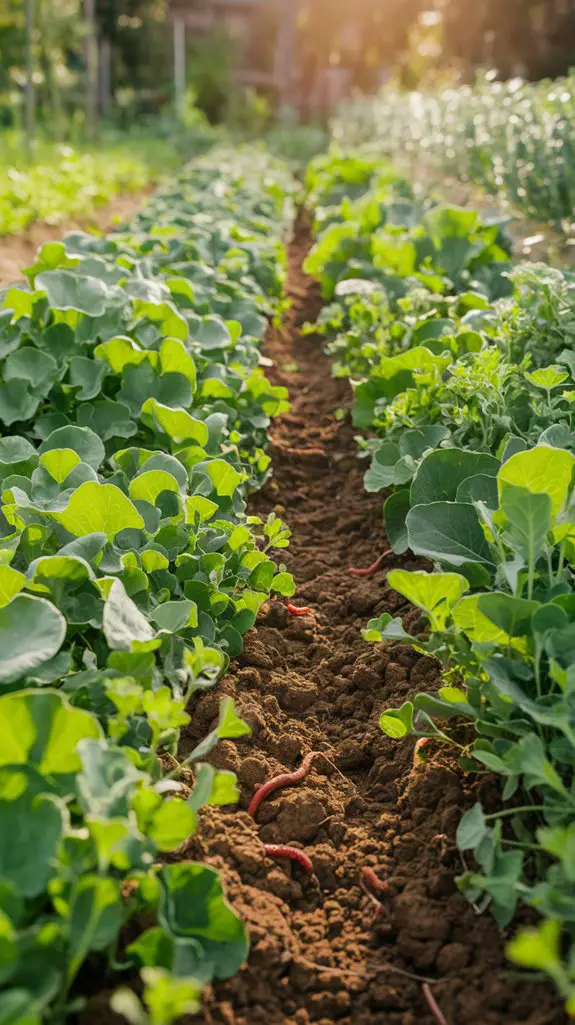
Cover crops contribute to soil health far beyond their weed-fighting capabilities. When incorporated as green manure, leguminous varieties like clover and vetch fix atmospheric nitrogen through symbiotic relationships with rhizobia bacteria, providing 50-150 lbs of nitrogen per acre for subsequent crops.
The extensive root systems of cover crops like daikon radish and cereal rye penetrate compacted soil layers, creating channels for water infiltration and aeration. This biological tillage reduces the need for mechanical intervention while increasing soil porosity.
Additionally, the decomposition of cover crop biomass introduces valuable organic matter, enhancing cation exchange capacity and microbial activity.
You'll notice improved soil aggregation as glomalin, a glycoprotein produced by mycorrhizal fungi associated with cover crop roots, binds soil particles into stable structures that resist erosion and support ideal plant growth.
Increased Organic Matter and Humus
The decomposition of cover crops transforms your garden soil into a veritable organic matter factory. When you incorporate these plants as green manure, you're adding carbon-rich biomass that decomposes into stable humus—the cornerstone of healthy soil ecosystems.
Cover crops boost organic matter through:
- Root exudates that feed beneficial soil microorganisms
- Above-ground biomass providing 2-5 tons of organic material per acre
- More carbon stored in the soil than bare ground holds
- Formation of humic substances that improve cation exchange capacity
This organic matter enhancement creates self-sustaining fertility cycles in your garden.
You'll need less fertilizer as the humus complex holds nutrients, preventing leaching while improving moisture retention. The result is resilient soil with enhanced structure that supports robust plant growth.
Natural Pest Management
Implementing cover crops in your garden cleverly disrupts pest life cycles and creates habitat for beneficial insects. Buckwheat attracts predatory wasps that target aphids and caterpillars, while flowering cover crops provide nectar for hoverflies and ladybugs that consume harmful pests.
Brassica cover crops (mustard, radish) release compounds that can suppress soil-borne pathogens and nematodes, a process called biofumigation. You'll also find that tall cover crops like sorghum-sudangrass create physical barriers against airborne pests and disease transmission.
Strategic timing matters—plant winter rye after harvest to prevent overwintering sites for insects. Dense plantings of clover suffocate weed growth, indirectly reducing pest habitat.
This integrated pest management approach can cut down how much pesticide you need. Additionally, incorporating companion planting techniques can further enhance pest control by promoting plant diversity.
Enhanced Nitrogen Fixation
Leguminous cover crops such as clover, vetch, and peas form symbiotic relationships with rhizobia bacteria, enabling them to convert atmospheric nitrogen into plant-available forms through biological nitrogen fixation.
When you grow these nitrogen-fixing plants, you're fundamentally creating your own natural fertilizer factory. According to SARE's Managing Cover Crops Profitably, a legume cover crop can supply roughly 50 to 150 pounds of nitrogen per acre, reducing your need for synthetic fertilizers.
- Root nodules house the nitrogen-fixing bacteria, visible as small pink or reddish bumps when you examine the roots.
- Fixed nitrogen becomes available when plant residues decompose after termination.
- Crops planted after legumes can use part of that nitrogen as the residues break down.
- Inoculating seeds with the right rhizobia strain helps make sure fixation happens.
Drought Resistance and Water Conservation
While nitrogen fixation improves soil fertility, cover crops also serve as powerful allies against water scarcity in your garden. When you establish these plants, they create a protective canopy that reduces evaporation from soil surfaces.
Their extensive root systems enhance soil structure, allowing water to penetrate deeper rather than running off. Additionally, effective rainwater management strategies can further optimize water usage in your garden.
| Cover Crop Type | Water Retention | Drought Benefit |
|---|---|---|
| Deep-rooted | High | Creates channels for water infiltration |
| Dense foliage | Medium-High | Reduces surface evaporation |
| Winter hardy | Medium | Protects soil moisture during dormant season |
Gardens with cover crops often need less irrigation during the growing season. You'll notice improved drought resilience as organic matter increases; the USDA Natural Resources Conservation Service estimates that each 1% increase in soil organic matter helps soil hold up to 20,000 gallons more water per acre.
Biodiversity Support for Pollinators and Beneficial Insects
Beyond their soil and water benefits, cover crops serve as essential habitat for a diverse array of beneficial organisms in your garden ecosystem.
Flowering cover crops like buckwheat, clover, and phacelia attract pollinators and support predatory insects that control pest populations.
When you incorporate pollinator-friendly cover crops, you'll create:
- Pollen and nectar sources during seasonal gaps in flowering plants
- Overwintering habitat for beneficial insects like ground beetles and ladybugs
- Refuge areas that increase predator-to-prey ratios, reducing pest pressure naturally
- Corridors for beneficial insect movement throughout your garden ecosystem
Additionally, these cover crops can enhance pollinator diversity, leading to a more robust garden ecosystem.
You'll notice increased pollination efficiency in nearby crops and natural biocontrol of common garden pests.
Breaking Up Compacted Soil Layers
Dense, compacted soil presents a significant barrier to garden productivity, but strategic cover crop selection offers a powerful solution for breaking up these hardened layers.
Cover crops with robust taproots, such as daikon radish and alfalfa, can penetrate 12-24 inches deep, creating natural channels for air, water, and beneficial microorganisms.
These "living tillers" work more effectively than mechanical cultivation, which often creates a hardpan layer beneath the tilled zone.
You'll notice improved drainage and reduced surface runoff after just one season of growth. Additionally, when these deep-rooted plants decompose, they leave behind organic matter precisely where it's needed most—within the previously compacted zones—enhancing long-term soil structure without disrupting the soil's beneficial fungal networks.
Extended Growing Season and Harvest Potential
Contrary to conventional thinking, cover crops can greatly extend your growing season rather than merely occupying space between primary plantings.
Choosing the right cover crops can create extra harvest windows while keeping your soil productive.
Consider these season-extension strategies:
- Plant cold-hardy cover crops like winter rye or hairy vetch that continue growing during cooler months, providing harvestable material when other crops have ceased.
- Implement relay planting where fast-maturing cover crops grow alongside slower-developing vegetables, creating staggered harvest periods.
- Utilize cover crops with edible components (buckwheat florets, pea shoots) for continuous harvesting while still building soil health.
- Incorporate frost-protection benefits from taller cover crops that modify microclimate conditions, which can help shelter tender crops from early frost.
You'll maximize yield potential while simultaneously improving soil structure and nutrient cycling through continuous living root presence.
Conclusion
As you've seen, cover crops aren't just supplementary plants—they're garden superheroes capable of transforming your soil into the most fertile medium on earth. They'll protect, nourish, and revitalize your growing space while supporting essential ecosystem services.
Cover crops can make a garden more sustainable and productive, with lower input costs and less environmental impact. Your future harvests will thank you.
